What is regrouping in math addition? If you’ve ever helped a child solve a tricky multi-digit addition problem, you’ve probably encountered this concept. Regrouping, also known as carrying, is a fundamental math skill that helps students understand place value and perform accurate calculations.
In this blog, we’ll clearly explain what regrouping is, why it’s important, and provide helpful addition with regrouping examples to guide both teachers and learners.
What Is Regrouping in Math Addition?
Regrouping in math addition—also known as carrying—is a process used when the sum of digits in a place value column is 10 or more.
Instead of writing a two-digit number in a single column, we “regroup” by placing the ones digit in the current column and carrying the tens digit to the next column on the left.

This technique helps keep numbers aligned correctly by carrying over extra values to the next column on the left. It’s used for all kinds of multi-digit addition, whether you’re adding 2-digit numbers, 3-digit numbers, or even larger numbers.
The key to mastering addition with regrouping is understanding place value—ones, tens, hundreds, and beyond—and performing the steps in the correct order.
Understanding How Regrouping Works: 4 Easy Steps
If you already know what regrouping in math addition is, then grasping how it works is super important for mastering the concept. Here’s a step-by-step breakdown of how to perform addition with regrouping:
- Step 1: Line up the numbers in columns based on their place values.
- Step 2: Begin adding from the rightmost column (ones), then move left to the tens, hundreds, and so on.
- Step 3: If the total in any column is 10 or more, break that number into tens and ones. Place the ones digit in the current column and carry the tens digit over to the next column on the left. Be sure to include the carried-over digit in the next addition.
- Step 4: After adding all columns, you’ll arrive at the final sum.

Addition with Regrouping Examples
Let’s walk through some simple examples involving addition:
1-Digit Addition With Regrouping
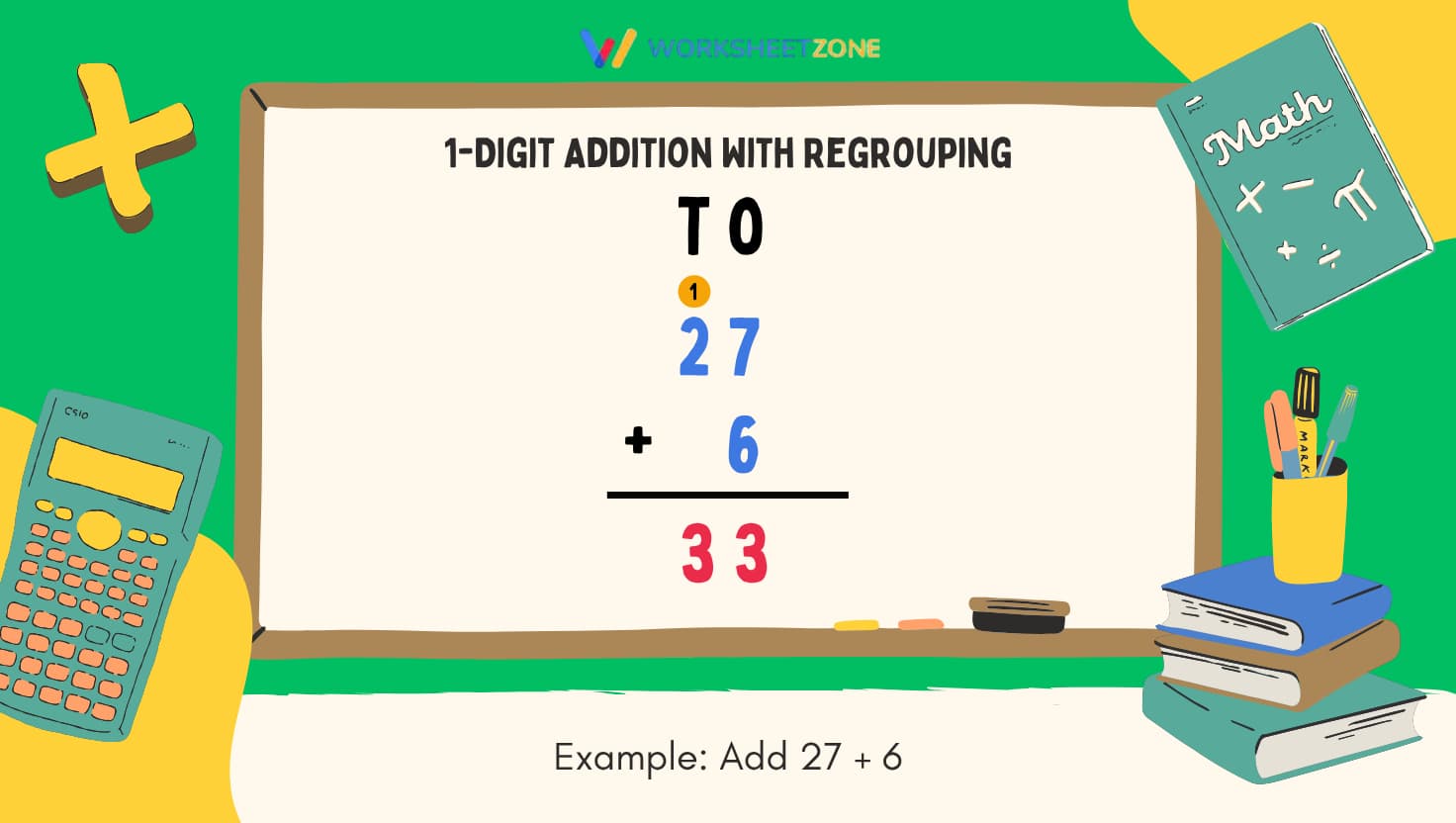
Example: Add 27 + 6
Solution: Let’s add these numbers using regrouping.
- Step 1: Write 27 and 6 in their proper place value columns, lining them up vertically.
- Step 2: Add the digits in the ones place: 7 + 6 = 13. Since 13 is greater than 9, regrouping is necessary. This means breaking the number 13 into tens and ones. Write down 3 in the ones column and carry over 1 to the tens column.
- Step 3: Now, add the carryover 1 to the digit already in the tens place, which is 2. The sum of this column is 3. Therefore, 27 + 6 equals 33
2-Digit Addition With Regrouping
In 2-digit addition with regrouping, we follow the same basic steps mentioned earlier. Let’s break it down using a new example.
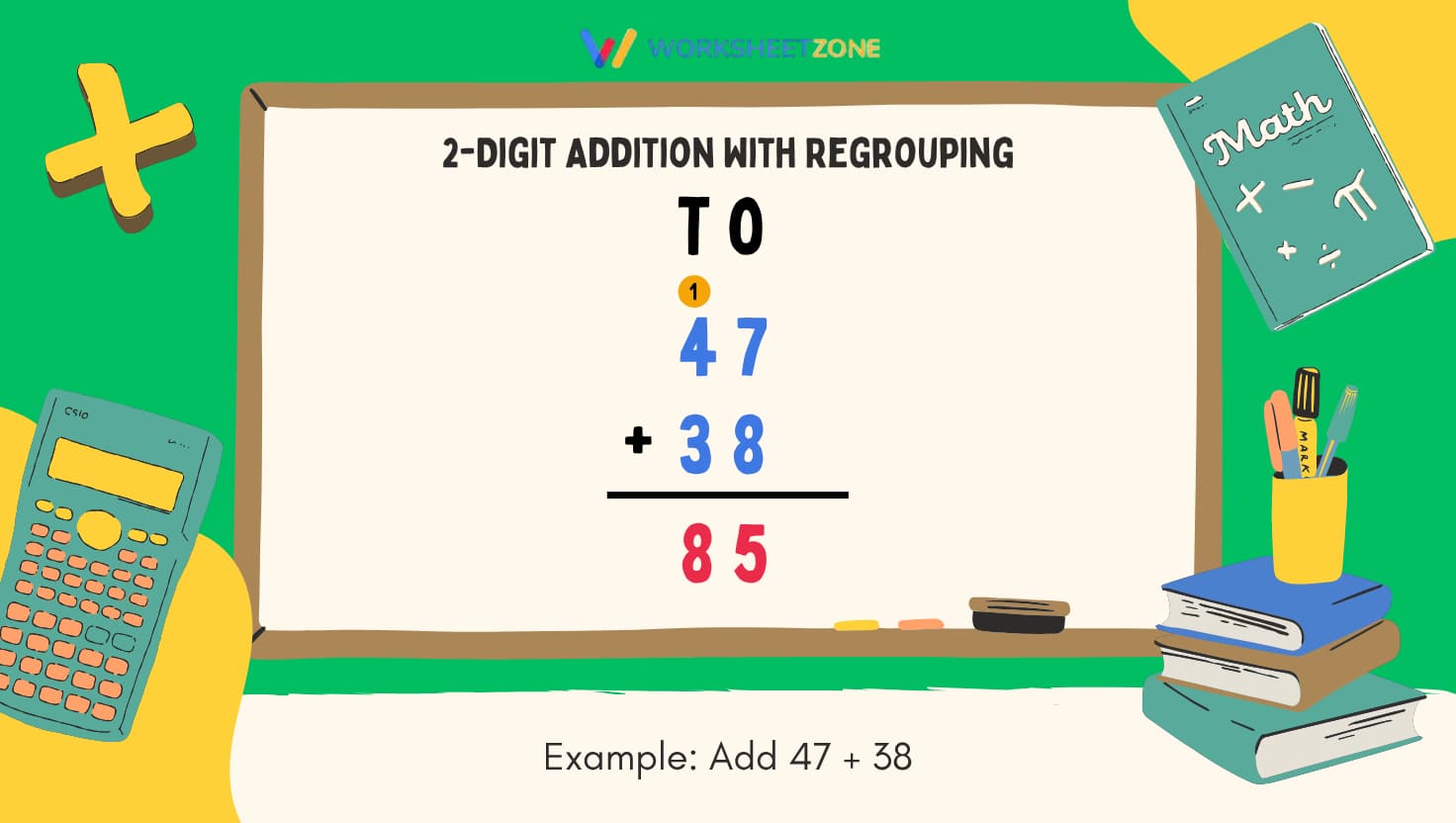
Example: Add 47 + 38
Solution: We’ll use step-by-step regrouping to solve this.
- Step 1: Write 47 and 38 in columns based on place value. That means 7 and 8 go in the ones column, while 4 and 3 go in the tens column.
- Step 2: Begin by adding the digits in the ones column: 7 + 8 = 15. Since 15 is greater than 9, we need to regroup. We put down the 5 in the ones column and carry over the 1 to the tens column.
- Step 3: Now add the tens column: 4 + 3 + 1 (the carried-over digit) = 8. So we place 8 in the tens column.
Final Answer: 47 + 38 = 85.
Now that you understand how regrouping works with two-digit numbers, you’re ready to explore it with three-digit numbers!
3-Digit Addition with Regrouping
The regrouping process in 3-digit addition is the same as what you do in 2-digit math addition. Let’s walk through an example to see how it works:
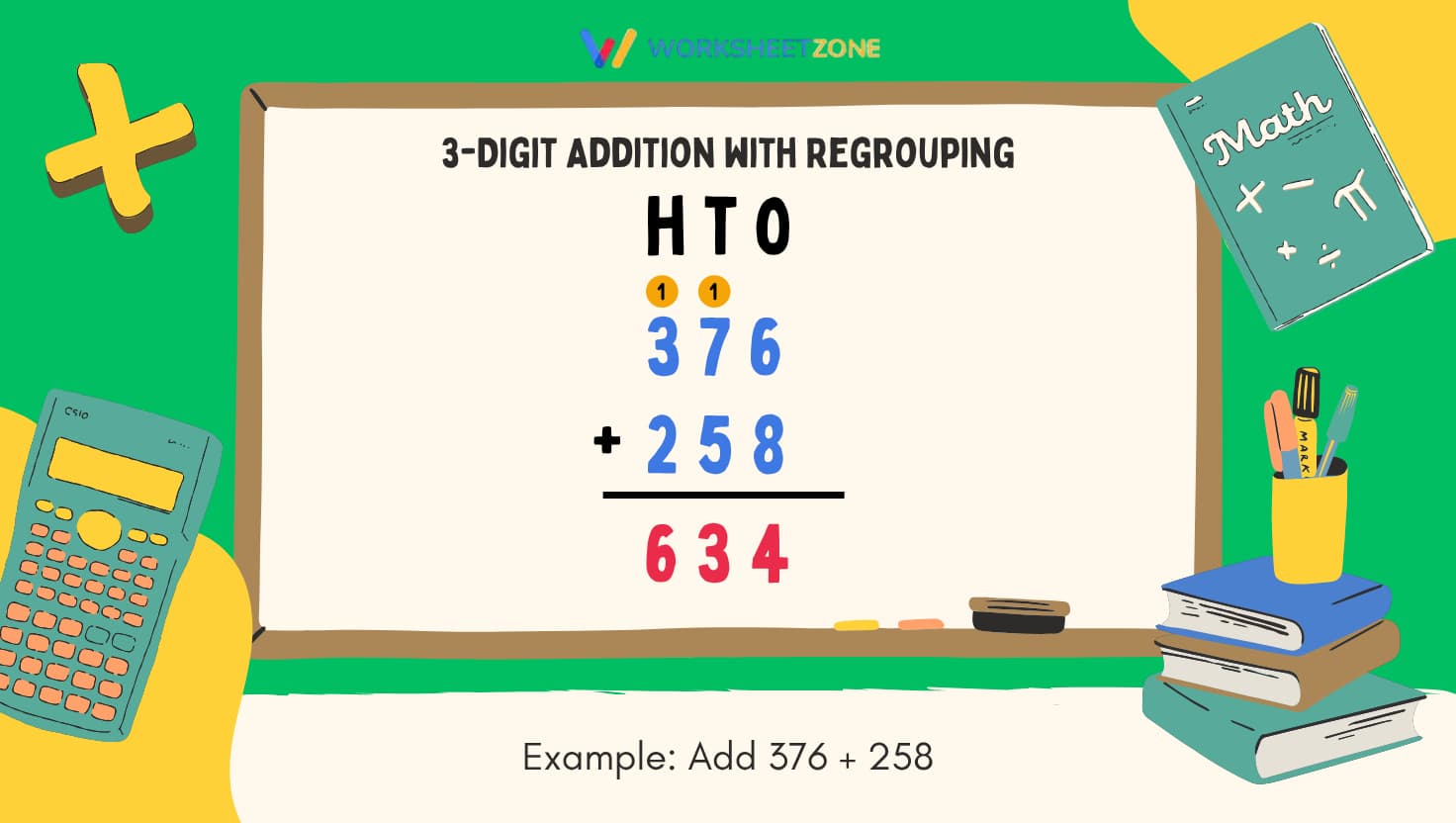
Example: Add 376 + 258
Solution: We’ll use the standard regrouping steps to solve this.
- Step 1: Write the numbers 376 and 258 in columns based on place value:
- 6 and 8 in the ones column
- 7 and 5 in the tens column
- 3 and 2 in the hundreds column
- Step 2: Begin with the ones place: 6 + 8 = 14. Since 14 is a two-digit number, we write 4 in the ones column and carry 1 over to the tens column.
- Step 3: Add the tens place digits plus the carry-over: 7 + 5 + 1 = 13. Write 3 in the tens column and carry 1 to the hundreds column.
- Step 4: Now add the hundreds place digits along with the carry-over: 3 + 2 + 1 = 6. Write 6 in the hundreds place. So, 376 + 258 = 634.
Adding Decimals with Regrouping
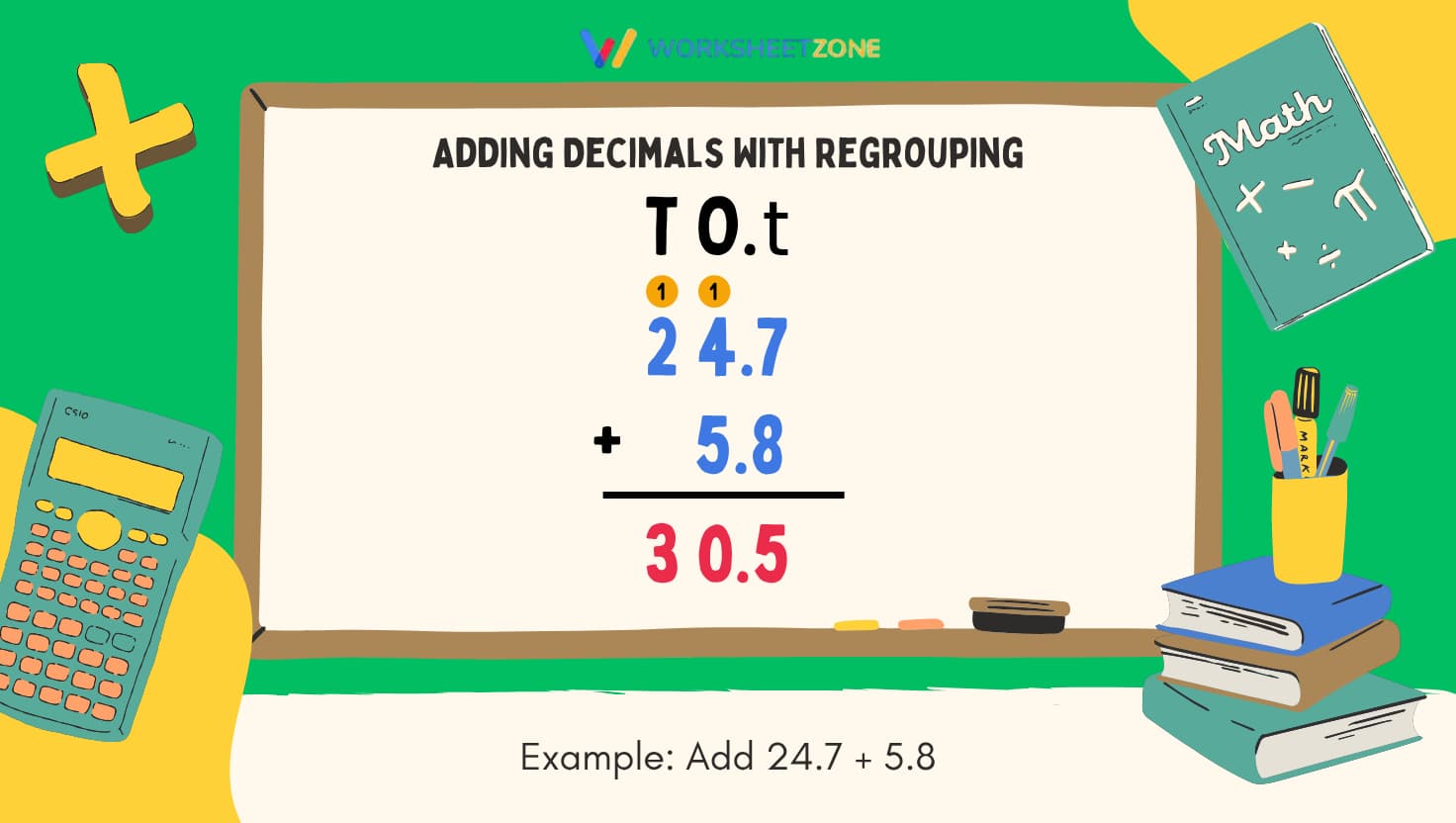
When adding decimals with regrouping, the process is similar to adding whole numbers with regrouping, but it’s important to align the decimal points vertically.
Additionally, you need to pay attention to the place values of the decimal digits such as tenths, hundredths, etc. Let’s see how this works with an example.
Example: Add 24.7 + 5.8
Solution: Follow these steps to add the decimals with regrouping:
- Arrange the numbers so that the decimal points are lined up vertically.
- If the numbers have a different number of decimal places, add zeros to equalize their length.
- Start by adding the digits in the tenths place: 7 + 8 = 15. Since 15 is greater than 9, write 5 in the tenths column and carry over 1 to the ones column.
- Next, add the ones place digits along with the carryover: 4 + 5 + 1 = 10. Write 0 in the ones column and carry 1 to the tens column.
- Finally, add the tens place digits and the carryover: 2 + 0 + 1 = 3.
Putting it all together, 24.7 + 5.8 equals 30.5.
Frequently Asked Questions
1. Are there other ways to teach regrouping besides the traditional method?
Yes, besides the standard written method, regrouping can be taught using hands-on tools like base-ten blocks or through mental math techniques. These alternative strategies help students grasp the concept more concretely before using standard algorithms.
2. Is regrouping only used in addition?
Regrouping is not only used in addition, it is also essential in subtraction. In subtraction, regrouping (often called borrowing) helps when the digit in the minuend is smaller than the digit in the subtrahend, allowing you to borrow from the next higher place value to complete the subtraction accurately.
Sum up
So, do your students truly understand what is regrouping in math addition? If not, this is your chance to make it click! Use clear, simple addition with regrouping examples in class to help them build confidence and accuracy. With the right guidance and practice, even tricky multi-digit problems become manageable.
Ready to transform your math lessons? Start today by downloading multi-digit addition worksheets and help your students master regrouping with confidence!