




















The addition of two digits is a core math skill that lays the groundwork for all future operations. It teaches young learners how to combine numbers, understand place value, and develop fluency in math facts.
By using engaging methods and examples, you’ll make adding two digits not only easy to understand but also fun to practice. Read on to explore helpful strategies, visual examples, and teaching tools that simplify math addition for young learners!
What is the addition of two digits?

Adding two-digit numbers means combining numbers between 10 and 99. These numbers have two place values: tens and ones. When the sum in a column exceeds 9, we use regrouping in addition (or carrying over) to move extra value to the next place. This ensures each digit stays in the correct column.
For example, in the equation 48 + 35, the ones column gives a sum of 13. Since 13 is greater than 9, we write down 3 in the ones place and carry over 1 to the tens place.
Now that you know the importance of regrouping in double digit adding, let’s break it down into a simple teaching routine for classroom success.
Addition of two digits guide
Understanding the addition of two digits becomes easier when broken down into clear and logical steps. Below is a step-by-step breakdown of how to correctly use double digit regrouping addition:
Step 1: Align the Numbers Vertically
The first and most important thing you need to do is set up the numbers correctly. Always write the two numbers vertically, one directly above the other.
- Make sure the ones digits are lined up in the rightmost column, and the tens digits are aligned in the column to the left.
- Use lined paper or graph paper if necessary to help students keep the columns neat and tidy.
For example, if you’re adding 48 + 35, it should look like this:
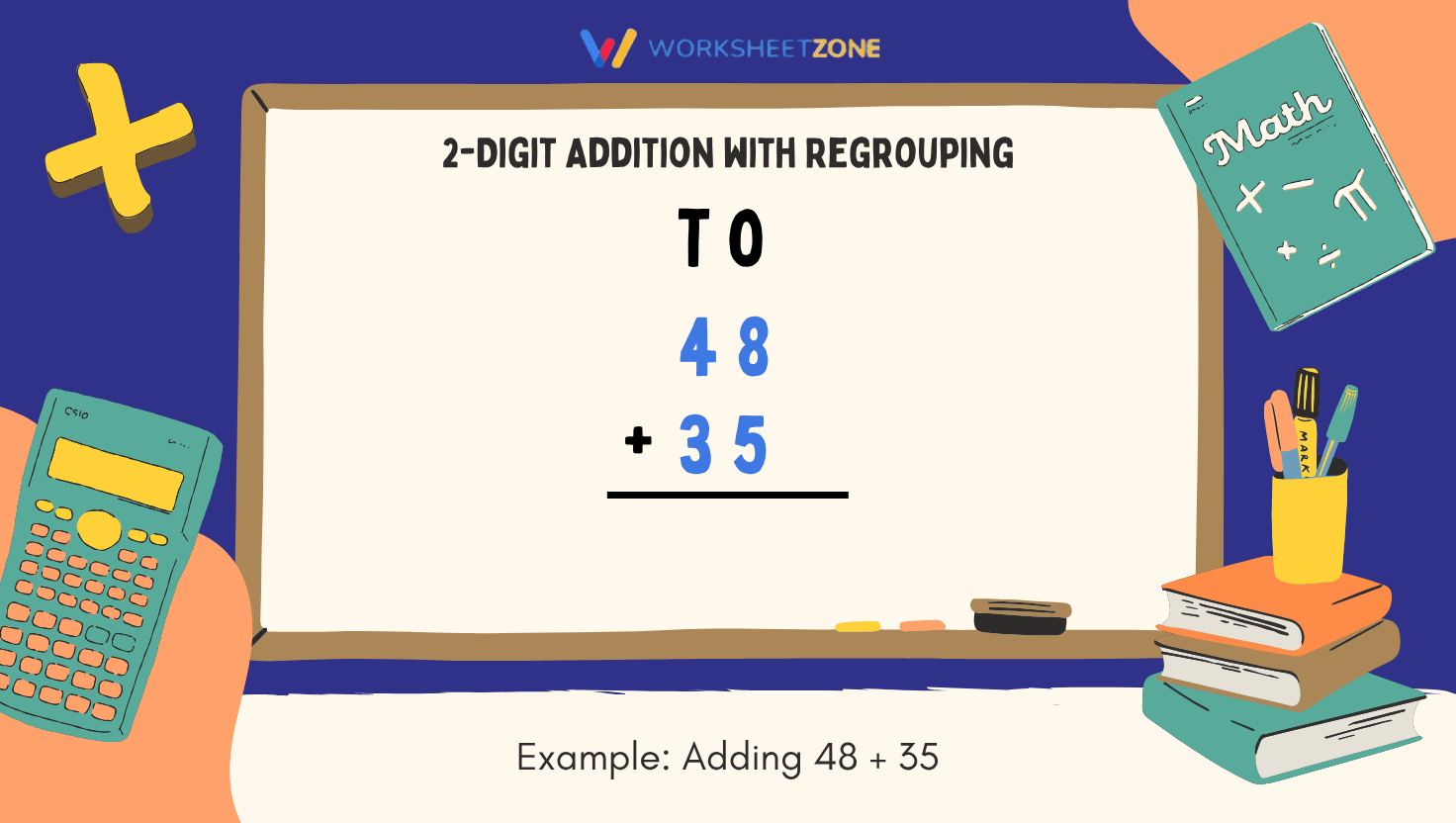
This vertical alignment ensures that you’re adding the correct digits together — tens with tens and ones with ones.
Tip for Teachers: Emphasize the place value of each digit (ones, tens) as you write them out.
Step 2: Start with the Ones Place
Once the numbers are aligned, always start by adding the digits in the ones column, which is the rightmost digit in each number.
If the result is 9 or less, it’s a single-digit sum, and you can write it directly in the answer row under the ones column.
If the result is 10 or greater, you have to regroup:
- Write the ones digit of the sum in the answer row under the ones column.
- Then, carry the tens digit over to the tens column. This is sometimes shown above the tens digits with a small “1”.

Name-image-3: step-2-start-with-the-ones-place
For example, in 48 + 35, you start with 8 + 5 = 13.
- Write down the 3
- Carry over the 1 (which represents 10) to the top of the tens column
Teaching Tip: You can represent the carry-over with a small number above the next column to remind students to include it in the next step.
Step 3: Add the Tens Place
Next, move to the tens column, which contains the digits in the tens place.
- If the sum in this step is less than 10, just write the number in the tens place of the answer.
- If it’s 10 or more, write down the ones digit and carry over again — this time to the hundreds column.

For instance, in 48 + 35:
- The digits in the tens column are 4 and 3, Add 4 + 3 = 7
- If you carried over 1 from the previous step, now compute 4 + 3 + 1 = 8
- Write 8 in the tens place of your final answer.
Step 4: Write the Final Answer
Now it’s time to put the pieces together. Write the full number clearly below your addition line.
- You’ve already written the correct digits in the ones and tens places based on your calculations.
- Simply combine those digits to form your final answer.
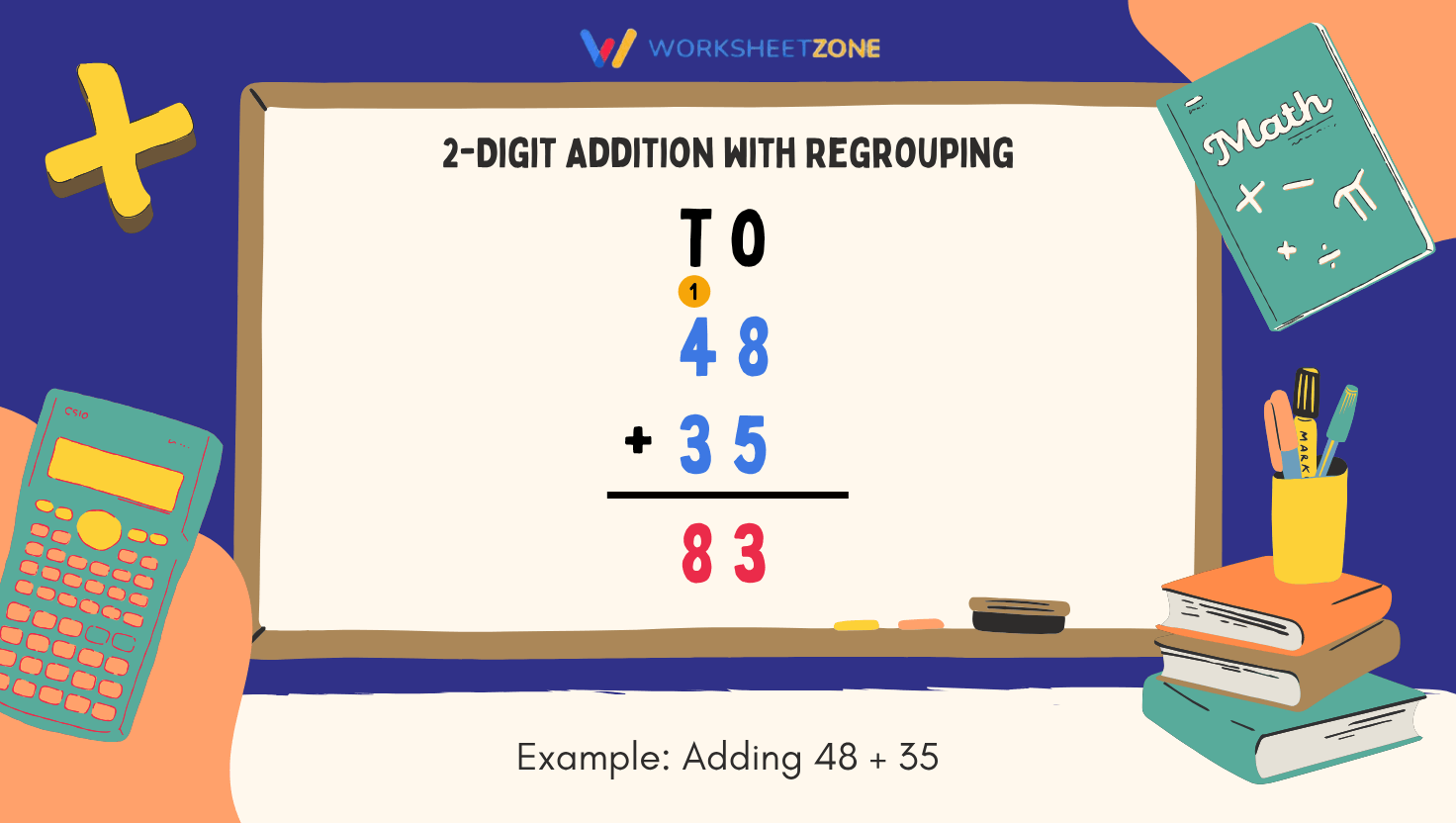
For example, with 48 + 35:
- Ones place: 3
- Tens place: 8
Final answer: 83
Examples of adding two digits
Here are five clear and detailed examples of adding two digits to master regrouping in addition, explained step by step to help students understand the process easily:
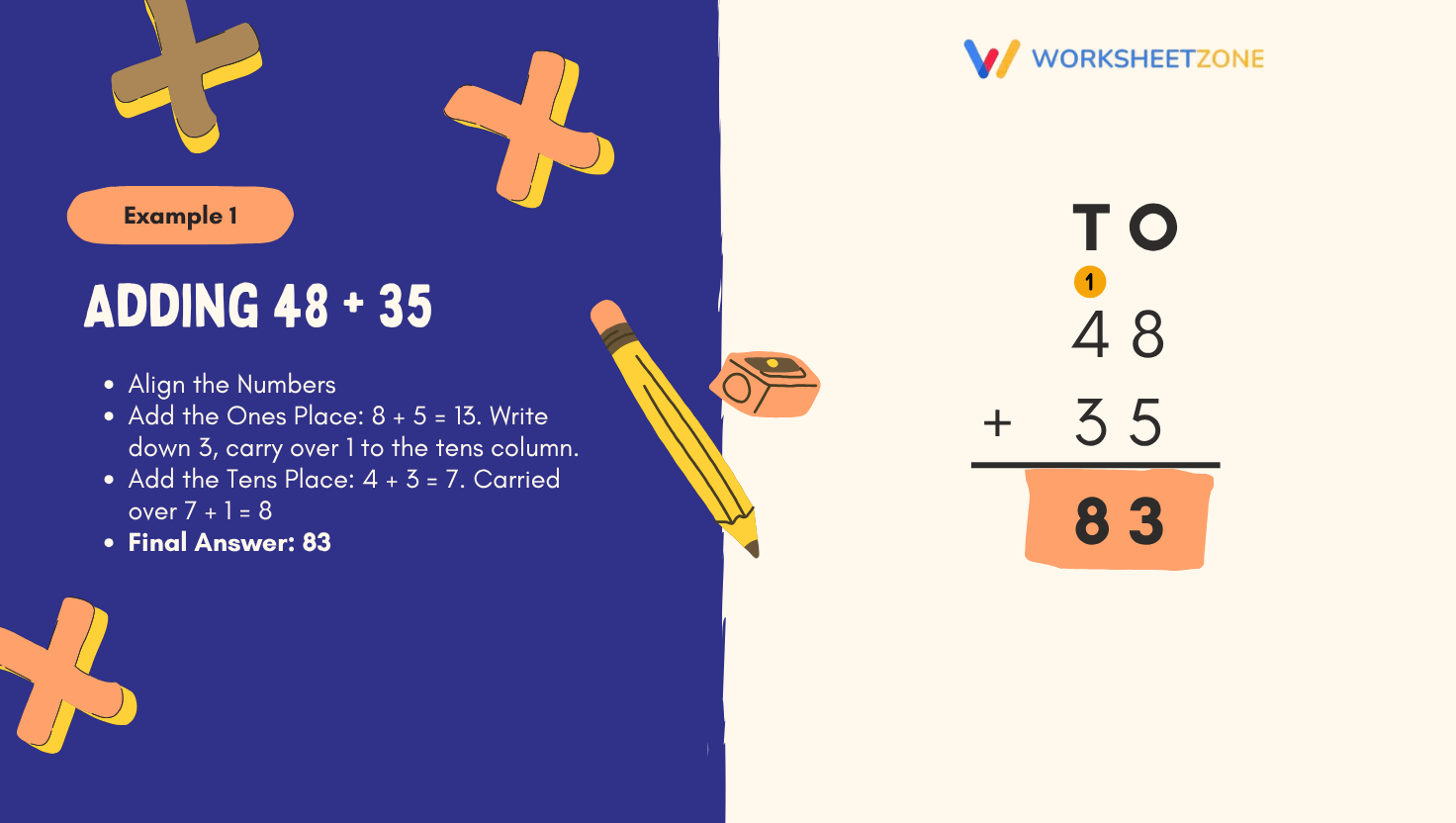
Example 1: Adding 48 + 35
Step 1: Start with the Ones Place
- We begin by adding the digits in the ones column: 8 + 5.
- 8 plus 5 equals 13, which is a two-digit number. This means we can’t write 13 directly into the answer.
- Instead, we write the 3 (ones digit) in the ones place of our final answer and carry the 1 (tens digit) over to the next column — the tens place.
Step 2: Move to the Tens Place
- Now we add the digits in the tens place: 4 + 3.
- 4 plus 3 equals 7, and don’t forget to add the 1 we carried over, so 7 + 1 = 8.
- We write 8 in the tens place.
Step 3: Combine the Results
We now have 8 in the tens place and 3 in the ones place. The full answer is 83.
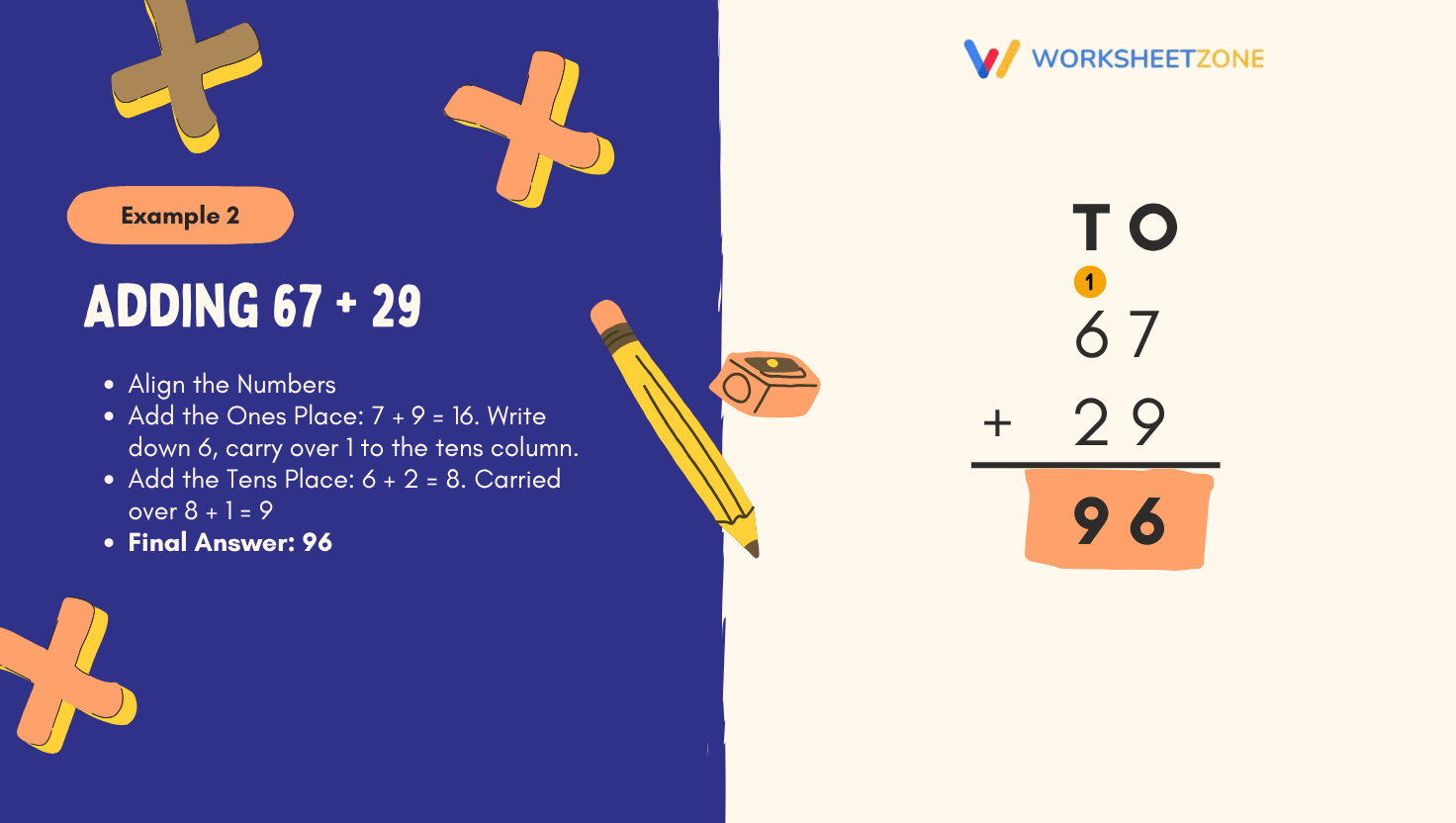
Example 2: Adding 67 + 29
Step 1: Add the Ones Place
- Let’s begin with the ones digits: 7 + 9. That gives us 16, which is more than 9, so again we can’t just write the whole thing.
- Write down 6 in the ones place and carry the 1 over to the tens column.
Step 2: Add the Tens Place
- Now, add the tens digits: 6 + 2 = 8.
- But remember, we carried a 1 from the previous step. So 8 + 1 = 9.
- Write down 9 in the tens place.
Step 3: Complete the Addition
Put together the digits: 9 in the tens place and 6 in the ones place.The final answer is 96
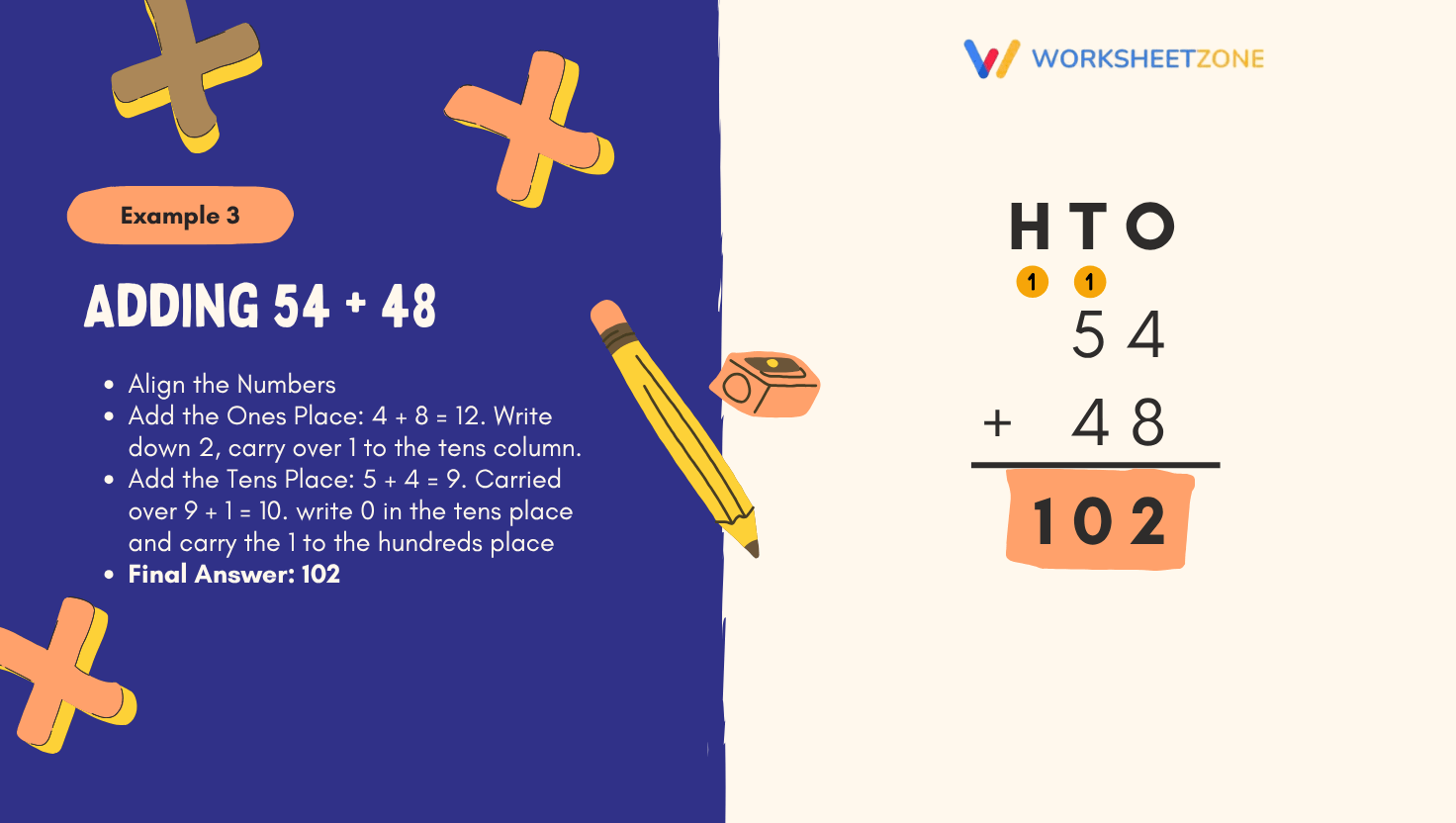
Example 3: Adding 54 + 48
Step 1: Add the Ones Digits
- Look at the ones column first: 4 + 8.
- This equals 12.
- We can’t write 12 as a single digit, so we take the 2 (ones digit) and write it in the ones place of our answer, then carry the 1 to the tens place.
Step 2: Add the Tens Digits
- Now, add the digits in the tens column: 5 + 4 = 9.
- Add the 1 carried over, which gives us 9 + 1 = 10.
- Again, 10 is a two-digit number, so we write 0 in the tens place and carry over the 1 to the hundreds column.
Step 3: Finish the Addition
- We now place the 1 in the hundreds place (this sometimes happens even in two-digit addition when regrouping twice!).
- Our digits are: 1 (hundreds), 0 (tens), and 2 (ones).
So the final answer is: 102
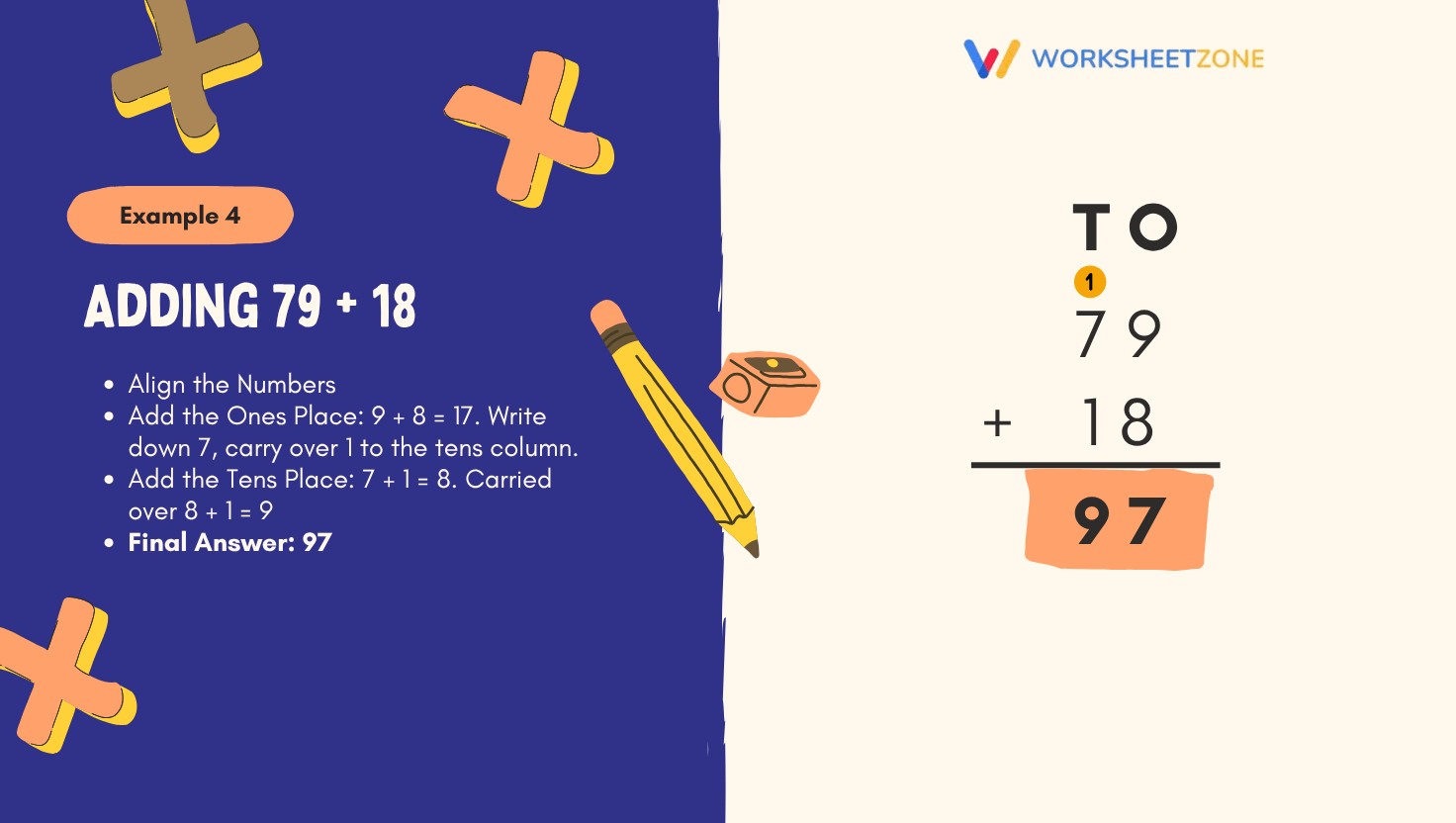
Example 4: Adding 79 + 18
Step 1: Add the Ones Place
- We begin with the ones: 9 + 8 = 17.
- Since 17 is two digits, write down the 7 in the ones place and carry the 1 over to the tens column.
Step 2: Add the Tens Place
- Next, add the tens digits: 7 + 1 = 8.
- Now include the 1 carried over, which gives us 9.
- Write 9 in the tens place.
Step 3: Combine the Result
Now we have 9 in the tens place and 7 in the ones place. That means the total is 97.
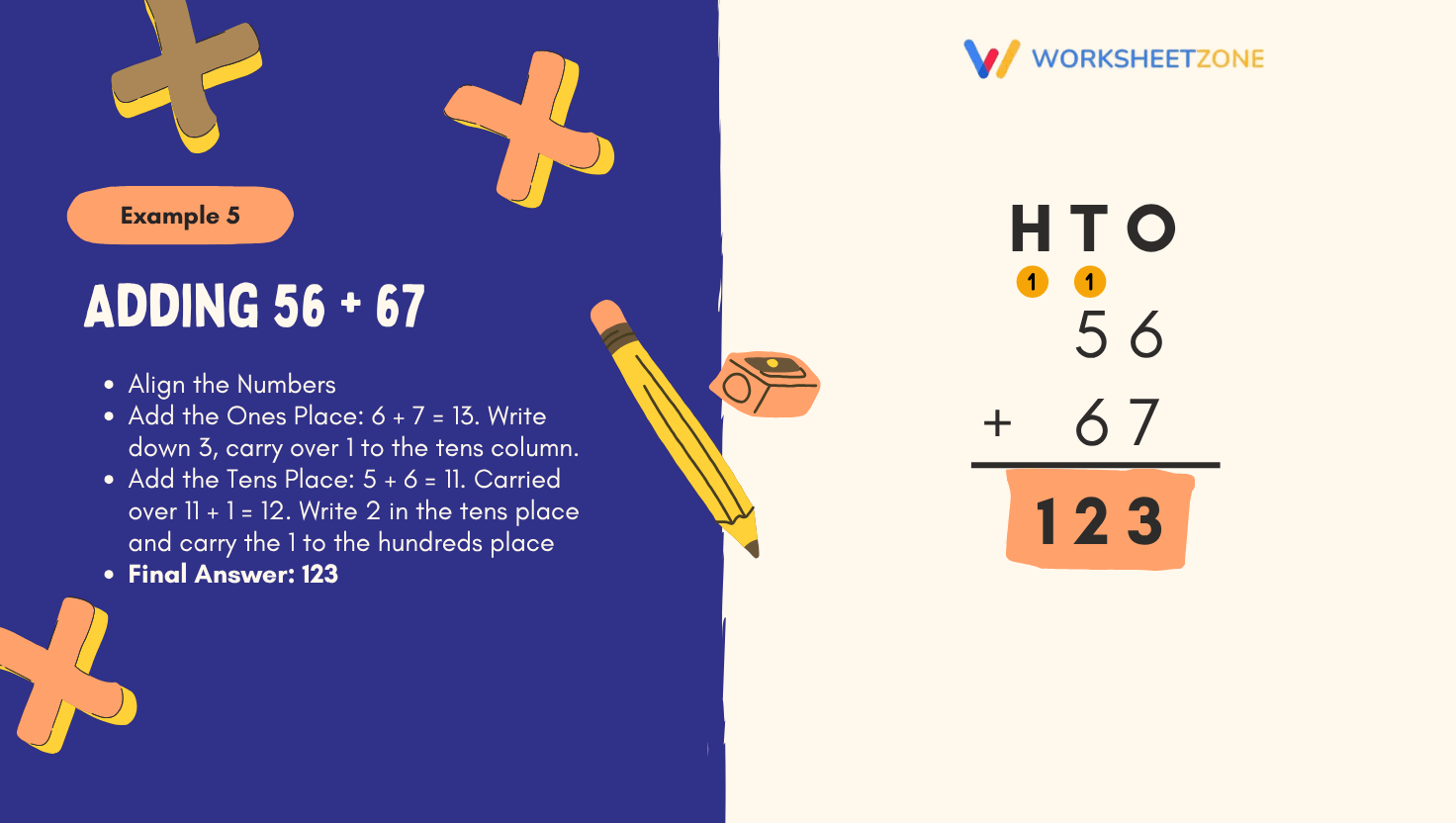
Example 5: Adding 56 + 67
Step 1: Add the Ones Digits
- Start with the ones: 6 + 7 = 13.
- This is more than 9, so we write down 3 in the ones place and carry the 1 to the tens.
Step 2: Add the Tens Digits
- Next, we add the tens digits: 5 + 6 = 11.
- Add the 1 from the carry-over, and we get 11 + 1 = 12.
- Again, this is a two-digit number, so we write 2 in the tens place and carry the 1 to the hundreds place.
Step 3: Final Step
- Write the carried-over 1 into the hundreds column.
- Now we have: 1 (hundreds), 2 (tens), and 3 (ones).
The final answer is: 123
Practice for the addition of two digits
Here are some examples of numerical problems and word problems to help your students practice addition of two digits effectively:
- 47 + 36 = ?
- 68 + 25 = ?
- 59 + 38 = ?
- 76 + 17 = ?
- 84 + 29 = ?
Word Problems
- Liam has 47 apples. His friend gives him 36 more. How many apples does he have now?
- There are 68 red balloons and 25 blue balloons at the party. How many balloons are there in total?
- Sophia read 59 pages on Monday and 38 pages on Tuesday. How many pages did she read altogether?
- A toy store sold 76 cars in the morning and 17 in the afternoon. How many cars did they sell that day?
- Emma collected 84 stickers from one box and 29 from another. What is the total number of stickers she collected?
Want to level up? If you’re ready to move on to bigger numbers, check out this easy step-by-step guide on adding three-digit numbers with regrouping.
FAQs
1. What is regrouping in addition and when is it used?
Regrouping, often called carrying, is the process of moving a group of ten ones to the tens column. This technique is used whenever the sum of a single column is 10 or higher. By placing the ones digit in the current column and the tens digit in the next, students maintain the correct place value and solve complex problems without confusion.
2. What are some common mistakes kids make with two-digit addition?
Many students forget to add the carried-over number or mistakenly align the digits incorrectly in horizontal problems. Another common error is writing the entire two-digit sum (like 13) into a single column instead of regrouping. Teachers can minimize these mistakes by encouraging students to use grid paper and clearly marking the carried digit at the top of the tens column.
Final thoughts
Mastering the addition of two digits doesn’t have to be challenging. With the right steps and regular practice, students can understand the structure of the math addition and gain fluency in no time.
Looking for more practice? Check out two-digit addition worksheets designed to reinforce skills in the addition of double digits. Make it part of your students’ daily routine, and watch as they grow stronger, faster, and more accurate with every problem they solve!


