




















7th grade poems are literary works selected to challenge middle schoolers through complex themes and emotional resonance. This list of 15 poems for 7th graders offers educators a diverse collection of voices to spark classroom discussion and foster critical thinking. These selections help transitional students bridge the gap between Poems For 4th Graders and sophisticated literary analysis.
15 poems for 7th graders
The following poems for 7th graders have been carefully selected to challenge middle schoolers while remaining highly relatable to their daily lives. These works offer a perfect balance of classic literature and modern voices to keep students engaged in the classroom.
1. “Phenomenal Woman” by Maya Angelou

Maya Angelou’s vibrant anthem celebrates self-confidence and the inherent power of womanhood through rhythmic, heartbeat-like stanzas. Angelou rejects traditional beauty standards in favor of inner strength and a magnetic spirit that draws people in. It is an empowering choice for middle schoolers who are often navigating their own identity and self-image issues.
Teaching tip: Focus on the use of repetition and how it builds a sense of rhythm similar to a heartbeat or a march. Have students identify specific qualities the speaker lists that are not based on physical appearance alone. This can lead to a healthy classroom dialogue about self-esteem and the difference between internal and external beauty.
2. “The Hill We Climb” by Amanda Gorman
Amanda Gorman’s historic inaugural poem addresses themes of national unity, hope, and the ongoing work required for social justice. Its modern style and use of spoken-word techniques like alliteration and internal rhyme make it highly accessible to 7th graders. The poem serves as a powerful reminder that history is being made every day and that young voices truly matter.

Teaching tip: Watch the video of the poem being performed so students can experience the impact of vocal delivery and pacing. Ask students to pick one metaphor from the text, such as “the hill,” and explain what it represents in the context of their own lives or community. This connects literature to current events and encourages students to think about their role in the future.
3. “Valentine” by Carol Ann Duffy
Carol Ann Duffy creates a unique and somewhat startling perspective on love by comparing it to an onion rather than a traditional rose. The poem explores the realistic, layered, and sometimes painful aspects of relationships, intentionally moving away from romantic clichés. Students regularly underestimate how much context shapes meaning here — a practical solution is to present each term in two contrasting sentences so the nuance becomes visible.

Teaching tip:
Use this poem to introduce the concept of “anti-clichés” and unconventional metaphors in creative writing sessions. Have students brainstorm other everyday, mundane objects that could represent complex emotions like:
- Friendship
- Anger
- Jealousy
This helps them move beyond “Hallmark card” styles of writing and into more original, descriptive territories.
4. “Mirror” by Sylvia Plath
Sylvia Plath’s poem is written from the perspective of an inanimate object to explore themes of truth, aging, and the search for identity. Personification is a literary device where human qualities are attributed to inanimate objects or animals. The mirror claims to be “unmisted by love or dislike,” providing a cold and objective view of the woman who looks into it. It is a haunting example of personification that usually captures the imagination of middle school readers.
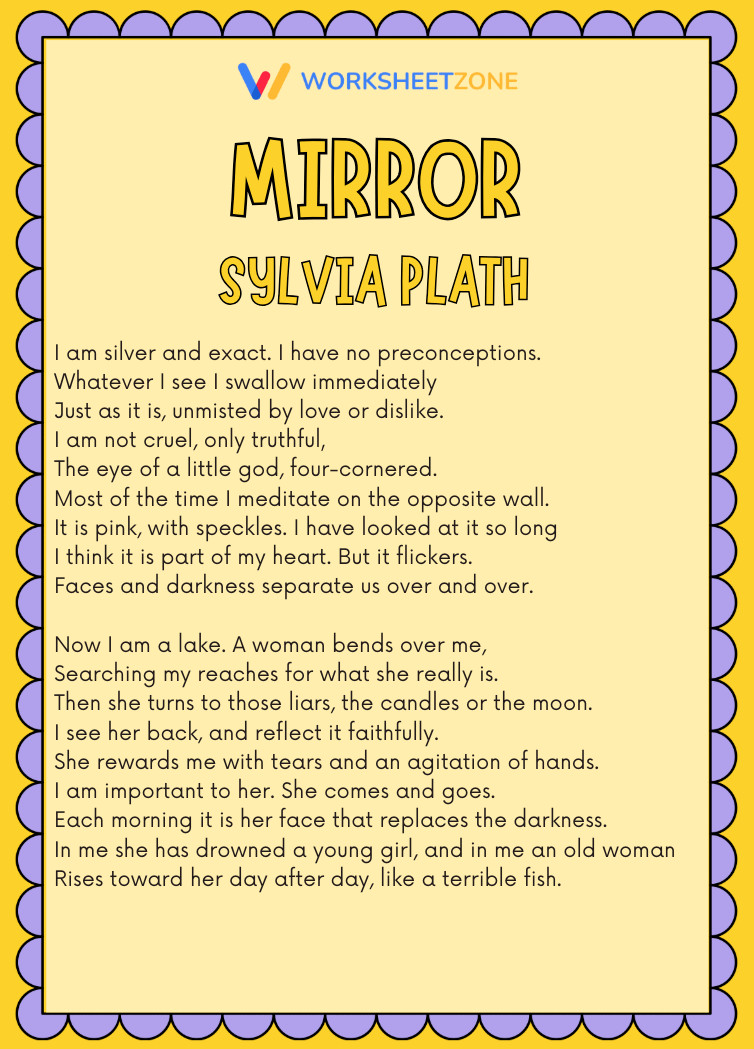
Teaching tip: Challenge students to write their own persona poem from the perspective of an object in their classroom, like a whiteboard or a desk. Ask them to consider how that object “views” the students and what truths it might reveal if it could finally speak. This exercise helps students practice voice and perspective while reinforcing the literary concept of personification.
5. “The Lanyard” by Billy Collins
Billy Collins uses humor and relatable imagery to discuss the vast imbalance between a mother’s selfless love and the simple gifts children provide. Irony is a rhetorical device where the intended meaning is the opposite of the literal expression. The speaker recalls weaving a plastic lanyard at summer camp and offering it as a return for “thousands of meals” and life itself. It captures the bittersweet realization of growing up and finally understanding parental sacrifice.

Teaching tip: Lead a discussion on the use of irony and hyperbole in the poem, focusing on the contrast between the “useless” lanyard and the weight of a parent’s care. Have students write a short reflection or a response poem about a simple gift they once gave to someone they love. This helps them connect the text to their personal history while exploring narrative structure.
6. “Paul Reverse’s Ride” by Henry Wadsworth Longfellow
This action-packed narrative poem tells the story of one of the most famous nights in American history. Longfellow uses a galloping rhythm and vivid descriptions to build suspense as the warning spreads through the Massachusetts countryside. It is a staple for connecting ELA with the 7th-grade Social Studies curriculum.

Teaching tip: Compare the poem’s version of events with actual historical accounts to discuss “poetic license” and why authors might change facts for dramatic effect. Have students map out the ride on a physical map based on the specific locations mentioned in the stanzas. This visual activity helps reinforce the setting and plot of the narrative poem.
7. “Annabel Lee” by Edgar Allan Poe
Edgar Allan Poe’s final complete poem is a beautiful and haunting tale of eternal love and tragic loss. Set “in a kingdom by the sea,” the rhythmic, melodic flow makes the poem sound almost like a lullaby or a classic fairy tale. Students are often drawn to its atmospheric Gothic style and the intensity of the narrator’s devotion.

Teaching tip: Have students analyze the “musicality” of the poem by looking at the repetition of specific sounds and words. Discuss whether the narrator seems reliable or if his obsession with Annabel Lee colors his version of the story. This is a great introduction to the Gothic genre and the concept of an unreliable narrator.
8. “A Dream Within a Dream” by Edgar Allan Poe
This philosophical poem questions the nature of reality and the pain associated with the inevitable passage of time. Poe uses the image of sand slipping through fingers to represent the inability to hold onto the people and moments we love. It encourages 7th graders to think deeply about existential themes in a way that feels both poetic and relatable.

Teaching tip: Use the “sand” metaphor to discuss symbolism and how physical objects can represent abstract concepts. Ask students to write about a memory that feels more like a dream to them, focusing on sensory details that seem to “slip away.” This allows them to engage with the poem’s emotional weight on a personal level.
9. “We Real Cool” by Gwendolyn Brooks
Gwendolyn Brooks uses a unique, jazz-like rhythm and the repetition of the word “We” at the end of lines to depict a group of rebellious teens. The poem provides a brief but powerful snapshot of urban youth culture and the consequences of leaving school. Its brevity and sharp tone make it incredibly memorable and impactful for middle school students as they prepare for the complexity of Poems For 10th Graders.

Teaching tip: Discuss the use of “enjambment” and how placing “We” at the end of each line changes the emphasis and pace of the reading. Have students practice reading the poem with different “beats” to see how the meaning and mood shift. This is an excellent text for discussing social commentary and subculture in poetry.
10. “Casey at the Bat” by Ernest Lawrence Thayer
This humorous ballad tells the story of a cocky baseball player who fails when his team needs him most. It is a classic narrative about overconfidence and the high stakes of sports in a small town. The building tension in the stands of Mudville is palpable, making it a great choice for teaching plot structure.

Teaching tip: Have students act out the poem as it is read aloud, with one student playing the role of the overly confident Casey. This helps them visualize the “rising action” and the “climax” of the poem’s narrative. Discuss the final “anti-climax” and what it teaches about the unpredictability of success and failure.
11. “On Turning Ten” by Billy Collins
Billy Collins captures the specific sadness of leaving childhood behind as the speaker laments the loss of their youthful imagination. The poem frames turning ten as the end of an era, where the world suddenly feels more serious and less magical. It is highly relatable for 7th graders who are currently navigating the transition into adolescence.

Teaching tip: Ask students to write about a “childish” toy or habit they have recently given up and the emotions associated with that change. Compare the “illness” mentioned in the poem to the metaphorical “spirit” of childhood. This encourages students to reflect on their own developmental milestones through a literary lens.
12. “Since Hanna Moved Away” by Judith Viorst
Judith Viorst uses simple, direct language to describe the deep sense of loneliness a child feels when a best friend moves. The poem lists everyday things that have lost their joy without the friend there to share them:
- Chocolate cake
- Toys
- Games
- Snacks
It is an honest and poignant look at the social dynamics that define middle school life.

Teaching tip: Have students identify the “concrete details” that show, rather than tell, the speaker’s sadness. This is a great opportunity to teach “show, don’t tell” in creative writing by asking students to write a stanza about a time they felt out of sorts. Focus on how specific physical sensations can represent larger emotional states.
13. “This Is Just to Say” by William Carlos Williams
This famous “apology” poem by William Carlos Williams is known for its extreme simplicity and focus on a small domestic moment. The speaker admits to eating plums that were being saved, creating a tone that is both playful and slightly mischievous. It serves as a perfect example of how poetry can be found in the smallest interactions of daily life.

Teaching tip:
This poem is an excellent “mentor text” for a quick writing exercise where students write their own “This Is Just to Say” apologies. They can write about:
- Eating a sibling’s snack
- Borrowing something without asking
- Forgetting a small chore
Focusing on sensory descriptions, it’s a low-stakes way for students to practice line breaks and minimalist verse.
14. “Landing of the Pilgrim Fathers” by Felicia Hemans
Felicia Hemans provides a dramatic account of the Pilgrims’ arrival in New England, emphasizing their search for religious freedom. It uses rugged imagery to set a mood of resilience, including:
- Breaking waves
- A stern coast
- A rock-bound coast
- Dark woods
This piece is ideal for teaching how poetry can capture and elevate historical narratives within the Social Studies context.

Teaching tip: Focus on the poem’s diction by having students highlight words that create a sense of strength or struggle. Compare this poetic version with actual historical accounts to discuss how poets use imagery to create a sense of national pride. Ask students to identify the different types of people mentioned in the stanzas and what they represent.
15. “That Sure Is My Little Dog” by Eleanor Farjeon
Eleanor Farjeon captures the chaotic and loving personality of a pet in this delightful narrative verse. The speaker describes the dog’s antics with a mix of frustration and affection, using a conversational tone that students find very engaging. It illustrates how poetry can be used to celebrate the unique personalities of the animals in our lives.

Teaching tip: Use this poem to teach “tone” and “speaker’s attitude” by looking for where the voice shifts from exasperation to warmth. Have students write their own “character sketch” poem about a pet or a favorite animal they know. Encourage them to use active verbs to mimic the sounds and movements of the creature they are describing.
To extend your poetry lessons, explore more poems and ready-to-use classroom resources designed specifically for middle school students. Visit 7th graders poems activities for engaging worksheets, discussion prompts, and activities that help students analyze and enjoy poems for 7th graders.
Frequently Asked Questions
1. Why is 7th grade an ideal time to introduce complex poetry?
At this transitional age, students are developing deeper critical thinking skills and emotional intelligence. This development makes them ready to explore sophisticated themes like identity, loss, and social justice through verse. Introducing complex poems helps bridge the gap between elementary rhymes and the high-level literary analysis required in later secondary education, fostering a more profound appreciation for creative expression.
2. How do teaching tips help in a poetry classroom?
Teaching tips provide concrete strategies for educators to move beyond simple reading and into active analysis. By focusing on specific devices like repetition, personification, or unconventional metaphors, these tips ground abstract concepts in actionable classroom activities. This approach encourages students to connect the text to their personal lives, current events, or creative writing practices, ensuring the literature feels relevant and engaging.
Final thoughts
Incorporating these poems for 7th graders into your curriculum provides a unique opportunity to enhance literacy while building a supportive classroom community. Poetry allows students to see the world through different lenses, encouraging empathy and self-reflection during their formative middle school years. Whether you are analyzing classic stanzas or contemporary spoken word, the goal is to make literature feel alive and accessible. By exploring these thirty selections, you can inspire your students to find their own voices and appreciate the enduring power of written words.


