


























Views
Downloads

Grade 9-12 Monomyth — Essential Printable Worksheet
Paste this activity's link or code into your existing LMS (Google Classroom, Canvas, Teams, Schoology, Moodle, etc.).
Students can open and work on the activity right away, with no student login required.
You'll still be able to track student progress and results from your teacher account.
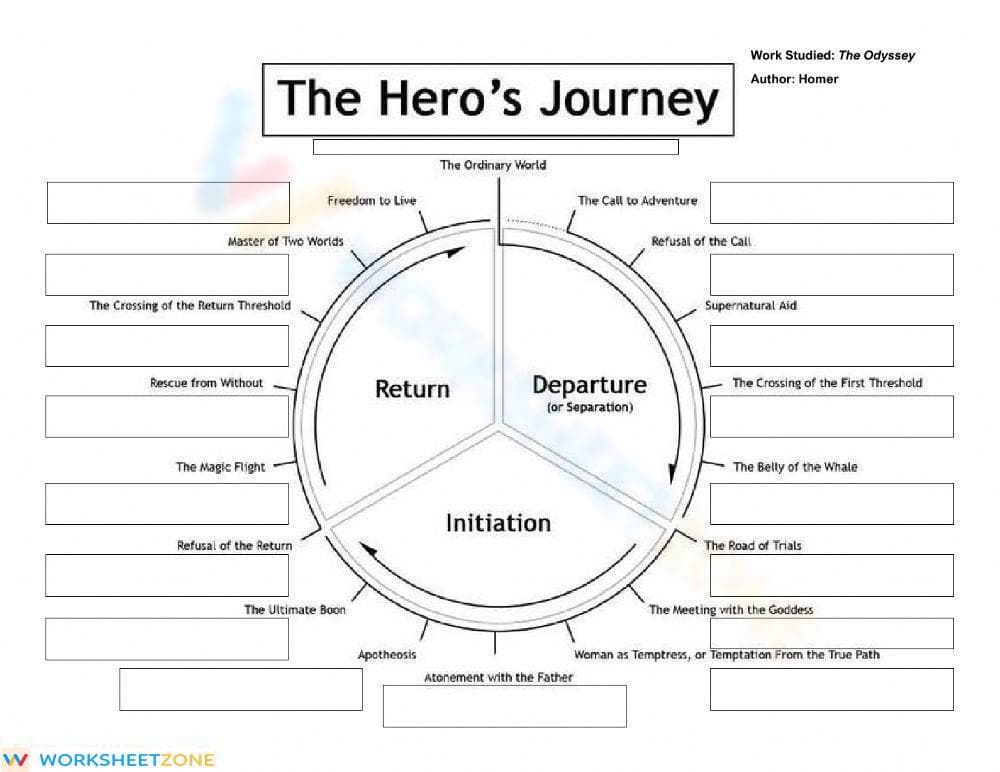
This blank Hero's Journey worksheet provides high school students with a structured framework to analyze narrative structure across any literary text. By mapping story events to Joseph Campbell’s seventeen stages of the monomyth, learners develop a deeper understanding of character development. This essential tool streamlines literary analysis for Grade 9 through 12 classrooms.
At a Glance
- Grade: 9–12 · Subject: English Language Arts
- Standard:
CCSS.ELA-LITERACY.RL.9-10.3— Analyze how complex characters develop over the course of a text and advance the plot- Skill Focus: Hero's Journey (Monomyth) Analysis
- Format: 1 page · 17 stages · Answer key not included · PDF
- Best For: Literary analysis and narrative structure mapping
- Time: 45–60 minutes
What's Inside
This printable resource features a clean diagram of the Monomyth, divided into Departure, Initiation, and Return. Each of the 17 stages includes a dedicated box for students to transcribe evidence from their study. The layout is optimized for high school use, ensuring students visualize the cyclical nature of the hero's transformation without visual clutter.
Zero-Prep Workflow
This resource is designed for immediate classroom implementation with teacher preparation time under 2 minutes. First, print the single-page PDF (30 seconds). Second, distribute and briefly review the definitions of Departure, Initiation, and Return (60 seconds). Finally, students begin mapping their text independently, allowing you to transition into a facilitator role. This is also an ideal emergency sub plan.
Standards Alignment
Aligned with CCSS.ELA-LITERACY.RL.9-10.3, this worksheet requires students to analyze how complex characters develop and advance the plot. By identifying archetypal milestones—like the Road of Trials—students generate empirical evidence to discuss growth. This standard code can be copied directly into lesson plans, IEP goals, or district curriculum mapping tools.
How to Use It
Use this worksheet during the reading phase of a novel to track structural developments. For a formative assessment, have students complete the Departure section early to predict future plot points. Observe if students can distinguish between the "Call to Adventure" and the "Refusal of the Call" to gauge their grasp of internal character conflict.
Who It's For
Tailored for Grade 9-12 students studying classical literature or modern film, this resource scaffolds analysis for reluctant readers by providing a visual roadmap. Pair this worksheet with a Hero's Journey anchor chart or an introductory lecture on Joseph Campbell's research to provide the necessary conceptual background for successful completion.
The use of graphic organizers like this Monomyth template is supported by research into cognitive load and literary comprehension. According to Fisher & Frey (2014), visual tools help students organize complex information and see relationships between story elements that might otherwise be missed. By mapping a text to the CCSS.ELA-LITERACY.RL.9-10.3 standard, students engage in higher-order thinking as they evaluate narrative events against specific archetypal stages. This 17-stage framework encourages 100% student participation by providing a clear, achievable goal for literary dissection. Whether used for a Greek myth or a contemporary novel, this worksheet ensures that rigorous Common Core requirements are met through structured, evidence-based practice. Research from the NAEP consistently shows that students who use structural organizers perform better on standardized reading assessments requiring plot-to-theme synthesis. This printable resource bridges the gap between passive reading and active analytical engagement.


