


























Views
Downloads
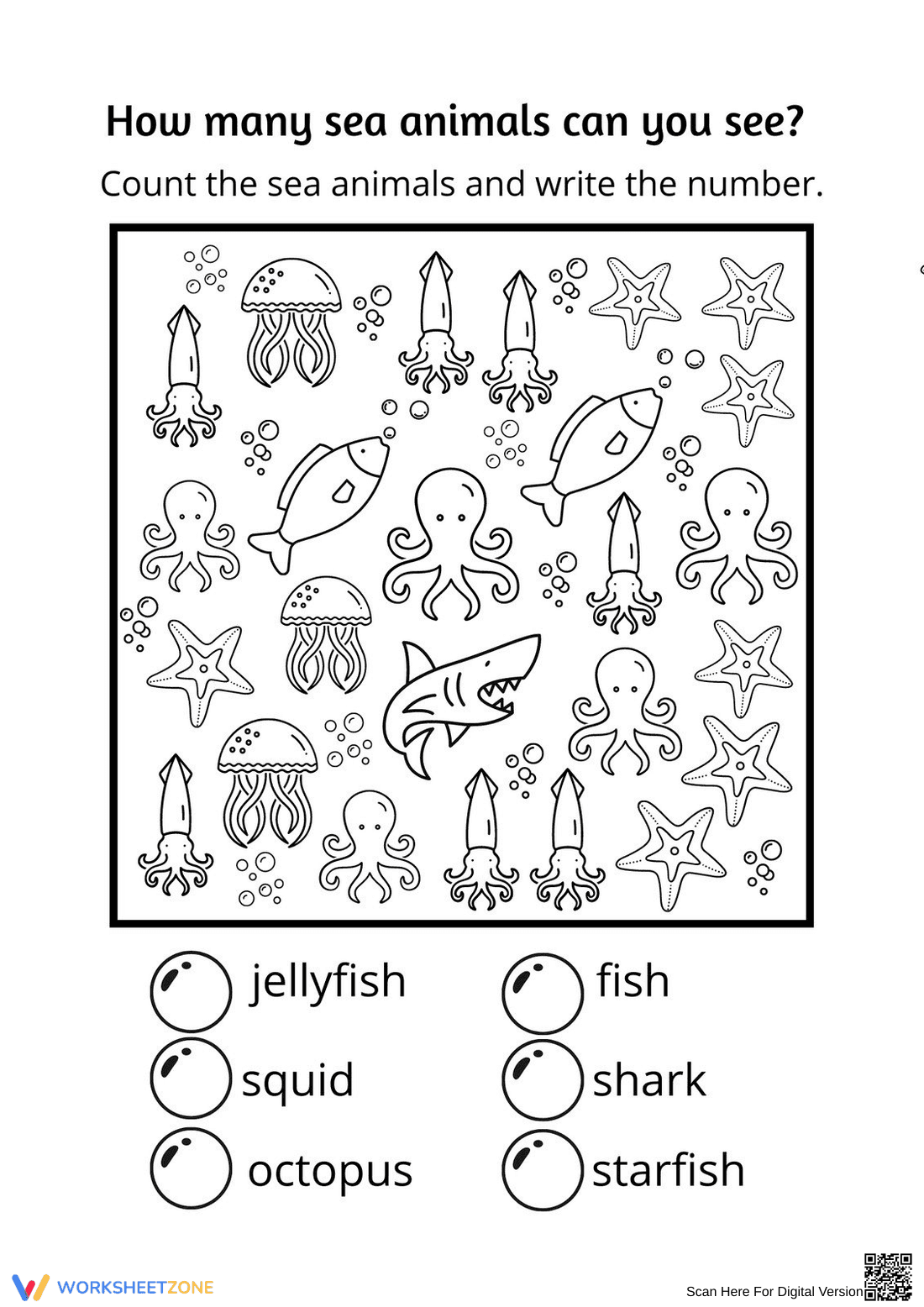

Counting Sea Animals Worksheet | Essential Grade K Math
Paste this activity's link or code into your existing LMS (Google Classroom, Canvas, Teams, Schoology, Moodle, etc.).
Students can open and work on the activity right away, with no student login required.
You'll still be able to track student progress and results from your teacher account.
This Grade K counting sea animals worksheet helps young learners develop essential early numeracy skills through engaging visual identification. Students practice one-to-one correspondence by locating and tallying various ocean creatures within a crowded field. This activity builds the foundational ability to connect numerical symbols with physical quantities in a fun, thematic context.
At a Glance
- Grade: Kindergarten · Subject: Math
- Standard:
CCSS.MATH.CONTENT.K.CC.B.5— Count to answer how many questions about as many as 20 things- Skill Focus: Counting and Cardinality
- Format: 1 page · 6 tasks · Answer key included · PDF
- Best For: Independent morning work or math centers
- Time: 10–15 minutes
What's Inside
This single-page PDF features a high-interest visual illustration filled with jellyfish, squid, octopuses, fish, sharks, and starfish. Below the main image, six dedicated response circles paired with animal labels provide a clear structure for students to record their findings. The black-and-white design is printer-friendly and doubles as a coloring activity for early finishers who enjoy creative expression after completing their math tasks.
Zero-Prep Workflow
- Print: Select the single-page PDF and print enough copies for your group in under 30 seconds.
- Distribute: Hand out the sheets along with pencils and optional crayons for a quick start.
- Review: Use the included answer key to quickly check student work or project the image for a whole-class count-along.
Total teacher preparation time is under 2 minutes, making this an ideal resource for emergency sub plans or transition periods.
Standards Alignment
The primary focus is `CCSS.MATH.CONTENT.K.CC.B.5`, which requires students to count to answer "how many?" questions about as many as 20 things arranged in a scattered configuration. It also supports `K.CC.B.4`, understanding the relationship between numbers and quantities. Both standard codes can be copied directly into lesson plans, IEP goals, or district curriculum mapping tools to ensure compliance with state frameworks.
How to Use It
Assign this worksheet during the independent practice phase of a lesson on counting to 10. It works exceptionally well as a formative assessment to observe if students are using strategies like marking off counted items to avoid double-counting. Expect students to complete the counting and recording within 10 to 15 minutes, depending on their fine motor speed and scanning ability.
Who It's For
This resource is designed for Kindergarten students but serves as an excellent intervention tool for first graders needing a refresher on cardinality. It pairs naturally with ocean-themed picture books or an anchor chart demonstrating counting strategies like "touch and count." It is also suitable for homeschool environments looking for structured, thematic math practice.
According to the RAND AIRS 2024 report, high-quality supplemental materials that integrate visual-spatial tasks with numerical recording significantly improve retention in early childhood mathematics. This worksheet aligns with CCSS.MATH.CONTENT.K.CC.B.5 by requiring students to count scattered objects and associate the total with a written numeral, a core competency for kindergarten readiness. Research from Fisher & Frey (2014) emphasizes that visual counting tasks encourage students to develop systematic scanning patterns, which are foundational for both mathematical accuracy and early literacy. By providing 6 distinct categories of sea animals to count, this resource offers repeated practice in a low-stakes, engaging format. The inclusion of an answer key ensures that educators can provide immediate feedback, a critical component of the gradual release of responsibility model. This worksheet is a reliable tool for building the one-to-one correspondence necessary for future operations and algebraic thinking, ensuring students meet grade-level expectations through targeted, printable practice.


