


























Views
Downloads
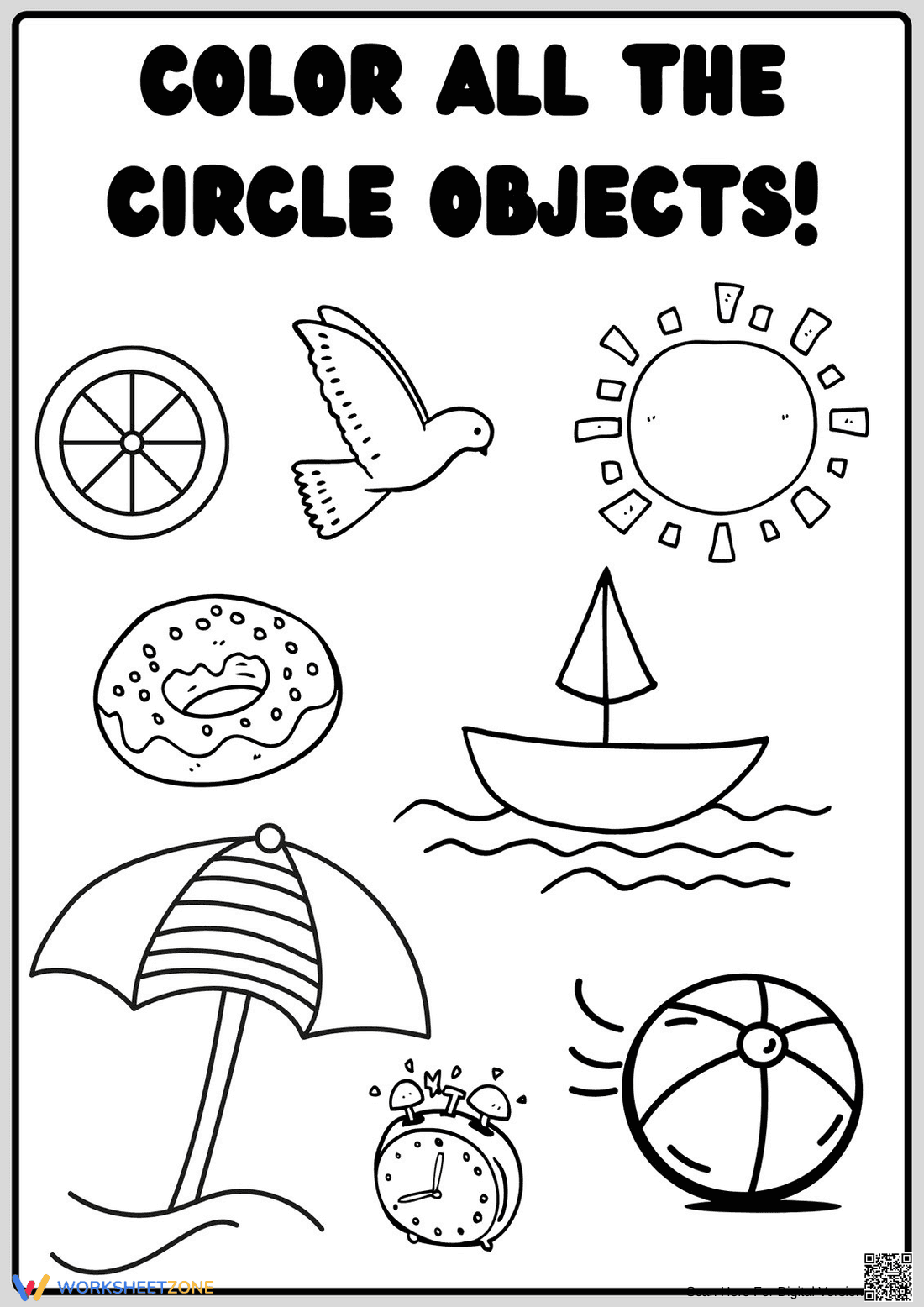

Grade K Circle Objects — Printable No-Prep Worksheet
Paste this activity's link or code into your existing LMS (Google Classroom, Canvas, Teams, Schoology, Moodle, etc.).
Students can open and work on the activity right away, with no student login required.
You'll still be able to track student progress and results from your teacher account.
This foundational geometry worksheet helps early learners identify circles in real-world contexts. Students evaluate eight familiar items and color only the objects shaped like circles. This targeted practice strengthens visual discrimination and shape recognition, ensuring students can confidently spot geometric forms in their everyday environment.
At a Glance
- Grade: K · Subject: Math
- Standard:
CCSS.MATH.CONTENT.K.G.A.2— Identify and name circles among other shapes- Skill Focus: Shape recognition
- Format: 1 page · 8 problems · No answer key · PDF
- Best For: Independent practice
- Time: 10–15 minutes
Inside this single-page resource, students find clear illustrations of eight common items, including a wheel, bird, sun, donut, boat, umbrella, clock, and beach ball. The straightforward layout removes visual clutter, allowing young learners to focus on geometric properties. Students evaluate each illustration and apply coloring skills only to the five circular objects, reinforcing fine motor control.
This resource is designed for immediate classroom implementation with a zero-prep workflow. Print (1 minute): Simply generate the PDF and print a class set. The black-and-white design ensures crisp copies while saving ink. Distribute (1 minute): Hand out the pages along with crayons or markers. The bold instructions are easy to read aloud. Review (3 minutes): Quickly scan student pages to check for understanding. With a total teacher prep time of under two minutes, this activity is an ideal, reliable option for emergency sub plans or quick transitions.
This activity is directly aligned to CCSS.MATH.CONTENT.K.G.A.2, requiring students to correctly name shapes regardless of their orientations or overall size. By presenting circles as everyday objects rather than abstract geometric drawings, the worksheet bridges the gap between theoretical math and environmental awareness. Both standard codes can be copied directly into lesson plans, IEP goals, or district curriculum mapping tools.
Deploy this worksheet during morning work to activate prior knowledge before a formal geometry lesson, or use it as an independent center activity. As a formative assessment observation tip, watch how students evaluate the umbrella; if they color the half-circle, it indicates a need to review the continuous boundary that defines a true circle. Expected completion time ranges from 10 to 15 minutes.
This printable is crafted primarily for Kindergarten students mastering basic 2D shapes, but it also serves as excellent remedial practice for first graders needing a geometry refresher. For differentiation, teachers can challenge advanced learners to draw their own circular objects on the back of the page. Pair this worksheet with a hands-on shape sorting activity or a read-aloud book about shapes to create a comprehensive, multi-sensory learning experience.
Mastering early geometry concepts like those found in CCSS.MATH.CONTENT.K.G.A.2 is critical for developing spatial reasoning. When students identify and name circles among other shapes, they build a cognitive foundation for later mathematical success. According to a recent EdReports 2024 analysis of foundational math curricula, integrating real-world object recognition into geometry practice significantly improves long-term retention of shape attributes. This worksheet leverages that pedagogical strategy by asking students to evaluate familiar items—such as clocks and donuts—rather than isolated geometric figures. This contextualized approach ensures that learners do not just memorize a definition, but actively apply their understanding of continuous curves and boundaries to their environment. By isolating the specific skill of circle identification within a simple, engaging coloring task, educators can effectively monitor progress and solidify essential early childhood math competencies.


