


























Views
Downloads
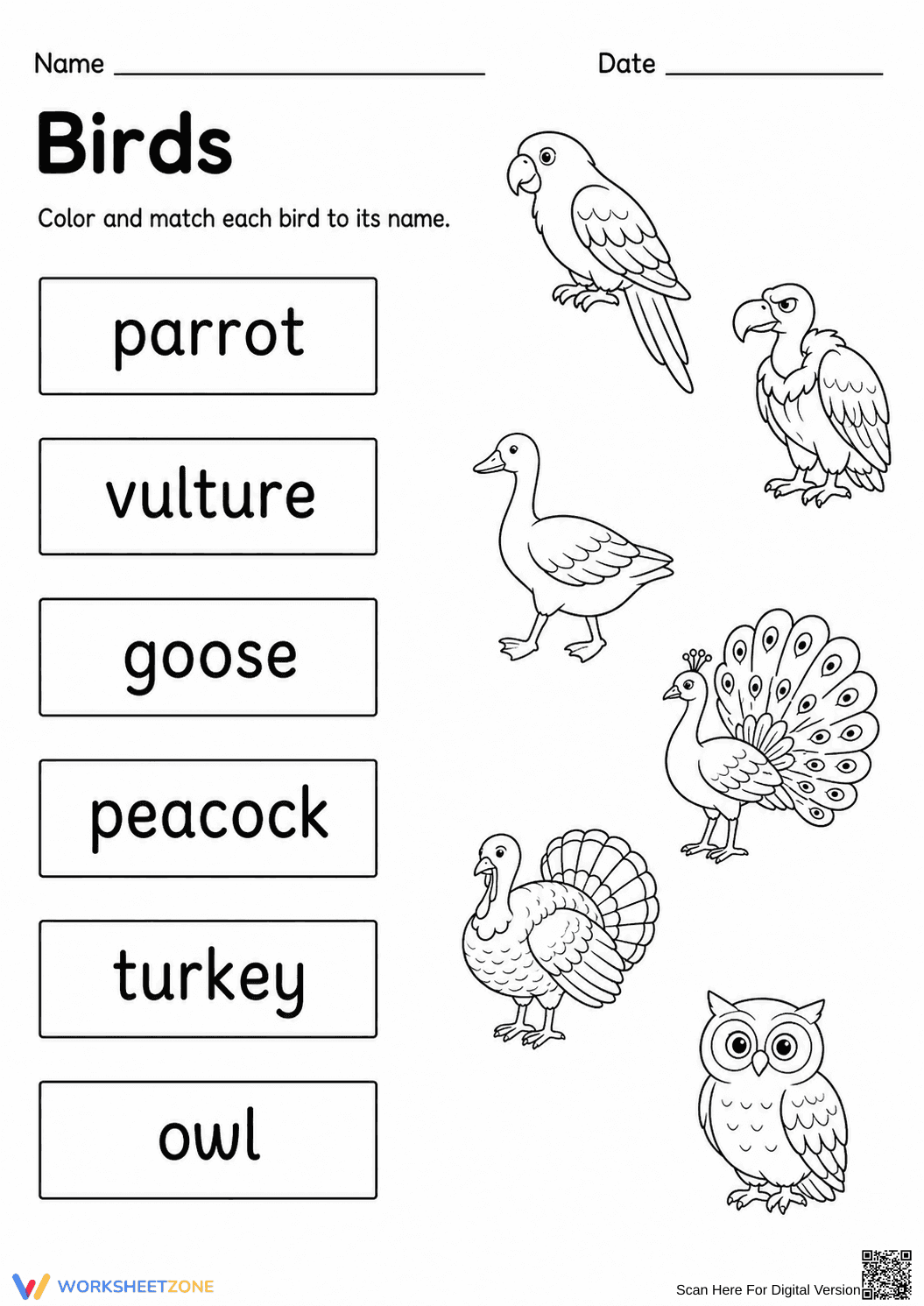

Printable Birds Matching Worksheet | Grade K-1 Science
Paste this activity's link or code into your existing LMS (Google Classroom, Canvas, Teams, Schoology, Moodle, etc.).
Students can open and work on the activity right away, with no student login required.
You'll still be able to track student progress and results from your teacher account.
Identifying common birds is a foundational skill in early life science education. This Birds Matching Worksheet helps young learners connect visual representations of birds with their written names through an engaging coloring and matching activity. Students build vocabulary and observation skills while exploring the diverse world of avian species in a fun, hands-on way.
At a Glance
- Grade: Kindergarten · Subject: Science
- Standard:
K-LS1-1— Use observations to describe patterns of what plants and animals need to survive- Skill Focus: Bird identification and vocabulary building
- Format: 1 page · 6 problems · Answer key included · PDF
- Best For: No-prep science centers and morning work
- Time: 10–15 minutes
What's Inside
This single-page PDF features six distinct bird illustrations—a parrot, vulture, goose, peacock, turkey, and owl—paired with a corresponding column of clear, easy-to-read name labels. The layout is designed specifically for early childhood learners, providing ample space for drawing lines and coloring each bird. A full answer key is provided to facilitate quick grading or student self-checking.
Zero-Prep Workflow
The zero-prep design ensures this activity can be implemented in under two minutes. First, print the required copies (30 seconds). Second, distribute the worksheets with crayons (1 minute). Finally, review the bird names as a whole group to reinforce recognition (30 seconds). It is an ideal resource for substitute teacher folders or unexpected schedule changes.
Standards Alignment
This resource is primarily aligned to K-LS1-1: "Use observations to describe patterns of what plants and animals (including humans) need to survive." By identifying specific birds, students begin to notice unique physical characteristics that help animals thrive in different environments. This standard code can be copied directly into lesson plans, IEP goals, or district curriculum mapping tools to ensure instructional consistency.
How to Use It
Use this worksheet as a formative assessment during a unit on living things to gauge student ability to identify common animals. It also works well as a post-instructional activity after reading a book about birds. For a quick observation tip, watch for students who hesitate to match the vulture or peacock; this may indicate a need for more direct exposure to non-standard bird species.
Who It's For
This activity is tailored for Preschool, Kindergarten, and Grade 1 students who are developing fine motor skills and early literacy. It is particularly effective for English Language Learners (ELLs) as the pictorial support helps bridge the gap between spoken words and written text. It pairs naturally with bird-themed anchor charts or nature observation walks.
Research highlighted in RAND AIRS 2024 emphasizes that multimodal learning—combining visual identification with motor tasks like coloring—significantly increases vocabulary retention in early childhood science education. This worksheet leverages that principle by requiring students to decode the standard code K-LS1-1 through the lens of observable bird traits. By matching names to images, students engage in foundational categorization, a critical cognitive milestone identified in Fisher & Frey (2014) as essential for scientific literacy. This specific task provides six structured opportunities for students to demonstrate mastery of avian identification, ensuring that the student action of "observing and describing" is met with high-quality, scaffolded support. The inclusion of diverse species like vultures and peacocks broadens the student’s biological schema, preparing them for more complex life science concepts.


