


























Views
Plays

Biology Enzyme Worksheet | Grade 9-10 Essential
Paste this activity's link or code into your existing LMS (Google Classroom, Canvas, Teams, Schoology, Moodle, etc.).
Students can open and work on the activity right away, with no student login required.
You'll still be able to track student progress and results from your teacher account.
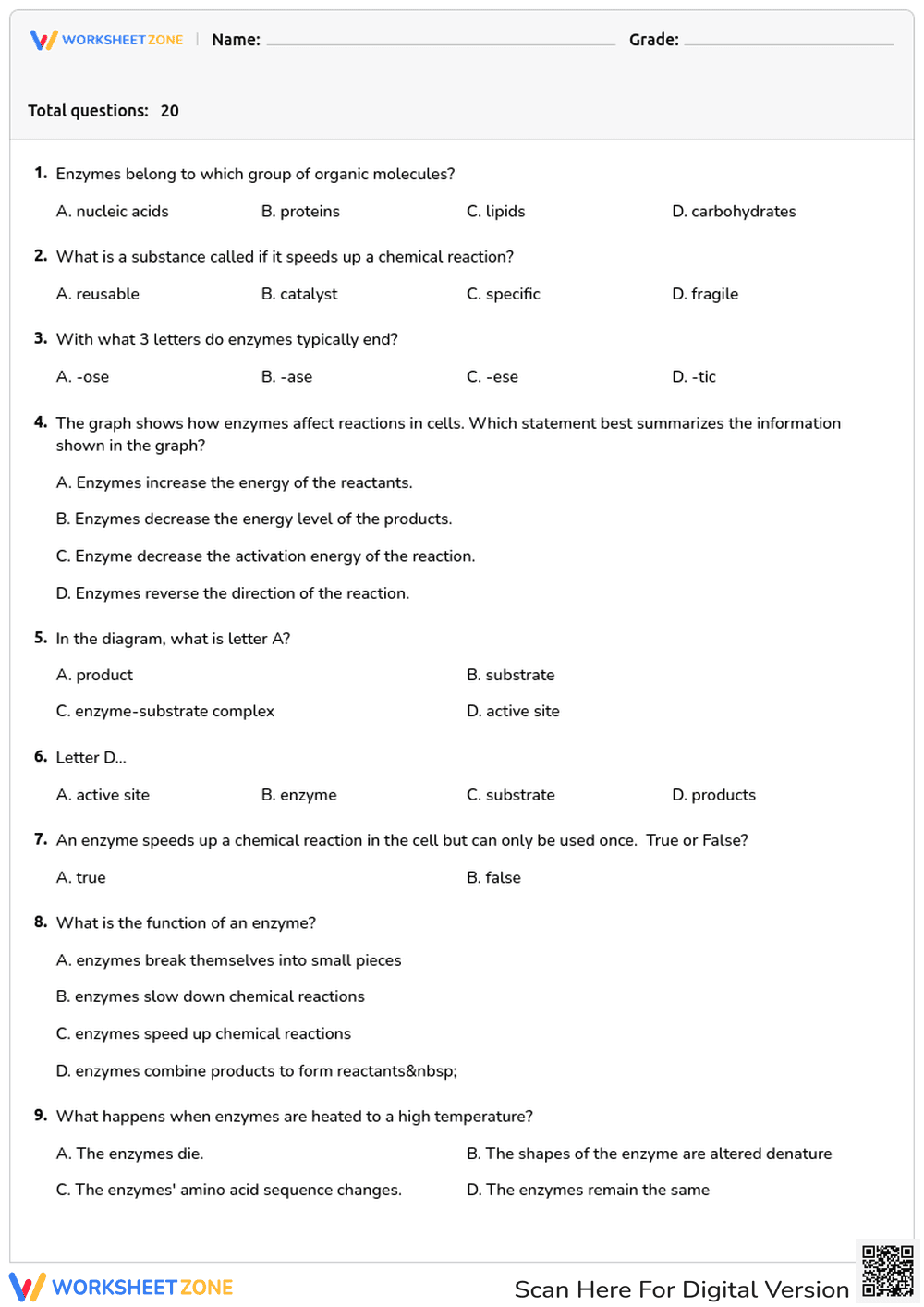
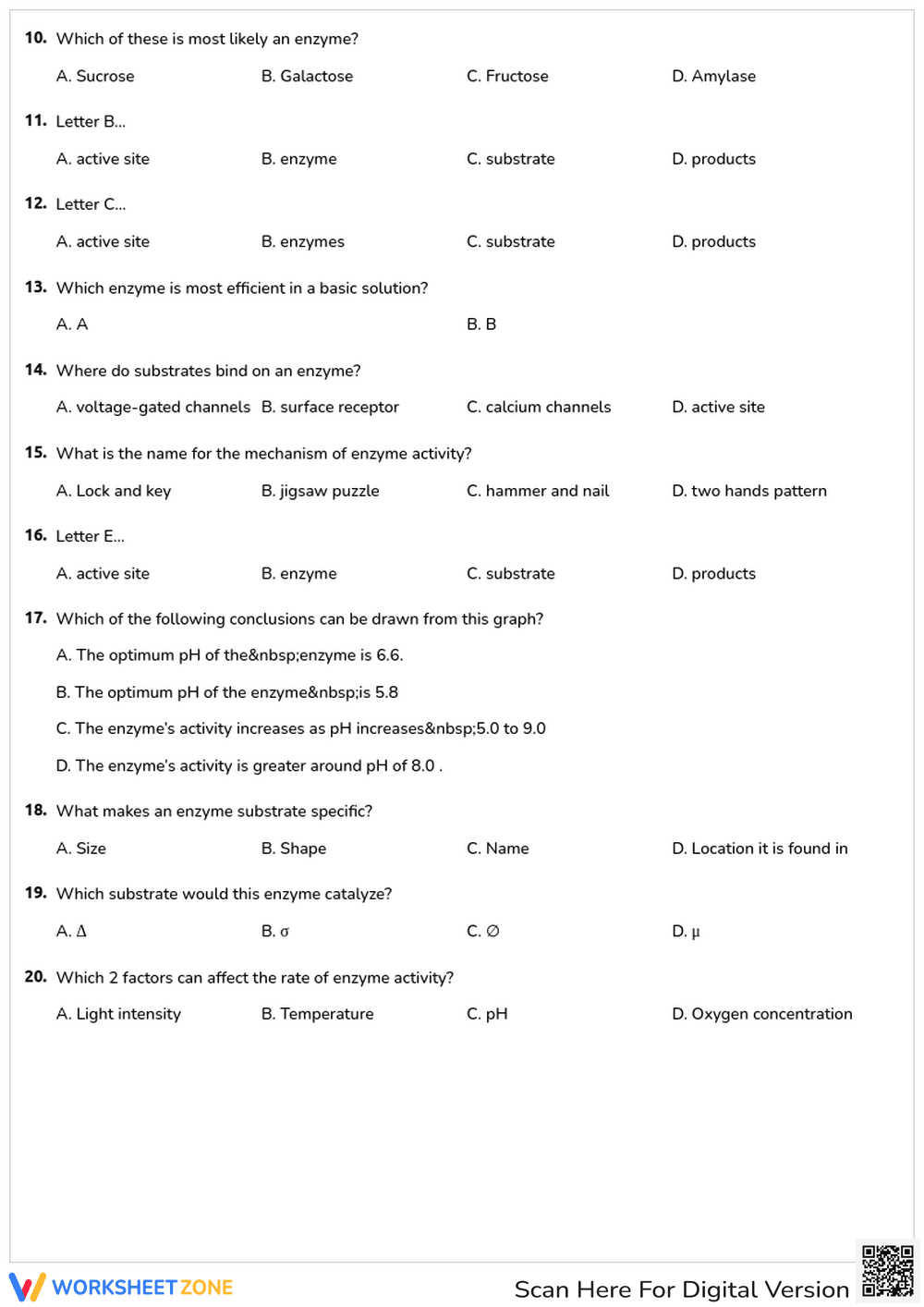
This Grade 9-10 Biology worksheet provides a comprehensive review of enzyme kinetics and protein structure. Students will analyze 20 targeted questions to demonstrate their understanding of how biological catalysts lower activation energy and facilitate chemical reactions within living organisms. It is designed to ensure students can identify key components like substrates and active sites.
At a Glance
- Grade: 9-10 · Subject: Biology
- Standard:
HS-LS1-1— Construct an explanation based on evidence for how the structure of DNA determines protein structure- Skill Focus: Enzyme function and denaturation
- Format: 2 pages · 20 problems · Answer key included · PDF
- Best For: Formative assessment or unit review
- Time: 20–30 minutes
This resource consists of a two-page assessment featuring 20 multiple-choice questions. The tasks are designed to evaluate student knowledge of organic molecules, catalyst properties, and the specific nomenclature of enzymes. Visual aids are integrated, requiring students to interpret graphs related to activation energy and diagrams illustrating the lock-and-key mechanism. A full answer key is provided for rapid grading.
The zero-prep workflow for this worksheet is designed for maximum efficiency in busy high school classrooms. First, print the two-page PDF (30 seconds). Second, distribute the copies to students as a bell-ringer or exit ticket (1 minute). Finally, review the answers using the included key to provide immediate feedback (5 minutes). Total teacher preparation time is under 2 minutes, making it an ideal emergency sub plan.
This worksheet is aligned with HS-LS1-1, which requires students to understand the hierarchical organization of interacting systems. Specifically, it focuses on the role of proteins as enzymes that carry out the essential functions of life. The questions also touch upon HS-LS1-6 regarding the formation of complex organic molecules. Both standard codes can be copied directly into lesson plans, IEP goals, or district curriculum mapping tools.
Use this worksheet as a mid-unit check for understanding after introducing the concept of biomolecules. It works effectively during the Explain phase of a 5E lesson cycle. Teachers should observe student responses to questions 9 and 20 to gauge their grasp of denaturation and environmental factors. Expected completion time ranges from 20 to 30 minutes depending on student prior knowledge.
This resource is tailored for Grade 9 and 10 Biology students, including those in Honors or General tracks. The clear formatting and multiple-choice structure provide necessary support for English Language Learners and students with IEPs who benefit from reduced writing demands. It pairs naturally with a classroom anchor chart illustrating the enzyme-substrate complex or a laboratory investigation on catalase.
According to the RAND AIRS 2024 report, high-quality science assessments must bridge the gap between conceptual knowledge and practical application. This worksheet addresses that need by requiring students to apply the HS-LS1-1 standard to real-world scenarios, such as the effect of temperature and pH on biological processes. Research from Fisher & Frey (2014) emphasizes that structured practice with specific feedback is essential for mastering complex biological systems. By focusing on the 20 critical components of enzyme activity, this resource ensures that students move beyond rote memorization toward a functional understanding of protein roles. The inclusion of graphical analysis aligns with NAEP frameworks for scientific inquiry, providing a robust tool for measuring student progress toward state and national benchmarks in life science. This self-contained assessment is a reliable instrument for documenting mastery in high school biology curricula.


