




























Views
Downloads
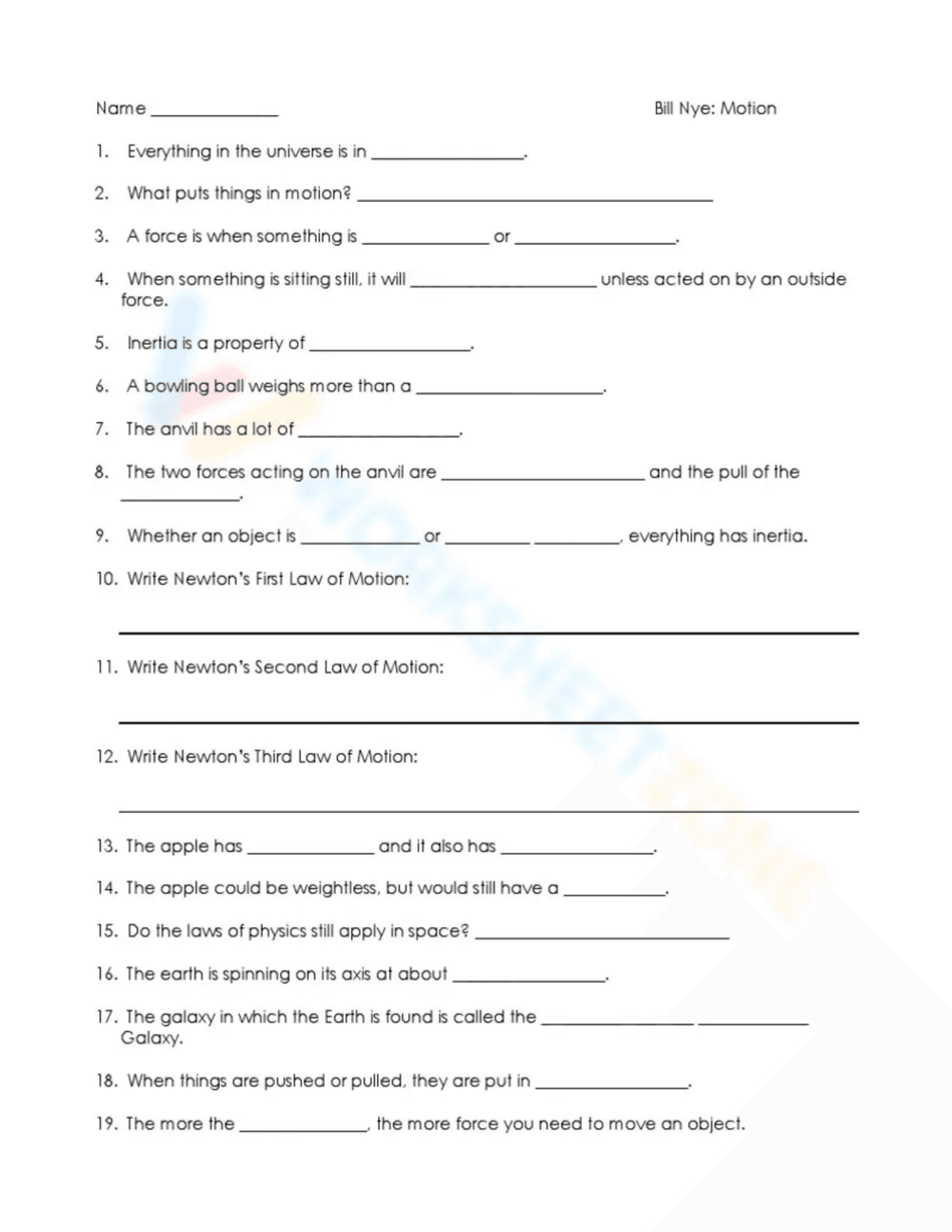


Grade 6 Forces & Motion — Printable No-Prep Worksheet

Paste this activity's link or code into your existing LMS (Google Classroom, Canvas, Teams, Schoology, Moodle, etc.).
Students can open and work on the activity right away, with no student login required.
You'll still be able to track student progress and results from your teacher account.
This Grade 6 and 7 science worksheet helps students identify key concepts of forces, inertia, and Newton's Laws of Motion while actively watching the Bill Nye Motion video. By completing these guided notes, learners will solidify their understanding of how mass and outside forces affect moving objects.
At a Glance
- Grade: 6 · Subject: Science
- Standard:
MS-PS2-2— Provide evidence that motion depends on forces and mass- Skill Focus: Forces and Motion
- Format: 1 page · 19 problems · PDF
- Best For: Video viewing guide and sub plans
- Time: 25–35 minutes
Inside this single-page resource, educators will find 19 sequential questions designed to follow along with the educational video. The task types include fill-in-the-blank sentences for quick fact recall and short-answer sections where students must write out Newton's First, Second, and Third Laws of Motion. The structured layout ensures students remain engaged with the multimedia content without feeling overwhelmed by extensive writing demands.
This resource is designed for a seamless classroom experience:
- Print (1 min): Print the single-page PDF for each student. No complex setups required.
- Distribute (1 min): Hand out worksheets before starting the video.
- Review (5 mins): Pause the video at key moments or review the 19 questions together at the end.
With teacher prep time under 2 minutes, this worksheet is an ideal addition to any physics unit or sub plan.
This activity aligns with MS-PS2-2: Plan an investigation to provide evidence that the change in an object's motion depends on the sum of the forces on the object and the mass of the object. By defining inertia and Newton's laws, students build the foundational vocabulary needed to analyze these physical interactions. Both standard codes can be copied directly into lesson plans, IEP goals, or district curriculum mapping tools.
Use this worksheet as an active listening guide during multimedia presentations. Distribute the page before pressing play, prompting students to listen for keywords like "inertia." As a formative assessment tip, walk around the room to observe which students are catching the fill-in-the-blank answers and who might need the video paused. Expect the activity to take 25 to 35 minutes.
This resource is primarily designed for middle school science students in grades 6 and 7 who are beginning their physics units. It serves as an excellent scaffold for visual and auditory learners who benefit from structured note-taking during videos. Pair this worksheet with a hands-on demonstration of inertia, such as the classic coin-and-cup trick, to bridge the gap between multimedia learning and real-world application.
Integrating multimedia with structured note-taking significantly enhances student retention of complex scientific principles in the middle school classroom. When students actively document evidence that motion depends on forces and mass, as outlined in the MS-PS2-2 standard, they transition from passive viewers to active participants in their own learning journey. According to a recent ScienceDirect TpT Analysis, providing guided viewing worksheets during educational videos reduces cognitive overload and helps students focus on primary learning objectives rather than extraneous details. By requiring learners to write out Newton's laws and identify key vocabulary in real-time, this resource reinforces memory encoding and boosts overall comprehension. This dual-channel approach—combining visual input with physical writing—ensures that foundational physics concepts are firmly established before moving on to more complex, inquiry-based laboratory investigations. Teachers can rely on this method to build strong background knowledge efficiently.


