




























Views
Downloads
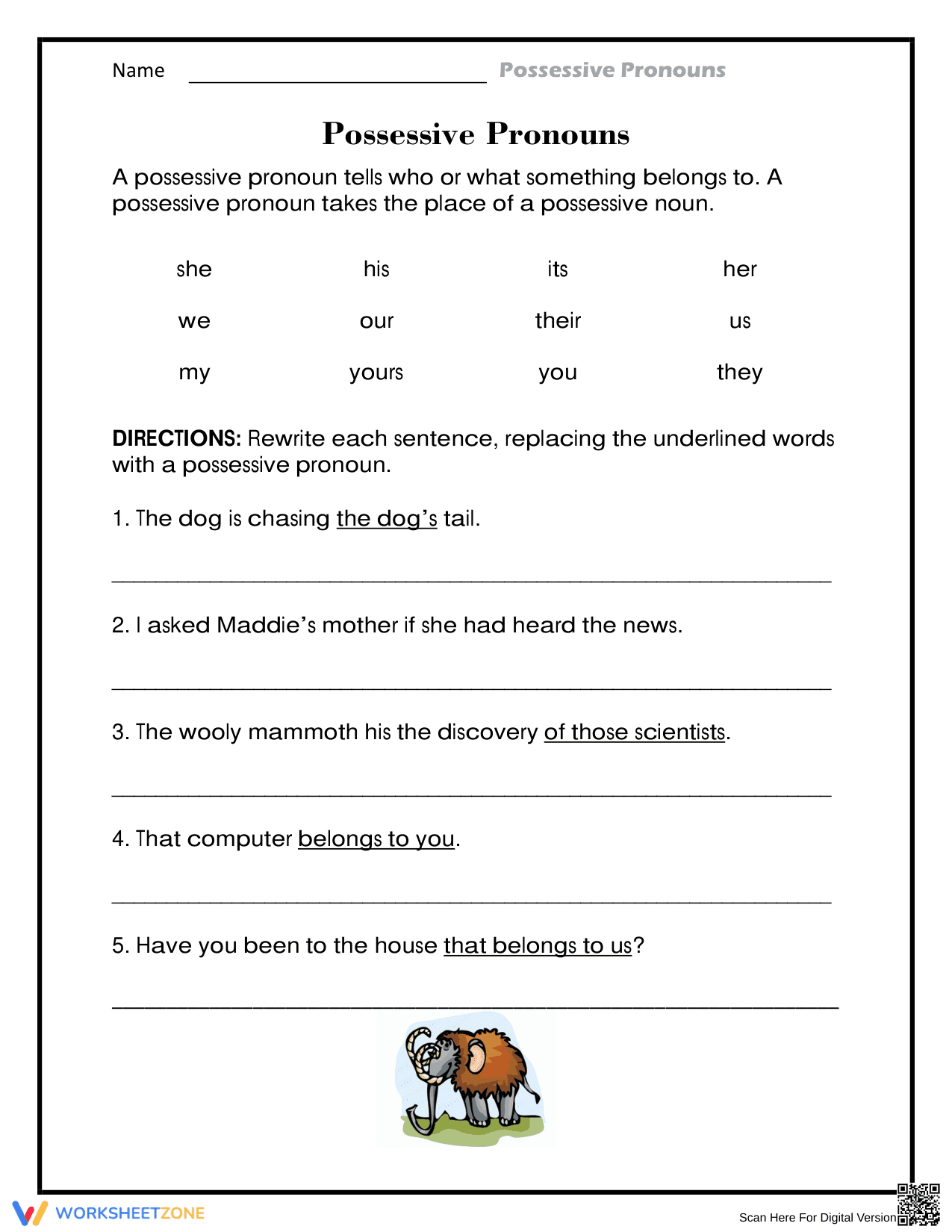

Essential Possessive Pronouns Worksheet | Grade 3 English

Paste this activity's link or code into your existing LMS (Google Classroom, Canvas, Teams, Schoology, Moodle, etc.).
Students can open and work on the activity right away, with no student login required.
You'll still be able to track student progress and results from your teacher account.
Master the mechanics of ownership with this focused possessive pronouns worksheet. Students practice replacing possessive nouns and phrases with the correct pronouns to improve sentence flow and grammatical accuracy. This activity ensures learners understand how words like "his," "her," and "their" function within complex sentences, leading to clearer writing and stronger reading comprehension skills.
At a Glance
- Grade: 3 · Subject: ELA
- Standard:
CCSS.ELA-LITERACY.L.3.1.A— Use possessive pronouns to explain the function of words in sentences accurately- Skill Focus: Possessive Pronouns
- Format: 1 page · 5 problems · Answer key included · PDF
- Best For: Grammar drills and quick sub plans
- Time: 10–15 minutes
This printable one-page worksheet features a helpful word bank and a clear definition of possessive pronouns at the top. Students encounter five sentence-level challenges where they must rewrite the entire sentence, replacing underlined possessive phrases (like "the dog's" or "discovery of those scientists") with the appropriate pronoun. A full answer key is provided for rapid grading and immediate student feedback.
This zero-prep workflow is designed for busy educators. First, print the single PDF page in under 30 seconds. Next, distribute the sheet to your class for a 10-minute bell-ringer or independent practice session during your literacy block. Finally, review the answers as a group or collect the papers for a quick formative check, taking less than 2 minutes of teacher review time per class set.
This resource is aligned to CCSS.ELA-LITERACY.L.3.1.A, which requires students to explain the function of nouns, pronouns, and other parts of speech in particular sentences. By focusing on the specific role of possessive pronouns, it builds a foundation for more complex pronoun-antecedent agreement tasks. This standard code can be copied directly into lesson plans, IEP goals, or district curriculum mapping tools.
Use this worksheet as an exit ticket after a direct instruction lesson on grammar. Ask students to complete the five sentences independently, then observe if they correctly identify "its" for "the dog's" to check for common spelling and usage errors. It also serves as an excellent morning work task or a supplemental activity for literacy centers during small-group rotations when teacher time is limited.
This practice is ideal for third-grade students but provides valuable review for Grade 2 learners or Grade 4 students needing a grammar refresher. It is particularly helpful for English Language Learners (ELLs) who often struggle with the distinction between "its" and "it's." Pair this resource with a possessive pronouns anchor chart or a short reading passage for a complete lesson that targets written fluency.
According to RAND AIRS 2024, focused grammar practice that utilizes sentence-level manipulation is highly effective for internalizing the rules of possessive pronoun usage. This worksheet targets CCSS.ELA-LITERACY.L.3.1.A by requiring students to actively replace possessive nouns with pronouns, a skill that bridges the gap between basic identification and fluent writing. The five-task structure provides enough repetition to reinforce the concept without overwhelming the learner, making it a staple for classroom-ready instruction. Research from Fisher & Frey (2014) supports this gradual release approach, where students use a word bank to support independent application of a specific skill. By reducing teacher preparation to a simple print-and-go format, this resource maximizes instructional time and provides clear data on student mastery of ownership markers in English grammar. Teachers can confidently integrate this into any ELA curriculum to ensure students meet the linguistic demands of state standards.


