




























Views
Downloads

Being Flexible Worksheet | Essential Grade 6-8 SEL

Paste this activity's link or code into your existing LMS (Google Classroom, Canvas, Teams, Schoology, Moodle, etc.).
Students can open and work on the activity right away, with no student login required.
You'll still be able to track student progress and results from your teacher account.
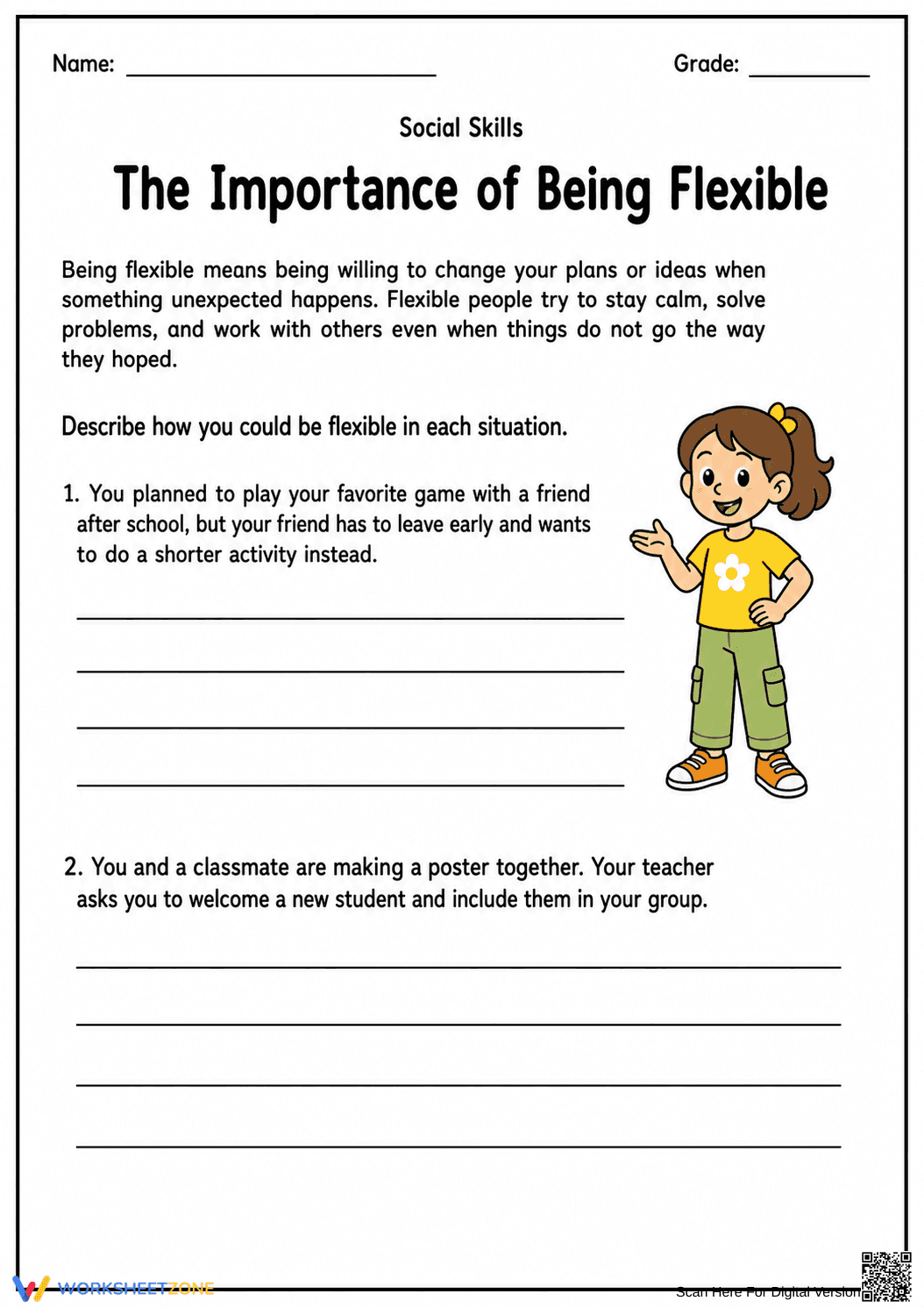
This Grade 6-8 social skills worksheet helps students master cognitive flexibility by navigating unexpected changes in social plans. By analyzing real-world scenarios, students learn to stay calm and adapt their expectations, fostering better peer relationships and emotional regulation. It provides a clear framework for understanding how to compromise when things do not go as planned.
At a Glance
- Grade: 6-8 · Subject: Social Skills
- Standard:
CCSS.ELA-LITERACY.SL.6.1— Engage effectively in a range of collaborative discussions and social interactions- Skill Focus: Cognitive flexibility and social adaptation
- Format: 1 page · 2 tasks · Open-response · PDF
- Best For: SEL blocks and advisory periods
- Time: 15–20 minutes
The worksheet features a concise, student-friendly definition of flexibility followed by two relatable middle school scenarios. Each scenario includes ample writing space for students to draft their responses. The layout is clean and distraction-free, featuring a supportive visual cue to engage younger middle schoolers while maintaining a focus on critical thinking and social problem-solving.
Zero-Prep Workflow
- Print: Select the single-page PDF and print enough copies for your class (30 seconds).
- Distribute: Hand out the worksheets during an advisory period or SEL block (1 minute).
- Review: Facilitate a 5-minute group discussion to share different flexible solutions (5 minutes).
Total teacher prep time is under 2 minutes, making this an ideal resource for busy educators or unexpected sub plans.
Standards Alignment
This resource aligns with `CCSS.ELA-LITERACY.SL.6.1`, which requires students to engage effectively in collaborative discussions and adapt to diverse perspectives. By reflecting on how to include new students or adjust plans with peers, students practice the foundational skills of social-emotional intelligence. This standard code can be copied directly into lesson plans, IEP goals, or district curriculum mapping tools.
How to Use It
Use this worksheet as a "Do Now" activity at the start of a social skills group to gauge students' baseline understanding of adaptation. It also serves as an effective formative assessment after a lesson on emotional regulation; observe whether students suggest compromises or simply "give in" to others. Completion typically takes 15 to 20 minutes depending on the depth of reflection.
Who It's For
This is designed for middle school students in general education, as well as those receiving Tier 2 social-emotional support or IEP services for social skills. It pairs naturally with an anchor chart on "Growth Mindset" or a direct instruction lesson on conflict resolution strategies.
According to Fisher & Frey (2014), the gradual release of responsibility in social-emotional learning requires students to move from understanding definitions to applying concepts in simulated scenarios. This worksheet facilitates that transition by providing a clear definition of flexibility followed by two structured prompts that mirror common middle school social challenges. By practicing these responses in a low-stakes environment, students build the cognitive pathways necessary for real-time social adaptation. Research from the RAND AIRS 2024 report emphasizes that explicit instruction in social skills, such as those aligned with CCSS.ELA-LITERACY.SL.6.1, significantly improves classroom climate and student engagement. This 1-page resource provides the necessary scaffolding for students to articulate flexible thinking patterns, a core component of executive functioning and long-term social success in academic and professional environments.


