


























Views
Downloads
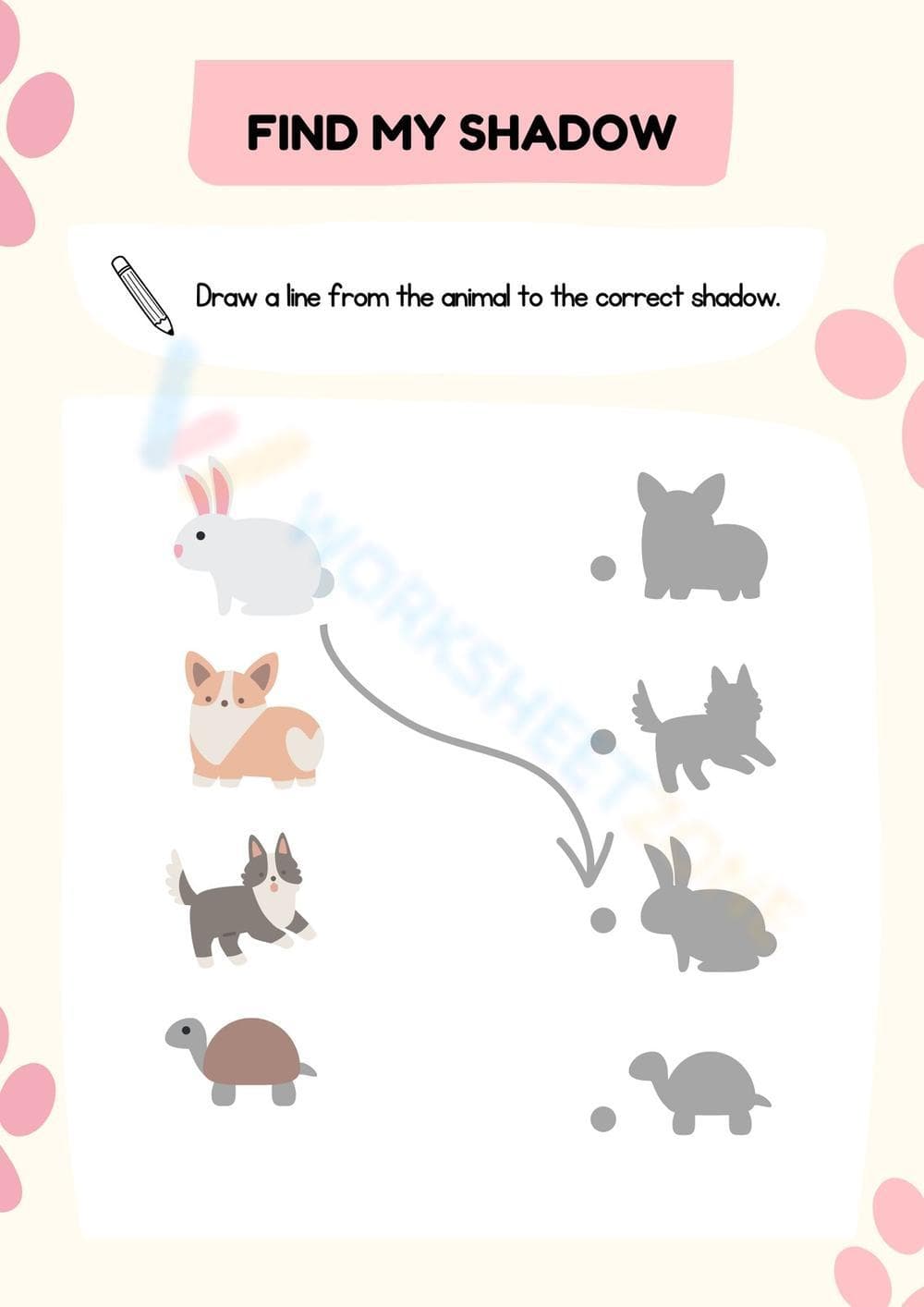

Pet Shadow Matching Worksheet | Printable Pre-K Ready
Paste this activity's link or code into your existing LMS (Google Classroom, Canvas, Teams, Schoology, Moodle, etc.).
Students can open and work on the activity right away, with no student login required.
You'll still be able to track student progress and results from your teacher account.
This Pre-K and Kindergarten shadow matching worksheet helps young learners develop essential visual discrimination skills by identifying animal silhouettes. Students observe four distinct pets—a rabbit, dog, cat, and turtle—and draw lines to their corresponding shadows. This activity strengthens the ability to recognize shapes and patterns, which is a foundational precursor to letter and number recognition.
At a Glance
At a Glance
- Grade: Pre-K–K · Subject: Early Learning
- Standard:
CCSS.MATH.CONTENT.K.G.B.4— Analyze and compare two- and three-dimensional shapes in different sizes and orientations- Skill Focus: Visual discrimination and shape matching
- Format: 1 page · 4 problems · Answer key not included · PDF
- Best For: Morning work or early finisher activity
- Time: 5–10 minutes
What's Inside
Inside this single-page PDF, you will find a clean, pet-themed layout featuring high-contrast illustrations. The worksheet includes four colorful animal icons on the left and their corresponding gray-scale shadows on the right. A clear instructional prompt and a pencil icon guide students to draw lines connecting the pairs, making it accessible even for non-readers.
Zero-Prep Workflow
The zero-prep workflow is designed for busy educators. First, print the single-page PDF (30 seconds). Second, distribute the sheets to students during center rotations or as a quiet-time activity (1 minute). Third, review the completed matches with the class to reinforce vocabulary and observation skills (30 seconds). Total teacher preparation time is under two minutes, making it an ideal sub-plan filler.
Standards Alignment
This resource aligns with `CCSS.MATH.CONTENT.K.G.B.4`, which requires students to analyze and compare two- and three-dimensional shapes in different sizes and orientations. By identifying the unique contours of each animal shadow, students practice spatial reasoning and geometric observation. This standard code can be copied directly into lesson plans, IEP goals, or district curriculum mapping tools.
How to Use It
Use this worksheet as a formative assessment during a unit on pets or light and shadows. Observe if students can distinguish between the similar silhouettes of the dog and cat, which indicates advanced visual processing. It also serves as an excellent sub plan filler or a calming transition activity after recess. Completion typically takes 5 to 10 minutes.
Who It's For
This activity is ideal for preschool and kindergarten students, including those receiving occupational therapy for fine motor development. It pairs naturally with a classroom read-aloud about pets or a science lesson on how shadows are formed. The soft beige and pink aesthetic provides a low-stimulation environment for neurodivergent learners.
Research from Fisher & Frey (2014) emphasizes that visual discrimination tasks are critical for early literacy, as the ability to distinguish between complex shapes directly correlates with the ability to differentiate between similar graphemes like 'b' and 'd'. This worksheet targets CCSS.MATH.CONTENT.K.G.B.4 by requiring students to analyze the orientation and specific features of animal silhouettes. By engaging in these 4 matching tasks, students build the cognitive pathways necessary for pattern recognition and spatial awareness. According to the NAEP, early exposure to geometric reasoning through shape comparison provides a significant advantage in later mathematical proficiency. This printable resource offers a structured, low-stakes environment for students to practice these high-leverage skills. The clear, high-contrast design ensures that the visual demands are appropriate for the developmental stage of Pre-K and Kindergarten learners, making it a reliable tool for both general education and early intervention settings.


