


























Views
Downloads

Grade 1 Animal Adaptations — Printable No-Prep Worksheet
Paste this activity's link or code into your existing LMS (Google Classroom, Canvas, Teams, Schoology, Moodle, etc.).
Students can open and work on the activity right away, with no student login required.
You'll still be able to track student progress and results from your teacher account.
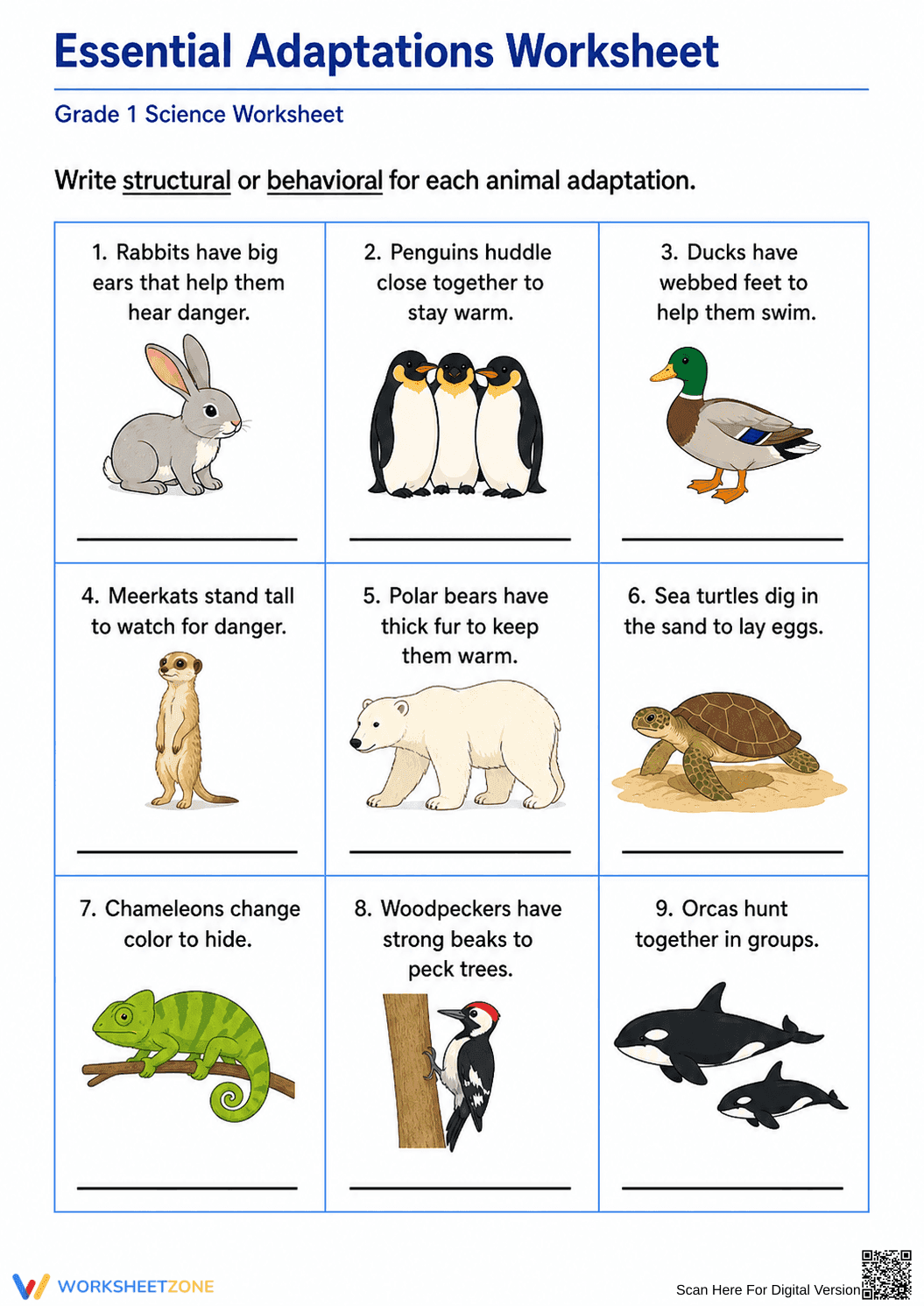
This Grade 1 science worksheet helps students distinguish between behavioral and structural adaptations to understand how animals survive in their habitats. By categorizing specific traits and actions, young learners build a foundational understanding of biological survival strategies and physical characteristics.
At a Glance
- Grade: 1 · Subject: Science
- Standard:
1-LS1-1— Identify animal parts and actions used for survival- Skill Focus: Behavioral and Structural Adaptations
- Format: 2 pages · 9 problems · Answer key included · PDF
- Best For: Independent practice or sub plans
- Time: 15–20 minutes
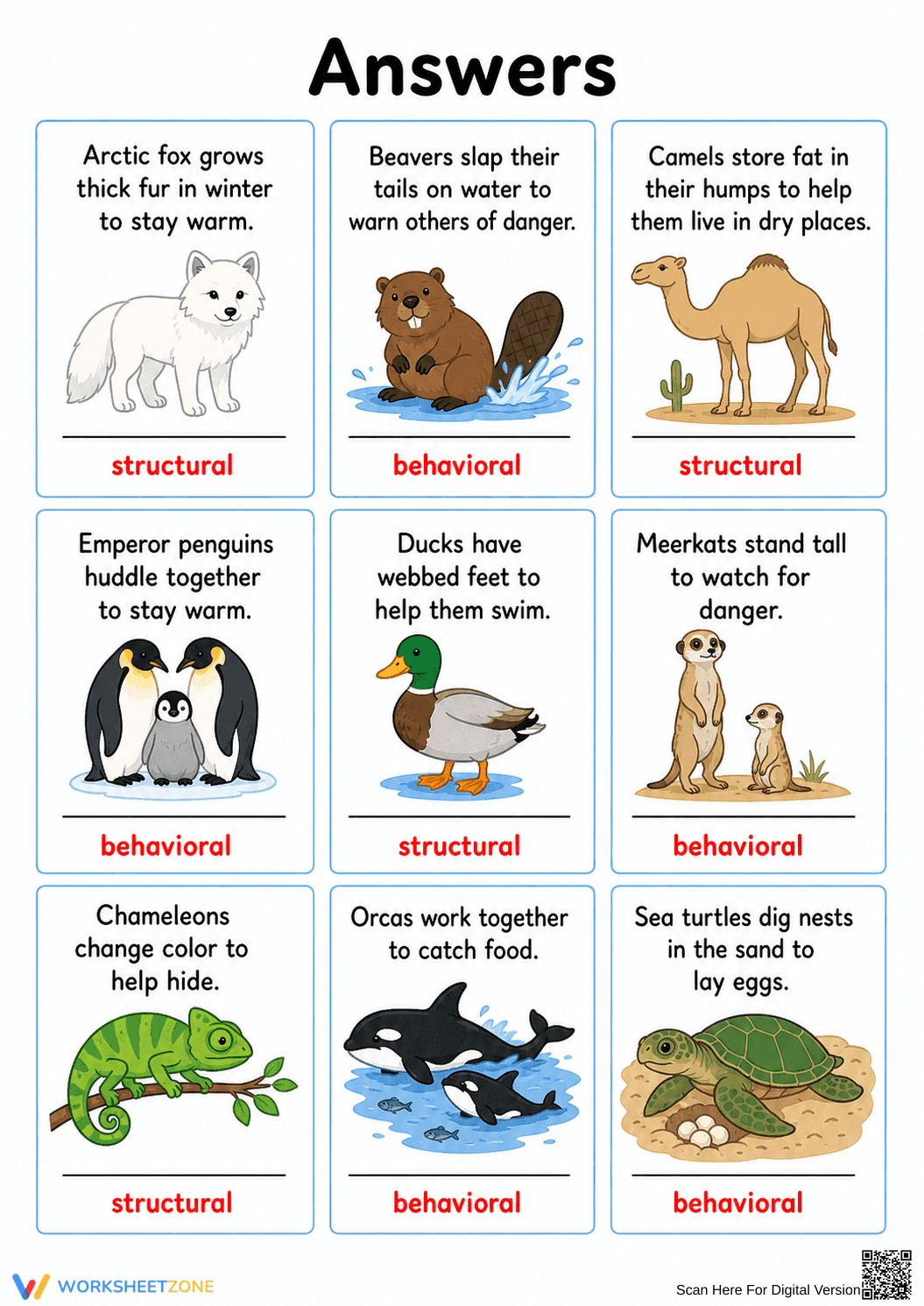
This two-page PDF includes a nine-item identification task and a full answer key. Each problem features an animal illustration paired with a brief text description of a specific trait, such as a duck's webbed feet or a meerkat's alert posture. The layout is clean and spacious, providing ample room for students to write responses.
The zero-prep design allows for rapid classroom implementation:
- Print (1 minute): Select the two-page PDF and print enough copies for your group.
- Distribute (1 minute): Hand out the single-page worksheet to students as a bell-ringer or independent practice.
- Review (2 minutes): Use the included answer key to project the correct responses for a quick whole-class check.
Total teacher preparation time is under three minutes, making this an ideal resource for busy mornings or sub-plan binders.
Primary alignment: 1-LS1-1. This standard requires students to use materials to design a solution to a human problem by mimicking how plants and/or animals use their external parts to help them survive, grow, and meet their needs. This worksheet provides the essential first step: identifying those survival-based parts and actions. A supporting alignment to K-2-ETS1-2 connects these biological observations to early engineering design principles. Both standard codes can be copied directly into lesson plans, IEP goals, or district curriculum mapping tools.
Utilize this resource during the "Explore" phase of a 5E lesson cycle on living things. Use it as a formative assessment after direct instruction on physical traits versus instincts. For a quick observation tip, watch for students who confuse physical features with specific actions; this indicates a need for concrete examples. Expected completion time is 15 to 20 minutes.
This worksheet is designed for first-grade students, but the high-interest animal facts and clear visuals make it accessible for English Language Learners (ELL) and students with IEP accommodations. It pairs naturally with a short video on animal habitats or a non-fiction passage about desert survival. The scaffolded text descriptions ensure that students can focus on the scientific classification rather than decoding complex vocabulary.
According to the RAND AIRS 2024 analysis of primary science education, the early introduction of classification tasks—specifically distinguishing between physical structures and behavioral patterns—is a critical predictor of later success in biological sciences. This worksheet bridges the gap between simple observation and scientific categorization by requiring students to justify their choices based on observable evidence. By engaging with nine distinct animal examples, students internalize the pattern of adaptation as a universal biological principle rather than an isolated fact. The use of standards-aligned identification tasks like 1-LS1-1 to identify animal parts and actions used for survival ensures that classroom time is spent on high-leverage content that builds toward NGSS mastery. This resource serves as a foundational tool for developing the analytical skills necessary for students to eventually design bio-mimicry solutions to complex human problems, as outlined in the broader K-12 science framework.


