


























Views
Downloads

Printable Beginning Sounds Worksheet | Preschool Phonics
Paste this activity's link or code into your existing LMS (Google Classroom, Canvas, Teams, Schoology, Moodle, etc.).
Students can open and work on the activity right away, with no student login required.
You'll still be able to track student progress and results from your teacher account.
This foundational phonics worksheet helps preschool students master the critical literacy skill of initial phoneme isolation through engaging visual cues. By identifying the starting letters of common objects, learners build the phonological awareness necessary for early reading success. This resource provides a structured path for students to connect sounds to symbols accurately.
At a Glance
- Grade: Preschool · Subject: English Language Arts
- Standard:
CCSS.ELA-LITERACY.RF.K.2.D— Isolate and pronounce the initial sounds in simple spoken words- Skill Focus: Beginning sound identification and phoneme-grapheme mapping
- Format: 2 pages · 6 problems · Answer key included · PDF
- Best For: Initial phonics instruction and morning work
- Time: 10–15 minutes
What's Inside
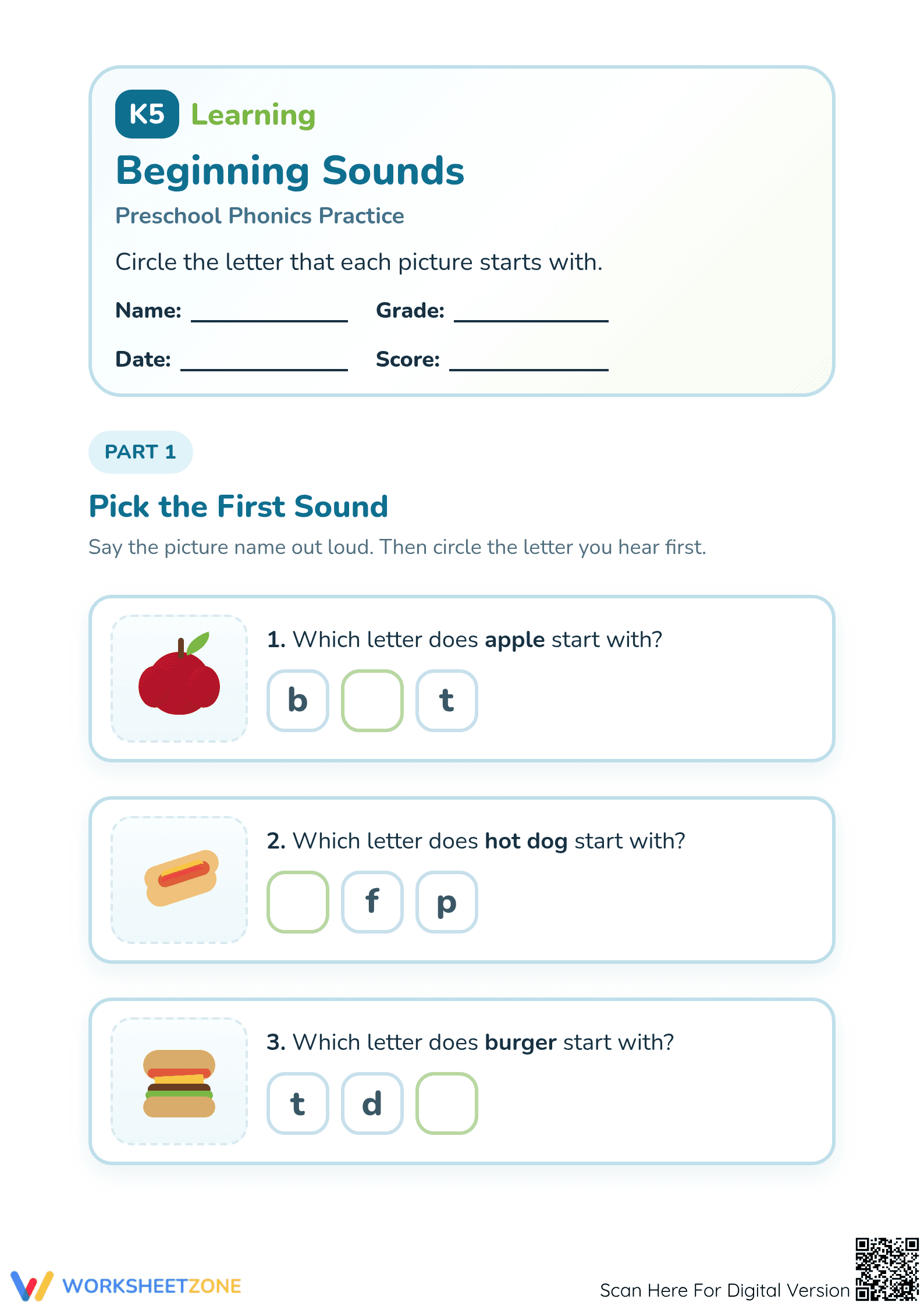
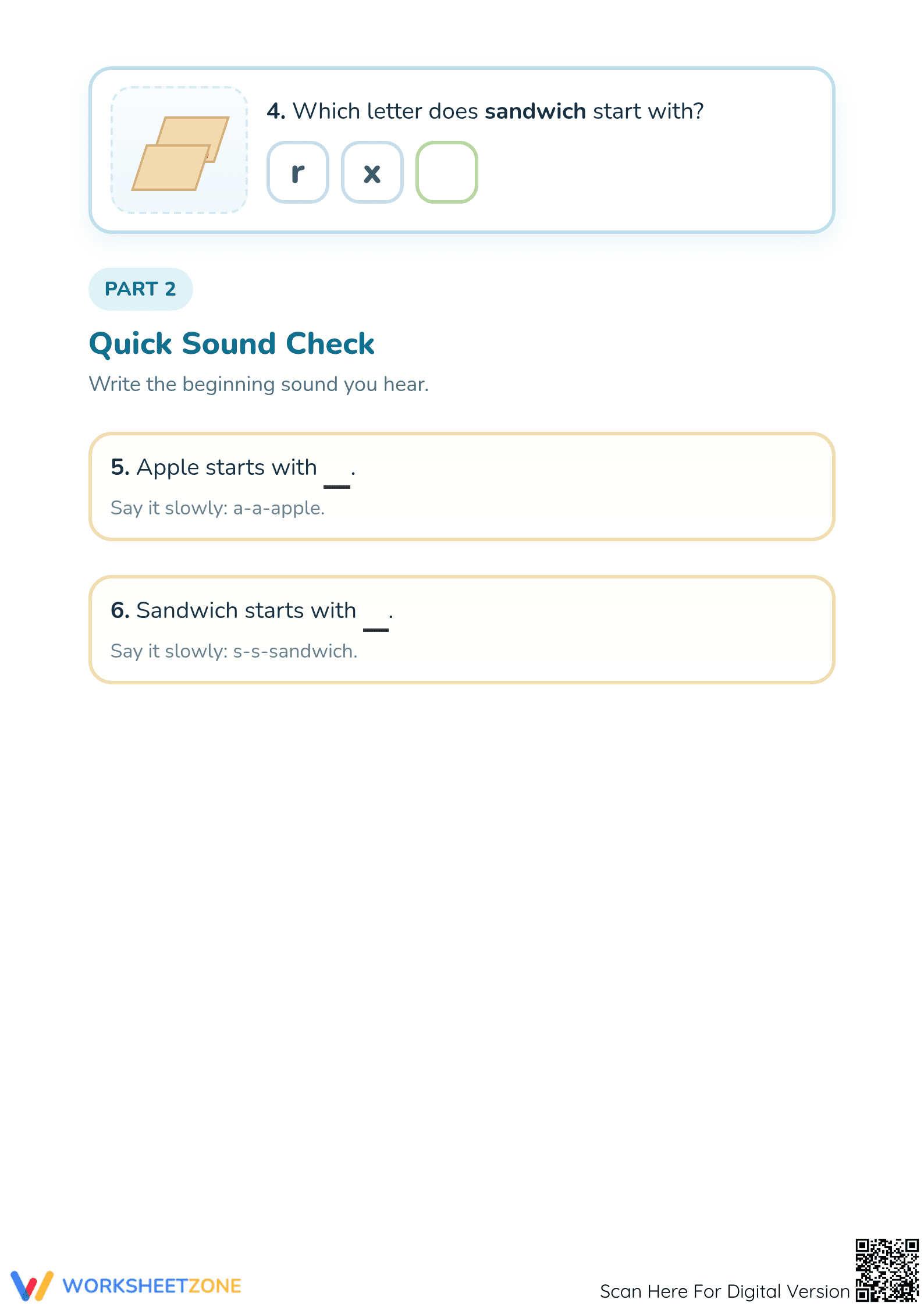
This 2-page PDF features 6 targeted phonics tasks designed for early learners. The first page presents multiple-choice identification where students circle the correct starting letter for objects like an apple and a burger. The second page transitions to a "Quick Sound Check," requiring students to write the beginning letter they hear. A full answer key ensures easy grading and immediate feedback.
Skill Progression
- Guided practice: Students begin by looking at high-quality images paired with the object's name, providing a strong visual-verbal connection for the first 4 problems.
- Supported practice: Multiple-choice letter options limit the field of possibilities, allowing students to use elimination strategies to find the correct initial sound.
- Independent practice: The final section removes the scaffolding of choice, challenging students to recall and write the letter associated with the sound they hear during a "say it slowly" exercise.
This progression follows a gradual-release model, moving from recognition to production.
Standards Alignment
The primary focus is CCSS.ELA-LITERACY.RF.K.2.D, which requires students to isolate and pronounce the initial sounds in spoken words. This worksheet directly supports this by requiring phoneme segmentation followed by grapheme selection. Both standard codes can be copied directly into lesson plans, IEP goals, or district curriculum mapping tools.
How to Use It
Use this worksheet as a formative assessment after introducing the alphabet. During small group instruction, have students "say the picture name out loud" as instructed to observe if they can clearly articulate the initial phoneme before circling. It also serves as a perfect independent center activity for students who have mastered basic letter-sound correspondence.
Who It's For
This resource is tailored for preschool and early kindergarten students who are just beginning their phonological journey. It provides necessary support for English Language Learners (ELLs) by pairing common vocabulary with clear images. Pair this worksheet with a beginning sounds anchor chart or a letter-of-the-week read-aloud to reinforce these early literacy concepts.
Phonological awareness is the strongest predictor of later reading achievement, and isolating initial phonemes is a foundational milestone in this development. According to Fisher & Frey (2014), the gradual release of responsibility—moving from teacher-led identification to independent student production—is essential for internalizing these literacy concepts. This worksheet aligns with CCSS.ELA-LITERACY.RF.K.2.D by providing 6 structured tasks that transition students from recognizing a beginning sound among options to independently writing the corresponding letter. By utilizing visual prompts such as an apple or a burger, the resource anchors abstract sounds to concrete objects, facilitating the phoneme-grapheme mapping required for decoding. Research from NAEP suggests that early intervention in phonics significantly improves long-term literacy outcomes. This 2-page printable ensures that preschool learners have the necessary repetitions to achieve mastery in initial sound isolation, providing a clear evidence base for classroom instruction or supplemental home practice.


