


























Views
Downloads

Printable Beginning Sounds Worksheet | Preschool ELA
Paste this activity's link or code into your existing LMS (Google Classroom, Canvas, Teams, Schoology, Moodle, etc.).
Students can open and work on the activity right away, with no student login required.
You'll still be able to track student progress and results from your teacher account.
Identifying initial sounds is the foundation of phonemic awareness. This printable worksheet helps preschool learners connect spoken words to written letters by focusing on beginning sounds. Through engaging visual prompts, students practice isolating the first sound they hear, a critical precursor to decoding success in any early childhood literacy curriculum.
At a Glance
- Grade: Preschool · Subject: ELA
- Standard:
CCSS.ELA-LITERACY.RF.K.3.A— Produce primary letter-sound correspondences for initial phonemes- Skill Focus: Beginning Sounds
- Format: 3 pages · 4 problems · Answer key included · PDF
- Best For: Initial phonemic awareness and sound matching
- Time: 10–15 minutes
What's Inside
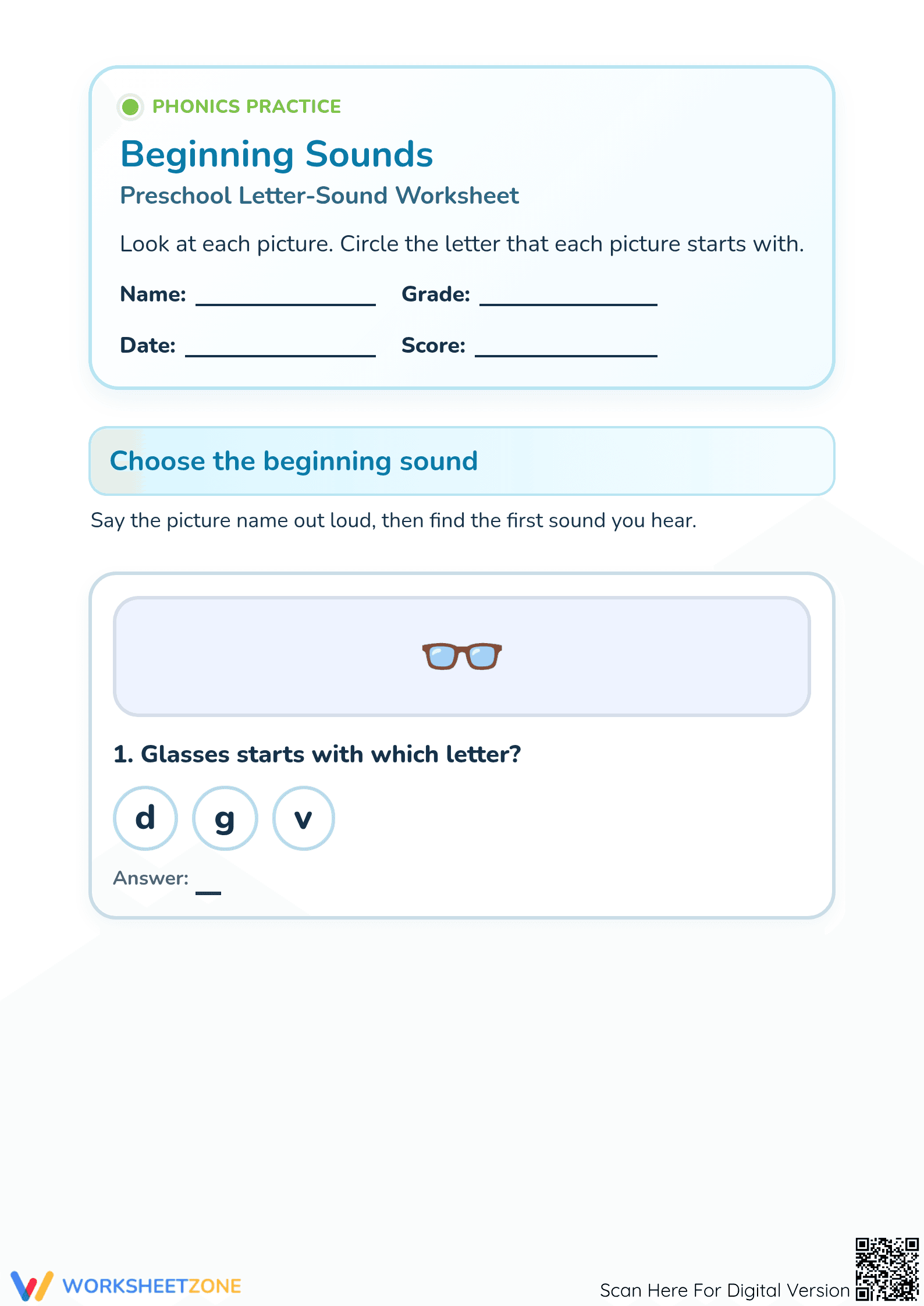
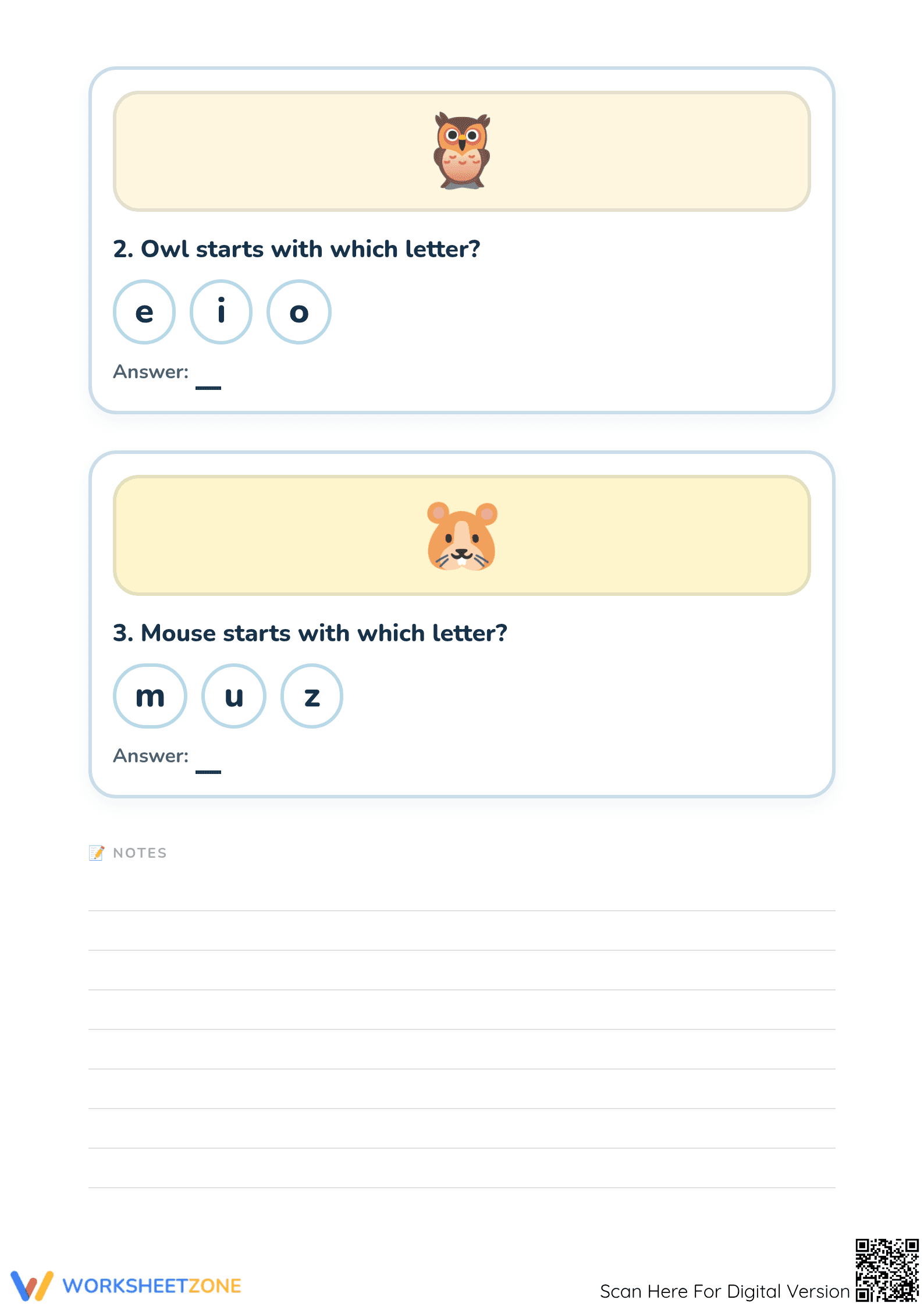
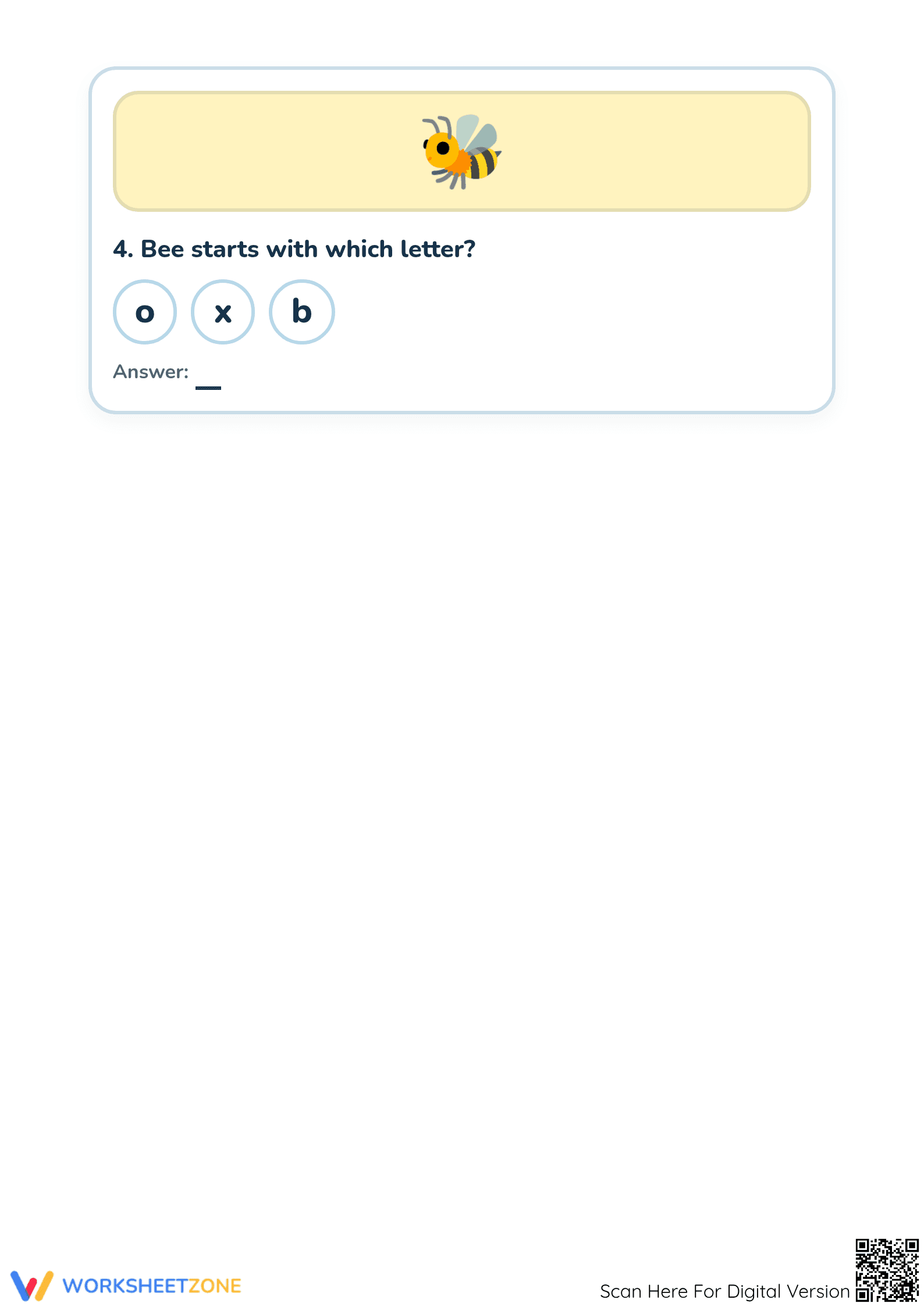
This resource contains three pages of focused phonics practice. Each of the four tasks features a large, clear emoji-style image, such as glasses, an owl, a mouse, and a bee, paired with a multiple-choice selection of letters. The structured layout includes a dedicated notes section for teacher observations or student dictation, and a full answer key is provided for immediate feedback.
Skill Progression
- Guided Practice: The worksheet begins with recognizable objects like "glasses" to build confidence through familiar vocabulary and phonemes.
- Supported Practice: Tasks 2 and 3 introduce animal sounds, encouraging students to elongate the initial phoneme before selecting the letter.
- Independent Practice: The final task requires students to independently apply their knowledge of the "b" sound, solidifying the letter-sound link.
This progression follows the gradual-release model, moving from high-support modeling to independent phoneme isolation.
Standards Alignment
This worksheet is primarily aligned to CCSS.ELA-LITERACY.RF.K.3.A, which requires students to demonstrate basic knowledge of letter-sound correspondences. By producing the primary sound for each consonant, students build the necessary scaffolding for future blending tasks. This standard code can be copied directly into lesson plans, IEP goals, or district curriculum mapping tools.
How to Use It
Use this worksheet during small-group literacy centers after direct instruction on initial sounds. As students work, observe if they are physically "catching" the sound before circling the letter. Alternatively, assign it as a quick formative assessment to gauge which students are ready for ending sounds. The expected completion time is under fifteen minutes.
Who It's For
This resource is designed for preschool and early kindergarten students who are just beginning their phonics journey. It is particularly effective for English Language Learners who benefit from the clear visual-to-word associations. Pair this with a read-aloud or a beginning sounds anchor chart for a comprehensive literacy experience.
Phonics instruction in the early years hinges on the systematic development of phonemic awareness, specifically the ability to isolate initial phonemes. Research by Fisher & Frey (2014) emphasizes the importance of the gradual release of responsibility, where visual scaffolds and clear modeling lead to student mastery. This resource aligns with CCSS.ELA-LITERACY.RF.K.3.A by providing a structured environment for students to practice letter-sound correspondences. By focusing on 4 high-frequency initial sounds across 3 pages, the worksheet ensures cognitive load is managed for preschool learners while providing enough rigor to meet foundational ELA standards. This approach is consistent with NAEP findings that highlight the correlation between early initial sound mastery and later reading fluency. Teachers can use this printable to document student progress toward phonics goals, ensuring a data-driven approach to early childhood literacy instruction.


