


























Views
Downloads

Printable Beginning Letter Sounds Worksheet | K Aligned
Paste this activity's link or code into your existing LMS (Google Classroom, Canvas, Teams, Schoology, Moodle, etc.).
Students can open and work on the activity right away, with no student login required.
You'll still be able to track student progress and results from your teacher account.
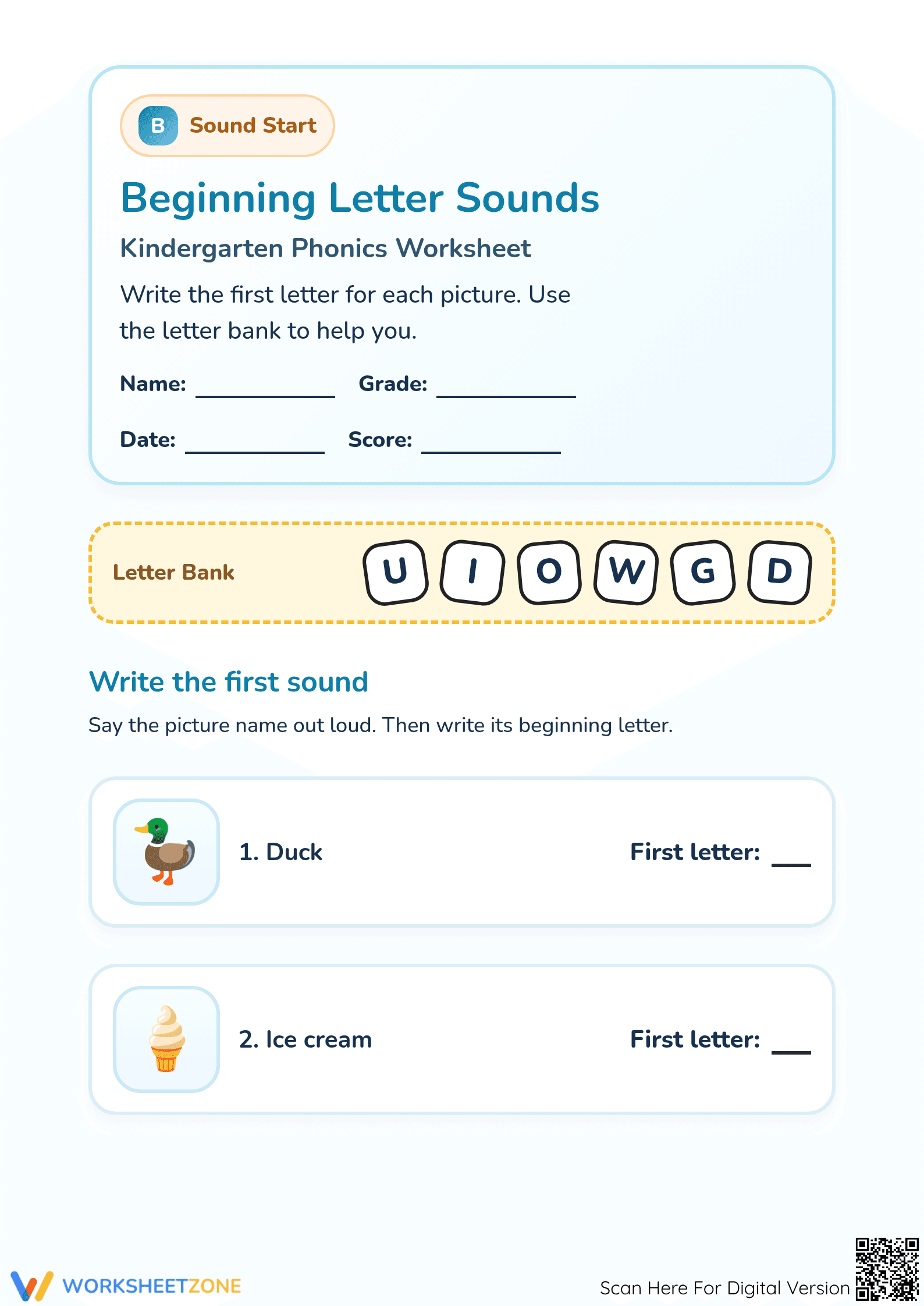
This Grade K phonics worksheet helps young learners master initial letter-sound correspondences through engaging visual cues. Students identify the first sound of common objects and write the corresponding letter. This essential practice builds the foundational decoding skills necessary for early literacy success and reading fluency.
At a Glance
- Grade: Kindergarten · Subject: ELA Phonics
- Standard:
CCSS.ELA-LITERACY.RF.K.3.A— Identify the common sounds that letters represent in spoken words- Skill Focus: Initial letter sound identification
- Format: 2 pages · 6 problems · Answer key included · PDF
- Best For: Independent morning work or phonics centers
- Time: 10–15 minutes
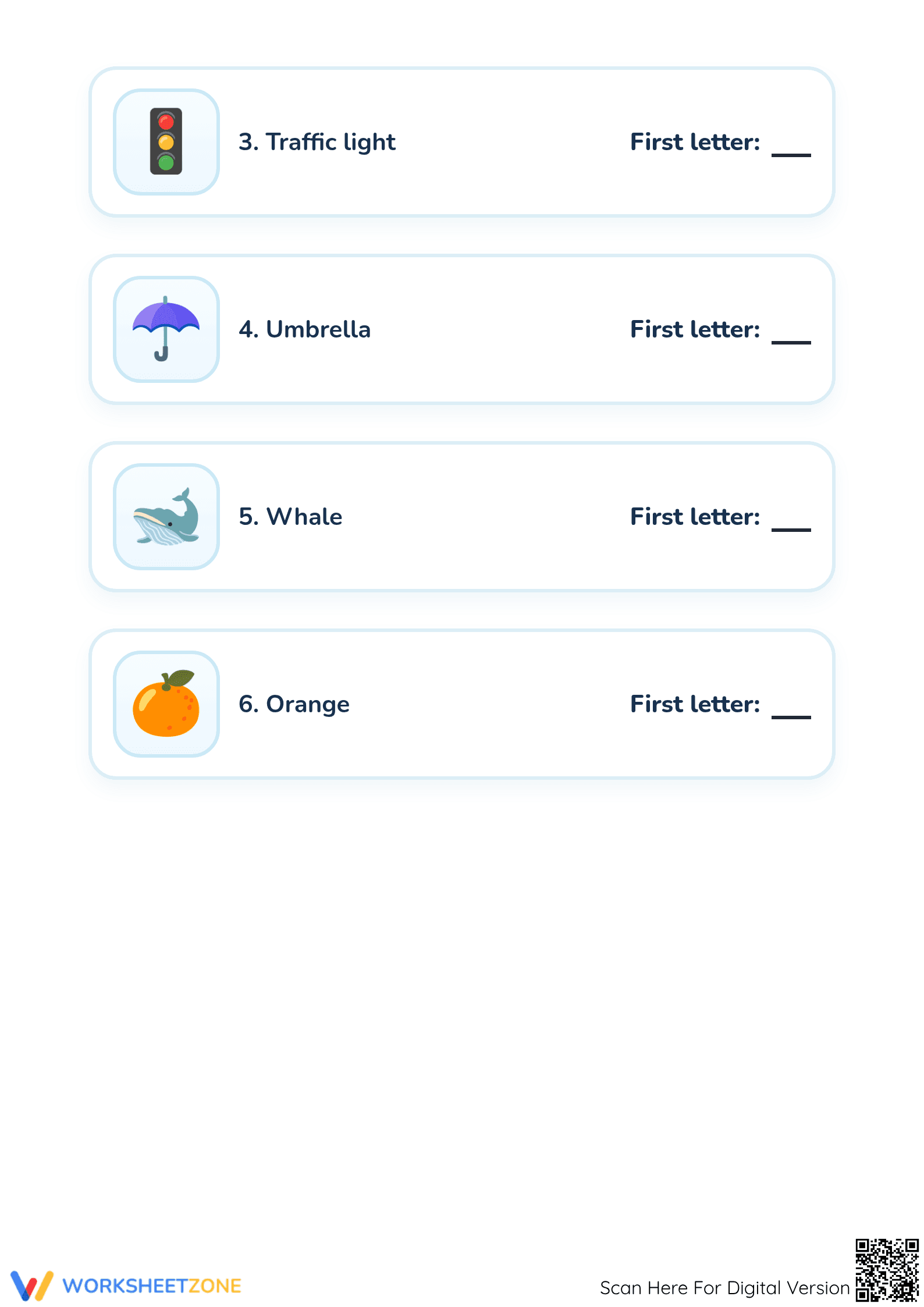
This two-page PDF includes six structured exercises featuring vibrant illustrations of familiar items like a duck, ice cream, and a whale. A clear letter bank at the top of the first page provides visual support, making this an ideal scaffolded activity. The worksheet includes a full answer key for easy checking.
- Guided Practice: The worksheet begins with clear instructions and a letter bank containing all required characters (U, I, O, W, G, D) to reduce cognitive load.
- Supported Practice: Students encounter high-frequency words and distinct beginning sounds, using the provided lines to practice proper letter formation.
- Independent Practice: The final set of problems requires them to independently recall letter-sound pairings after initial guided success.
This structure follows a gradual-release model of "I Do, We Do, You Do" to ensure student confidence and mastery.
This resource aligns with CCSS.ELA-LITERACY.RF.K.3.A, which requires students to demonstrate basic knowledge of one-to-one letter-sound correspondences by producing the primary sound or many of the most frequent sounds for each consonant. Both standard codes can be copied directly into lesson plans, IEP goals, or district curriculum mapping tools.
Assign this worksheet during the "You Do" phase of a phonics lesson to evaluate individual student mastery of beginning sounds. Alternatively, use it as a quick formative assessment; observe if students need to reference the letter bank or if they can produce the letters independently. Expected completion time is 10–15 minutes.
Designed for Kindergarten students and advanced preschoolers, this resource is perfect for learners needing targeted phonics support. It pairs naturally with an alphabet anchor chart or a "letter of the week" direct instruction lesson to reinforce letter-sound relationships through visual association.
According to the RAND AIRS (2024) report on foundational literacy development, explicit and systematic instruction in letter-sound correspondence is a critical and necessary predictor of later reading achievement across all student populations. This Grade K worksheet directly targets CCSS.ELA-LITERACY.RF.K.3.A by providing students with repeated, high-quality opportunities to map phonemes to graphemes in a highly structured and supportive environment. Research from Fisher & Frey (2014) emphasizes that scaffolded practice, such as the included letter bank, supports the gradual release of responsibility and promotes self-regulation in early writers. By isolating the initial sound of common objects, students can focus entirely on the specific phonological awareness skill of onset identification without the cognitive distraction of complex multi-syllabic word structures. This pedagogical approach ensures that young learners build the phonemic strength required for more advanced blending, segmenting, and decoding tasks encountered later in the academic year. Educators can utilize this resource to confirm that students have internalized the one-to-one correspondence needed for literacy fluency.


