


























Views
Downloads

Printable Beginning Letter Sounds Worksheet: Preschool Phonics
Paste this activity's link or code into your existing LMS (Google Classroom, Canvas, Teams, Schoology, Moodle, etc.).
Students can open and work on the activity right away, with no student login required.
You'll still be able to track student progress and results from your teacher account.
This Beginning Letter Sounds worksheet helps preschool and kindergarten students master initial phoneme identification by connecting visual images to their corresponding letters. Students practice sounding out words and selecting the correct starting letter from a provided bank, building a strong foundation for early literacy and phonemic awareness skills.
At a Glance
- Grade: Preschool · Subject: ELA Phonics
- Standard:
CCSS.ELA-LITERACY.RF.K.3.A— Demonstrate basic knowledge of one-to-one letter-sound correspondences- Skill Focus: Initial letter sound identification
- Format: 2 pages · 6 problems · Answer key included · PDF
- Best For: Early phonics practice and letter-sound matching
- Time: 10–15 minutes
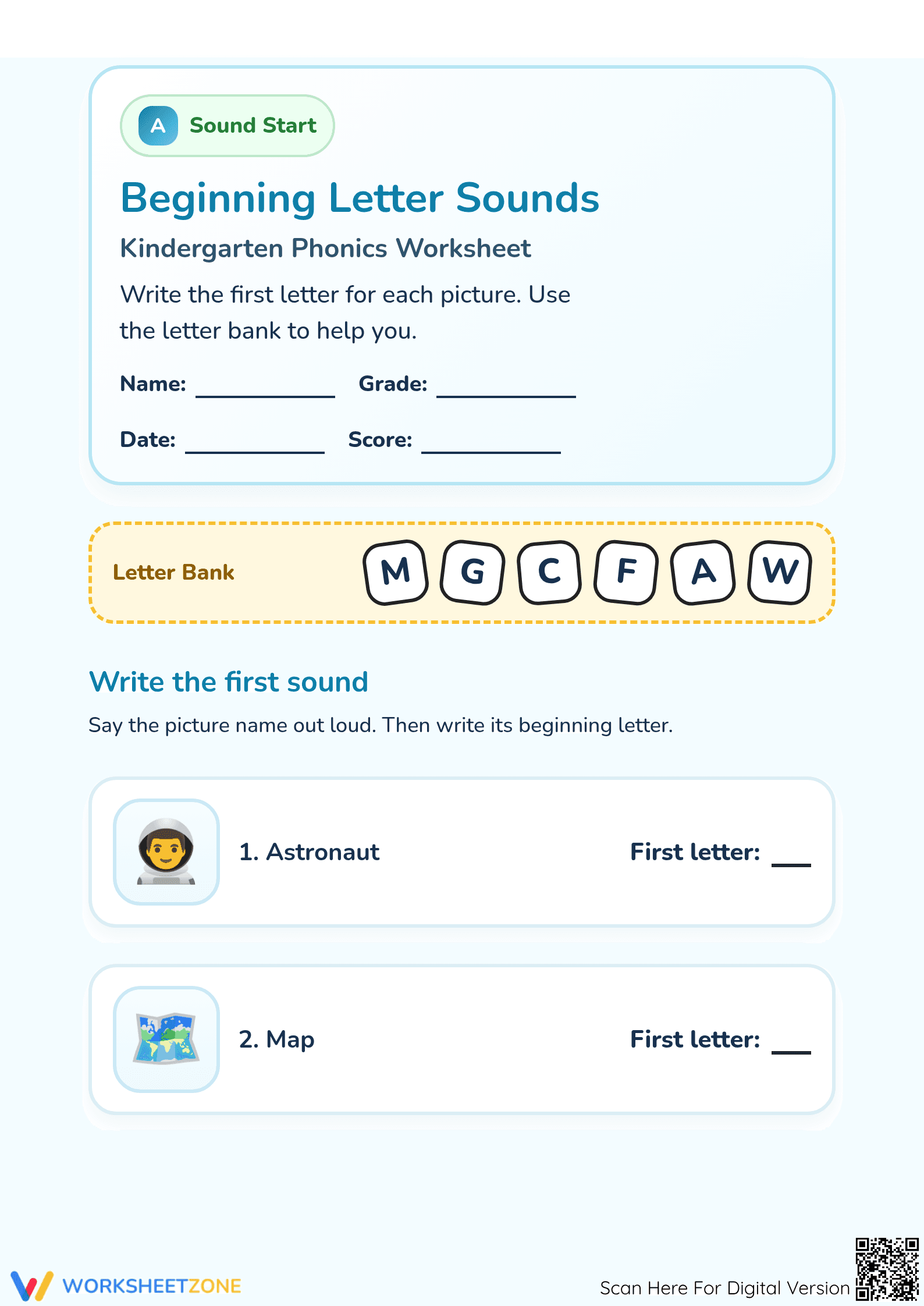
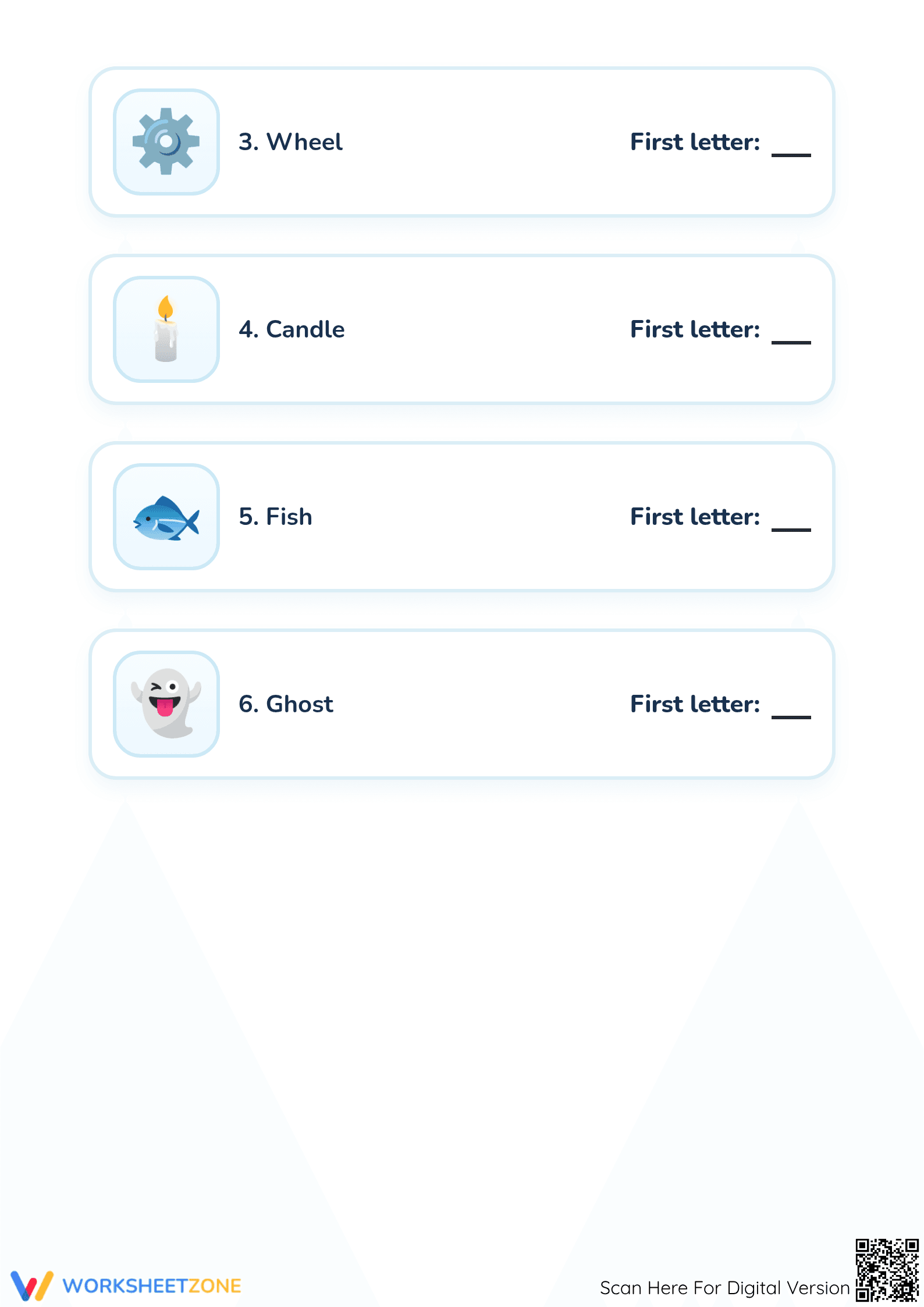
The worksheet contains two pages of interactive phonics practice. It features a helpful letter bank (M, G, C, F, A, W) at the top of the first page to scaffold student success. Across the six tasks, children encounter clear icons representing common objects—such as an astronaut, map, and wheel—with dedicated space to write the corresponding first letter for each word.
Skill Progression
- Guided Practice: The teacher introduces the letter bank and models the "Say it, Hear it, Write it" process, demonstrating how to isolate the initial sound of 'Astronaut'.
- Supported Practice: Students work through items with verbal prompts, using the letter bank to narrow down choices for 'Map' and 'Wheel' with teacher guidance.
- Independent Practice: Learners complete the remaining tasks on page two, identifying the beginning sounds for 'Candle', 'Fish', and 'Ghost' autonomously.
This progression follows a gradual-release model, moving from shared observation to independent phonetic application through a focused six-problem sequence.
Standards Alignment
This resource is aligned to CCSS.ELA-LITERACY.RF.K.3.A, which requires students to demonstrate basic knowledge of one-to-one letter-sound correspondences by producing the primary sound for consonants. It also supports CCSS.ELA-LITERACY.RF.K.1.D regarding letter recognition and alphabetical order application. Both standard codes can be copied directly into lesson plans, IEP goals, or district curriculum mapping tools.
How to Use It
Assign this worksheet during the independent practice phase of a phonics lesson after introducing the letters M, G, C, F, A, and W. For a formative-assessment tip, observe students as they say the word 'Ghost'—if they struggle to isolate the back-of-the-throat sound, provide a mirror so they can see their mouth movement. This activity typically takes 10 to 15 minutes to complete in a standard classroom setting.
Who It's For
This printable is designed for preschool and kindergarten students beginning their journey with phonics. It is particularly effective for English Language Learners who need visual cues to build vocabulary alongside sound recognition. This resource pairs naturally with alphabet anchor charts or a read-aloud focused on initial consonant sounds during a whole-group literacy block.
The development of initial phoneme isolation is a critical predictor of later reading success in early childhood education. This worksheet targets CCSS.ELA-LITERACY.RF.K.3.A by requiring students to map the spoken sound of a word to its written grapheme. By utilizing a letter bank and familiar imagery, the resource reduces cognitive load while focusing specifically on the skill of initial sound identification. According to the NAEP framework for reading, early exposure to structured phonics practice significantly improves word recognition speed and accuracy. Fisher & Frey (2014) emphasize that providing visual scaffolds, such as the icons in this 6-problem set, allows students to engage in higher-level phonetic analysis before they have fully mastered decoding entire words. This zero-prep PDF provides a practical application of the gradual release of responsibility, moving students toward mastery in a 15-minute instructional block.


