


























Views
Downloads
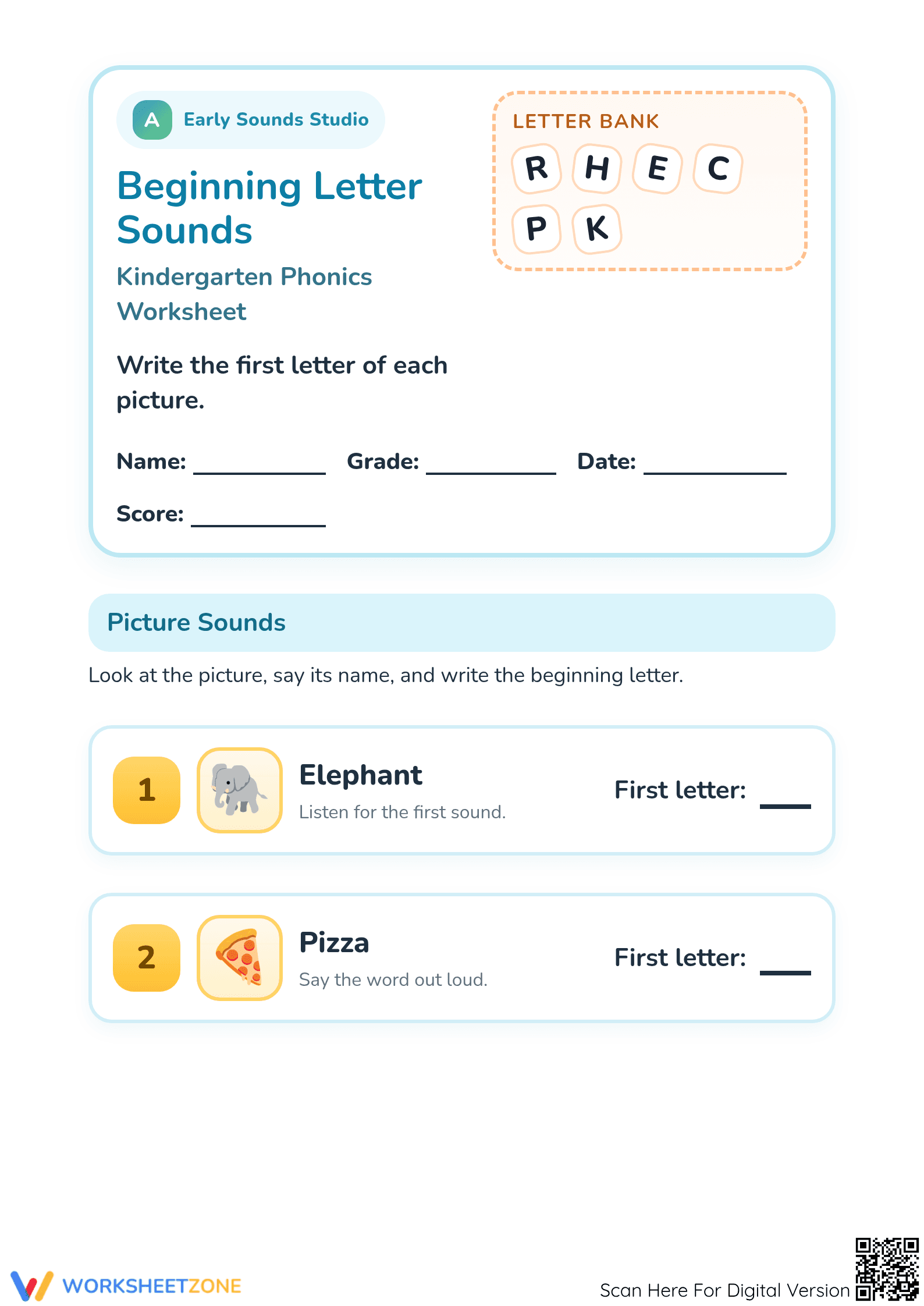
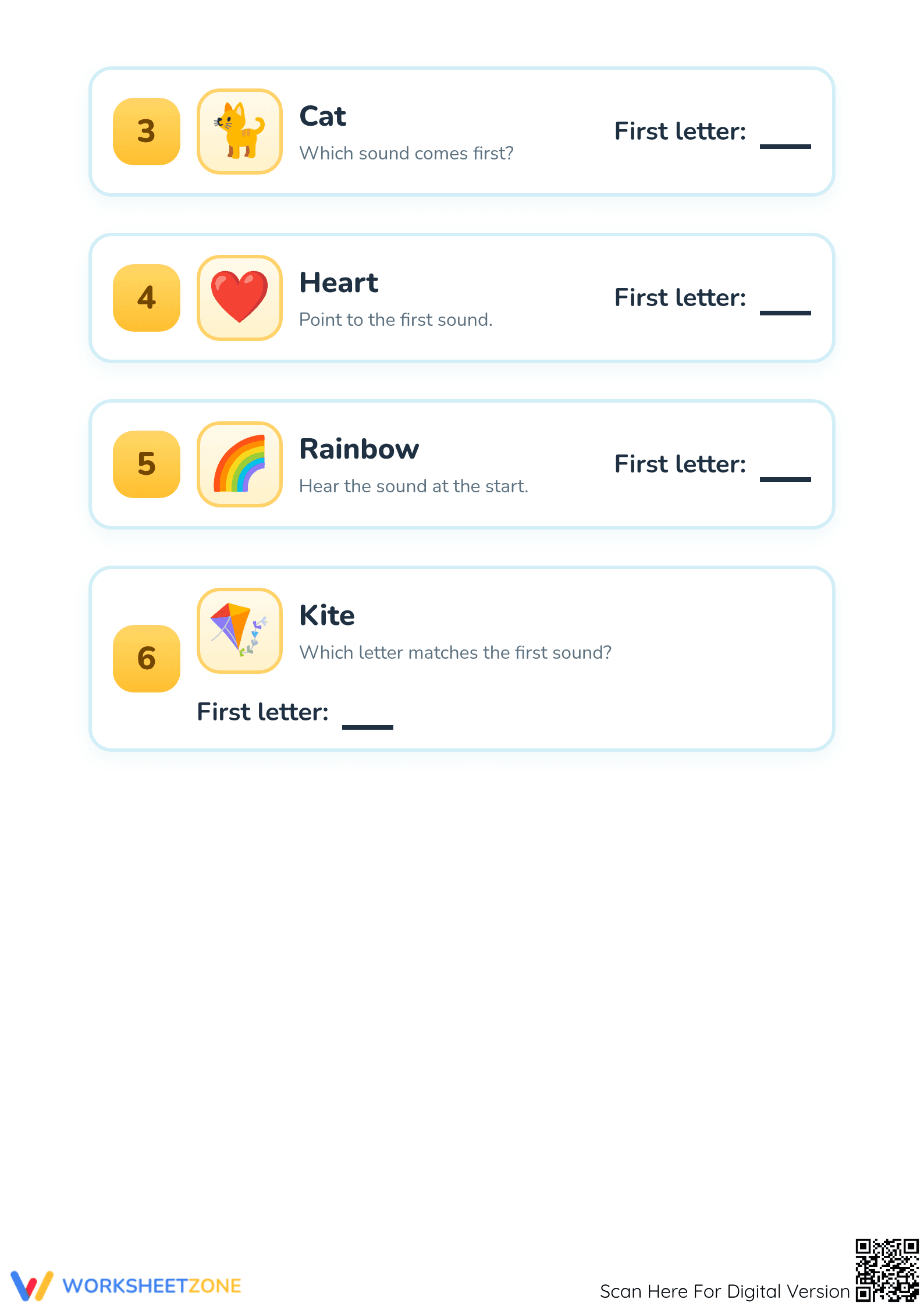

Printable Beginning Letter Sounds Worksheet | Grade K Ready
Paste this activity's link or code into your existing LMS (Google Classroom, Canvas, Teams, Schoology, Moodle, etc.).
Students can open and work on the activity right away, with no student login required.
You'll still be able to track student progress and results from your teacher account.
Foundational Phonics Practice
Students master the foundational phonemic awareness skill of identifying initial consonants with this engaging printable. By connecting visual cues to phonetic sounds, learners bridge the gap between spoken language and written symbols. This resource ensures students gain the confidence needed to tackle early reading and decoding tasks independently.
At a Glance
- Grade: Kindergarten · Subject: ELA
- Standard:
CCSS.RF.K.3.A— Demonstrate basic knowledge of one-to-one letter-sound correspondences for initial consonants- Skill Focus: Initial Consonant Recognition
- Format: 2 pages · 6 problems · Answer key included · PDF
- Best For: Early phonics intervention and center work
- Time: 10–15 minutes
What's Inside
This two-page PDF features a curated set of six high-frequency words paired with vibrant illustrations to support phonological processing. The worksheet includes a "Letter Bank" to scaffold the writing task, ensuring students focus on the sound-symbol connection rather than spelling recall. Each task provides a specific prompt, such as "Listen for the first sound," to guide the student's phonetic analysis. A comprehensive answer key is included for rapid grading or self-correction.
Zero-Prep Workflow
Designed for the busy educator, this resource follows a streamlined three-step implementation: Print, Distribute, and Review. Teachers can go from download to desk in under two minutes, as the worksheet requires no cutting, laminating, or additional manipulatives. The clear layout and included prompts make it an ideal candidate for emergency sub plans or "fast finisher" folders where student independence is paramount.
Standards Alignment
The primary focus is CCSS.RF.K.3.A: "Demonstrate basic knowledge of one-to-one letter-sound correspondences by producing the primary sound or many of the most frequent sounds for each consonant." The worksheet specifically targets initial position sounds to build phonemic sensitivity. Both standard codes can be copied directly into lesson plans, IEP goals, or district curriculum mapping tools.
How to Use It
Use this worksheet during small-group guided reading or as a formative assessment after introducing a new set of consonants. During instruction, observe if students can name the picture before attempting the letter sound; a hesitation here suggests a vocabulary gap rather than a phonetic one. The tasks are designed to be completed in approximately 12 minutes, making them perfect for transition periods.
Who It's For
This resource is specifically tailored for Preschool and Kindergarten students entering the alphabetic principle phase. It is also highly effective for English Language Learners (ELLs) who need visual support to anchor new phonemes. Pair this worksheet with an initial sound sorting activity or an alphabet anchor chart to provide a multi-sensory learning experience.
Identifying initial sounds is a critical milestone in the development of phonological awareness, a primary predictor of later reading success. Research from Fisher & Frey (2014) emphasizes the importance of gradual release and visual scaffolding in early literacy, which this worksheet provides through its combination of high-interest imagery and a structured letter bank. By focusing on CCSS.RF.K.3.A, students engage in the essential cognitive work of mapping phonemes to graphemes in the initial position. This specific skill, often referred to as "initial sound isolation," allows learners to segment spoken words into discrete parts, a precursor to full blending and decoding. Consistent practice with these one-to-one correspondences ensures that the "alphabetic principle" is firmly established before students move to more complex vowel patterns. This resource provides the high-frequency repetition required for neural pathways to automate letter-sound recall during the foundational years of ELA instruction.


