


























Views
Downloads

Letter H Beginning Consonants — Printable No-Prep Worksheet
Paste this activity's link or code into your existing LMS (Google Classroom, Canvas, Teams, Schoology, Moodle, etc.).
Students can open and work on the activity right away, with no student login required.
You'll still be able to track student progress and results from your teacher account.
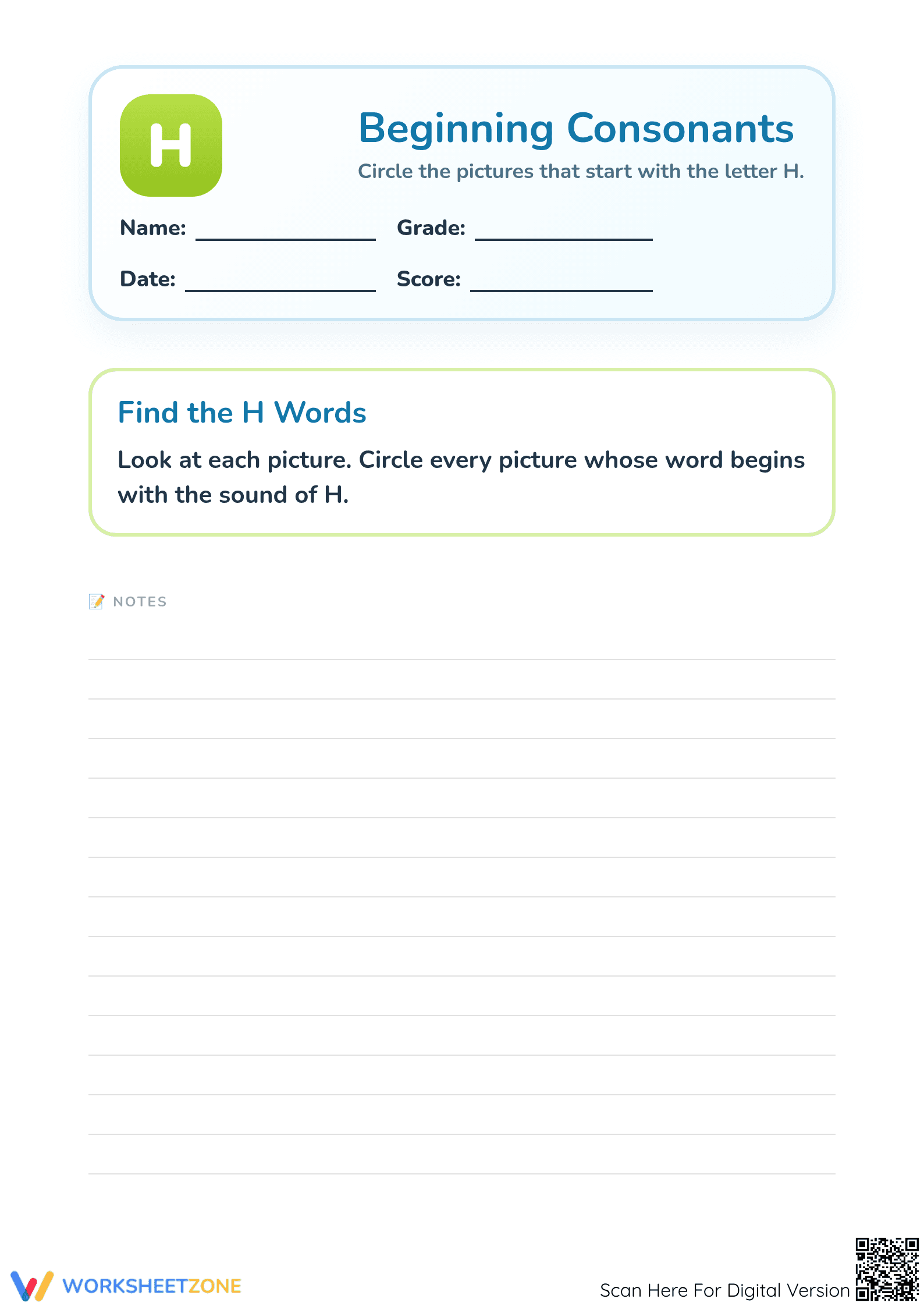
This Preschool beginning consonants worksheet provides focused practice on the letter H sound through visual identification tasks. By engaging with familiar objects like a hammer and horse, young learners build the phonemic awareness necessary to isolate initial consonant sounds. Students transition from letter recognition to active sound application, ensuring a solid foundation for early literacy and decoding skills.
At a Glance
- Grade: Preschool · Subject: English Language Arts (ELA)
- Standard:
CCSS.ELA-LITERACY.RF.K.2.D— Isolate and pronounce the initial sounds in words to build phonemic awareness- Skill Focus: Beginning Consonant Sound (Letter H)
- Format: 2 pages · 6 problems · Answer key included · PDF
- Best For: Independent phonics practice and morning work
- Time: 10–15 minutes
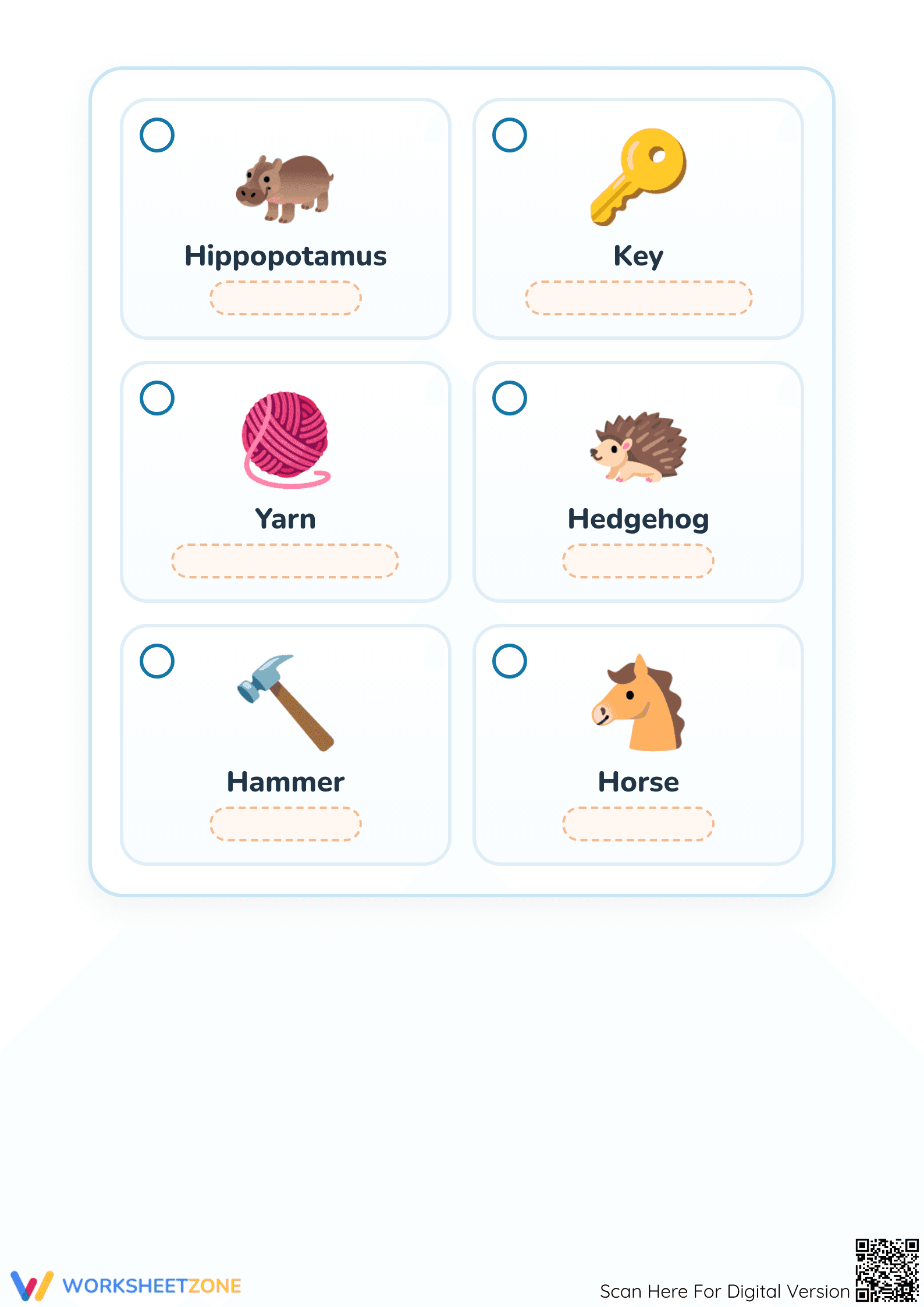
The resource includes a two-page PDF featuring six distinct visual identification tasks. The first page contains a structured header and a dedicated notes section for teacher observations or student scribbles. The second page presents six boxed images—including a hippopotamus, hedgehog, and yarn—where students must identify and circle the pictures that start with the letter H. A full answer key is provided for quick grading.
Zero-Prep Workflow
The zero-prep workflow for this worksheet is designed for maximum classroom efficiency. First, print the two-page document in about 30 seconds. Second, distribute the sheets to students with simple verbal instructions to "find the H sounds" which takes roughly one minute. Finally, review the completed work using the provided answer key to provide immediate feedback on letter-sound correspondence. Total teacher preparation time is less than two minutes.
Standards Alignment
The primary standard addressed is `CCSS.ELA-LITERACY.RF.K.2.D`, which requires students to isolate and pronounce the initial sounds (phonemes) in words. By evaluating pictures of common objects, students demonstrate their ability to distinguish the /h/ sound from other initial consonants. This standard code can be copied directly into lesson plans, IEP goals, or district curriculum mapping tools to track early literacy progress.
How to Use It
This worksheet is best used during the "You Do" phase of a gradual release model following a direct instruction lesson on the letter H. For a formative assessment, observe students as they evaluate the "Yarn" and "Key" distractors; this reveals whether they are guessing based on visual patterns or truly isolating the initial phoneme. Expect students to complete the tasks within 10 to 15 minutes.
Who It's For
The activity is tailored for Preschool and Kindergarten students who are beginning their phonics journey. It provides excellent support for English Language Learners (ELLs) by pairing clear illustrations with vocabulary words. This resource pairs naturally with an alphabet anchor chart or a read-aloud story featuring a character whose name starts with H, reinforcing the sound in multiple contexts.
Early phonemic awareness, specifically the ability to isolate initial consonant sounds like the letter H, is a primary predictor of later reading success. According to the RAND AIRS (2024) report on foundational literacy, structured visual-to-phoneme mapping activities significantly reduce the cognitive load for early learners by providing concrete anchors for abstract sounds. This worksheet utilizes high-frequency vocabulary to ensure that students focus on the phoneme /h/ rather than struggling with unfamiliar object names. By requiring students to distinguish between target sounds and phonetically distinct distractors (such as 'Key' or 'Yarn'), the task reinforces the CCSS.ELA-LITERACY.RF.K.2.D requirement for precise phoneme isolation. Educational research emphasizes that these brief, repetitive exposures to letter-sound correspondences are essential for building the neural pathways required for decoding. Teachers can use this assessment data to identify students who may need additional tier-2 intervention in phonological processing or articulation before moving to complex blending tasks.


