




























Views
Downloads
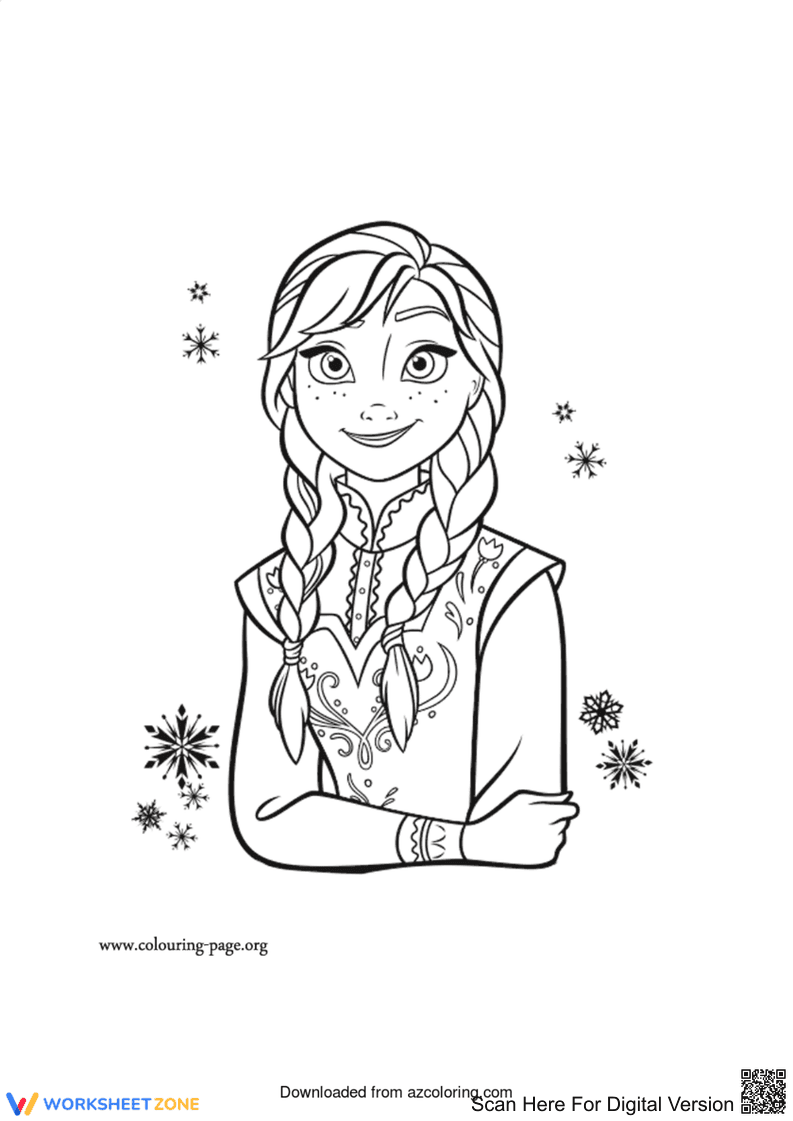

Anna Coloring Page | Printable Grade K-5 Activity

Paste this activity's link or code into your existing LMS (Google Classroom, Canvas, Teams, Schoology, Moodle, etc.).
Students can open and work on the activity right away, with no student login required.
You'll still be able to track student progress and results from your teacher account.
This printable Anna coloring page provides young students with an engaging way to develop fine motor skills and express creativity. By focusing on coloring within the lines and selecting appropriate hues, learners strengthen hand-eye coordination and pencil grip, which are essential foundational skills for early handwriting and visual communication.
At a Glance
- Grade: K · Subject: English
- Standard:
CCSS.ELA-LITERACY.SL.K.5— Add drawings or visual displays to descriptions- Skill Focus: Fine motor skills and coloring
- Format: 1 page · 1 problem · No answer key · PDF
- Best For: Independent practice or morning work
- Time: 15–20 minutes
Inside this single-page resource, educators will find a black-and-white line art illustration of Anna surrounded by snowflakes. The page features clear, bold outlines making it easy for early elementary students to practice staying within boundaries. No answer key is required, as this open-ended creative task fosters artistic expression and provides a calming, focused classroom activity.
This resource offers a highly efficient zero-prep workflow. First, print the required copies (under 1 minute). Next, distribute the pages with crayons or markers (1 minute). Finally, review the completed artwork (ongoing). Total teacher preparation time is under two minutes, making this an ideal option for emergency sub plans, indoor recess, or transition periods.
This activity aligns with CCSS.ELA-LITERACY.SL.K.5: Add drawings or other visual displays to descriptions as desired to provide additional detail. While primarily a fine motor and artistic task, coloring familiar characters supports narrative comprehension and visual storytelling. Both standard codes can be copied directly into lesson plans, IEP goals, or district curriculum mapping tools.
Teachers can utilize this coloring page in multiple ways throughout the school day. It serves as an excellent morning work activity, allowing students to settle in quietly while practicing their pencil grip before formal instruction begins. Alternatively, it can be used as a fast-finisher reward during literacy centers. While students color, teachers can conduct formative assessments by observing their grip, pressure, and ability to track visual boundaries, offering gentle corrections to support future handwriting success. Expected completion time ranges from 15 to 20 minutes.
This worksheet is primarily designed for Kindergarten through second-grade students who are actively developing their fine motor control and visual-spatial awareness. It is easily differentiated by allowing students to choose their preferred medium, such as thick crayons for those needing more grip support or fine-tipped markers for advanced control. This resource pairs perfectly with a read-aloud session of a related fairy tale or a direct instruction lesson on character traits.
Integrating creative visual tasks into the early childhood curriculum provides significant developmental benefits. Aligned with CCSS.ELA-LITERACY.SL.K.5, this activity encourages students to add drawings or visual displays to descriptions, reinforcing the connection between visual arts and narrative comprehension. According to Fisher & Frey (2014), providing structured yet creative tasks allows students to build stamina and focus, which translates directly to improved performance in core academic areas like reading and writing. Engaging with familiar characters also lowers the affective filter, making students more receptive to practicing foundational skills like pencil grip and hand-eye coordination. By incorporating this simple coloring activity, educators can support both cognitive and physical development in a low-stress, highly motivating format.


