


























Views
Downloads

Grade 6-8 Bats Reading Comprehension — Essential Worksheet
Paste this activity's link or code into your existing LMS (Google Classroom, Canvas, Teams, Schoology, Moodle, etc.).
Students can open and work on the activity right away, with no student login required.
You'll still be able to track student progress and results from your teacher account.
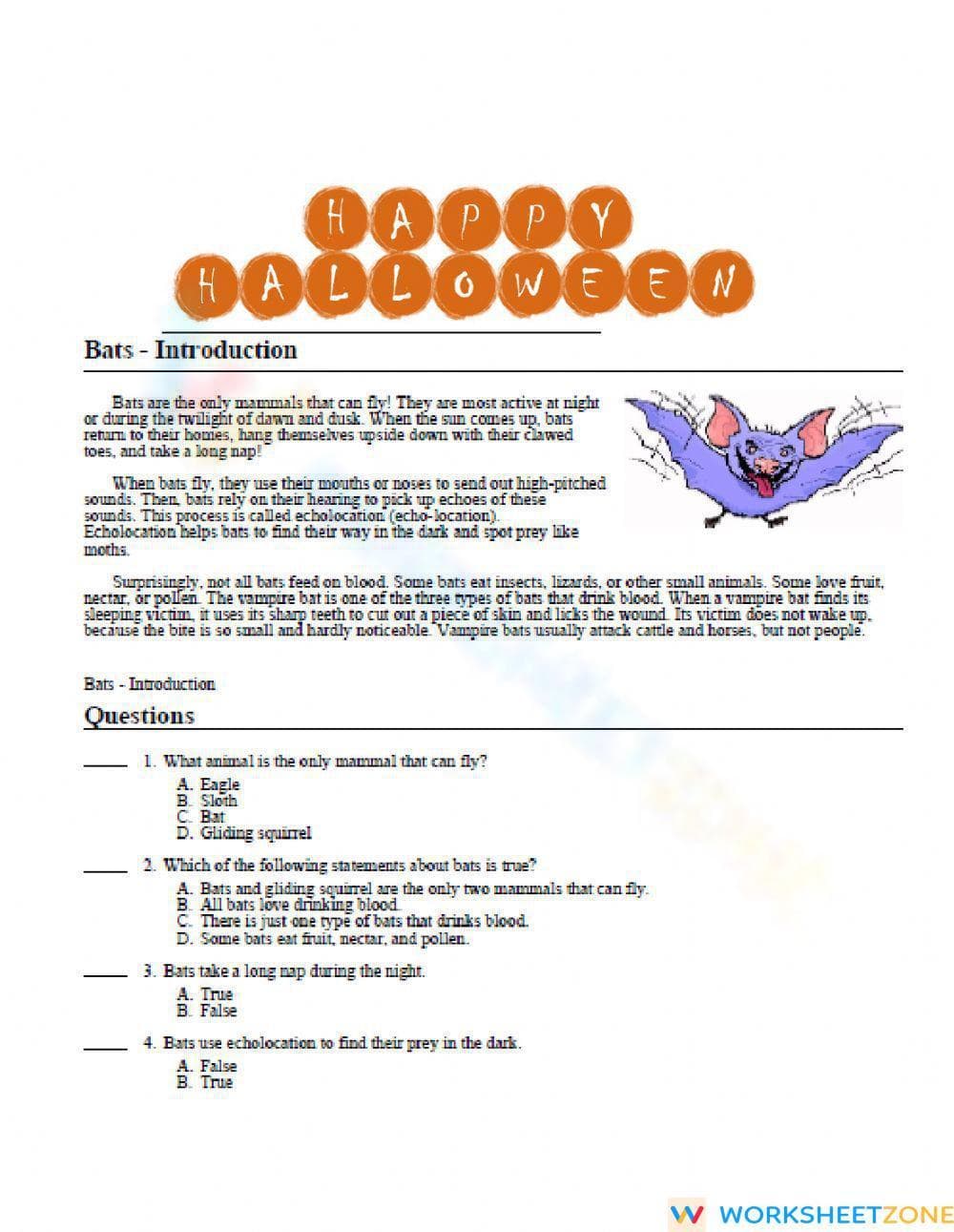
This Grade 6-8 reading comprehension worksheet provides an engaging informational text about bats, focusing on their unique biological traits and echolocation abilities. By analyzing the provided "Bats - Introduction" text, students strengthen their evidence-based reading skills and demonstrate mastery of key scientific facts. It delivers a complete instructional cycle in a single page.
At a Glance
- Grade: 6-8 · Subject: ELA Literature
- Standard:
CCSS.ELA-LITERACY.RI.6.1— Cite textual evidence to support analysis of what the informational text says explicitly.- Skill Focus: Informational Text Analysis
- Format: 1 page · 4 problems · Answer key included · PDF
- Best For: Independent reading or quick sub plans
- Time: 15–20 minutes
The resource includes a structured informational passage titled "Bats - Introduction" that covers mammalian flight, nocturnal habits, echolocation, and dietary variations among species. Following the text, students encounter four multiple-choice questions designed to test literal comprehension and detail recall. The layout is clean, featuring a festive "Happy Halloween" header, making it an ideal thematic addition to October lesson plans.
The implementation workflow is designed for maximum teacher efficiency. First, print the single-page PDF (approx. 30 seconds). Next, distribute the worksheets to the class with zero additional setup or context required, as the introductory text is self-contained (approx. 1 minute). Finally, review the four multiple-choice responses using the included answer key for immediate formative feedback (approx. 1 minute).
The primary alignment for this activity is `CCSS.ELA-LITERACY.RI.6.1`, which requires students to cite textual evidence to support analysis of what the text says explicitly. The questions specifically target the ability to locate facts within the introductory paragraphs. Both standard codes can be copied directly into lesson plans, IEP goals, or district curriculum mapping tools.
This worksheet is most effective as a "bell-ringer" or warm-up activity during an ELA block or science-integration period. Use it after a brief discussion on mammals to assess student ability to extract specific details from technical writing. As a formative assessment observation tip, notice if students refer back to the text to answer question two regarding dietary facts.
This resource is tailored for middle school students in Grades 6 through 8 who are developing their informational reading stamina. It is particularly useful for English Language Learners due to the clear, direct sentence structures and supported vocabulary. It pairs naturally with an anchor chart on echolocation or a short video clip showing bats in flight.
This educational resource centers on `CCSS.ELA-LITERACY.RI.6.1`, focusing on the core academic skill of citing evidence from informational texts to confirm factual understanding. According to the RAND AIRS 2024 report, high-quality, focused practice with short-form informational passages is critical for bridging the gap between literal comprehension and analytical reasoning in middle school learners. By providing a self-contained reading environment with 4 targeted multiple-choice tasks, this worksheet ensures that students remain focused on text-to-answer mapping without the cognitive load of over-complex layouts. The content addresses biological science themes while maintaining a rigorous ELA framework, supporting cross-curricular literacy goals essential for college and career readiness. This instructional design aligns with best practices for gradual release, allowing for successful independent practice in diverse classroom settings. Teachers can reliably use this tool to gather quick data on student proficiency in evidence extraction from non-fiction sources.


