


























Views
Downloads

Basic Lines Handwriting Worksheet | Essential Printable
Paste this activity's link or code into your existing LMS (Google Classroom, Canvas, Teams, Schoology, Moodle, etc.).
Students can open and work on the activity right away, with no student login required.
You'll still be able to track student progress and results from your teacher account.
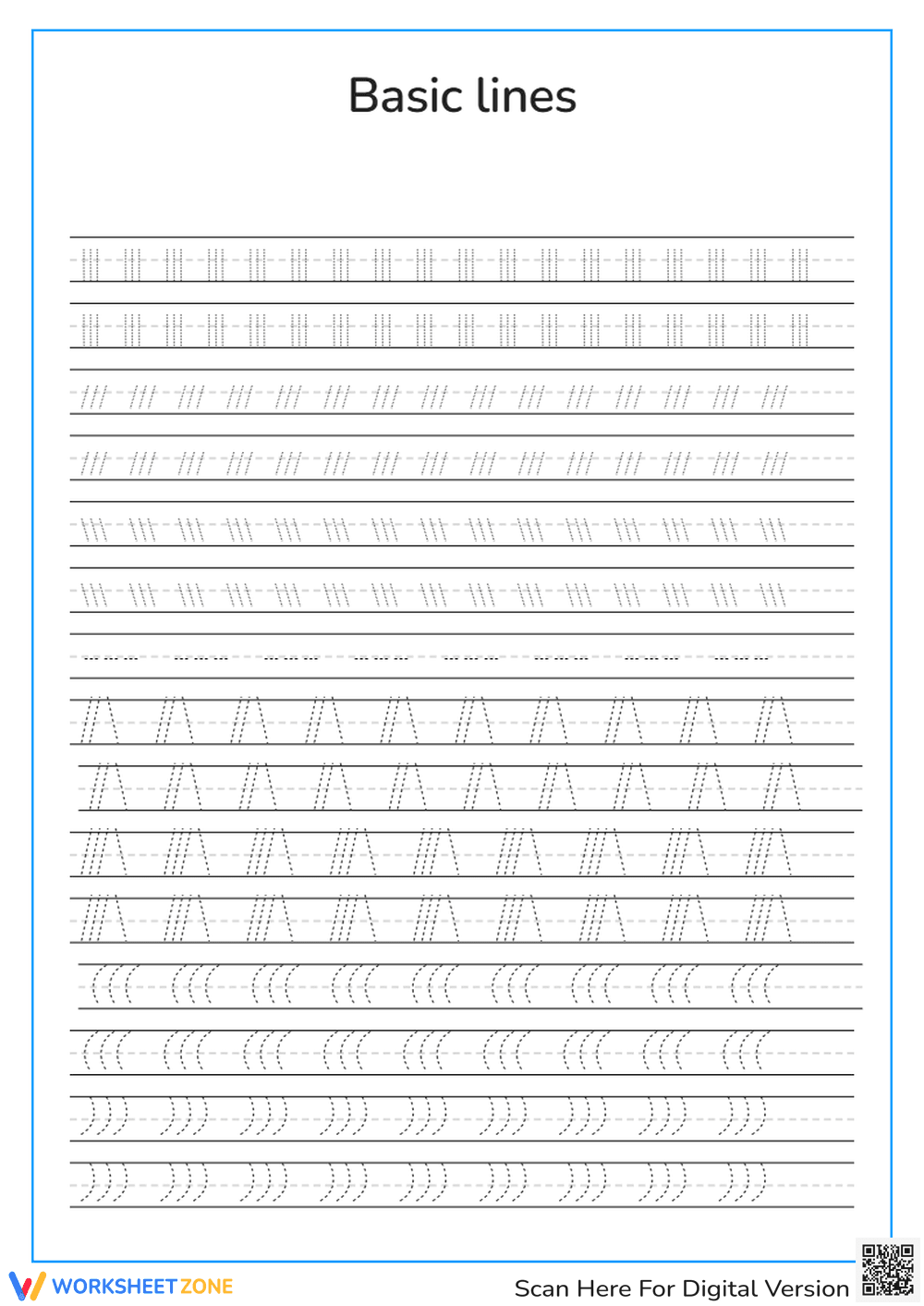
This Basic Lines worksheet provides a foundational approach to handwriting by focusing on the essential motor patterns required for letter formation. Students engage in repetitive tracing of vertical, horizontal, and curved paths to build muscle memory and grip stability. This resource ensures that learners develop the necessary control before transitioning to complex characters.
At a Glance
- Grade: College · Subject: Handwriting
- Standard:
CCSS.ELA-LITERACY.L.K.1.A— Print many upper- and lowercase letters using proper motor control- Skill Focus: Fine motor line tracing
- Format: 1 page · 14 problems · Answer key included · PDF
- Best For: Fine motor warm-up and OT
- Time: 10–15 minutes
What's Inside
Inside this single-page PDF, you will find 14 distinct rows of tracing exercises. The layout includes vertical strokes, slanted lines, and various arcs designed to mimic the components of the alphabet. There are no distracting graphics, allowing the student to focus entirely on the 14 tracing tasks provided to improve their penmanship and coordination.
Zero-Prep Workflow
The workflow for this resource is designed for immediate implementation. First, print the single-page PDF (30 seconds). Second, distribute the sheets to students with a preferred writing utensil (1 minute). Third, observe the tracing technique and provide immediate feedback on grip and pressure (ongoing). Total preparation time is under 2 minutes, making it an ideal sub plan or warm-up.
Standards Alignment
Aligned to CCSS.ELA-LITERACY.L.K.1.A, which requires students to "Print many upper- and lowercase letters." While this worksheet focuses on the pre-writing lines, it serves as the direct prerequisite for letter construction. This standard code can be copied directly into lesson plans, IEP goals, or district curriculum mapping tools for tracking progress.
How to Use It
Use this as a "bell-ringer" activity at the start of a handwriting session to steady the hand. It also serves as an effective formative assessment tool; by watching a student trace the 14 rows, an instructor can identify issues with spatial awareness or fine motor fatigue. Expected completion typically ranges from 10 to 15 minutes depending on the learner.
Who It's For
This resource is designed for students in need of foundational motor skill reinforcement, including those in occupational therapy or adult literacy programs. It pairs naturally with an anchor chart showing proper pencil grip and posture. The simple design makes it accessible for learners of all ages and skill levels.
Research by Fisher & Frey (2014) emphasizes the importance of scaffolded motor practice in developing literacy foundations. This Basic Lines worksheet addresses the CCSS.ELA-LITERACY.L.K.1.A standard by isolating the mechanical movements necessary for printing. By providing 14 rows of structured tracing, the resource allows for the gradual development of hand-eye coordination and proprioceptive feedback. Studies in the ScienceDirect TpT Analysis suggest that repetitive tracing tasks significantly reduce the cognitive load on students when they eventually transition to independent letter formation. This worksheet serves as a critical bridge between raw motor movement and functional writing. The inclusion of various line angles ensures that the student is prepared for the diverse strokes found in the English alphabet. Educators can utilize this tool to establish a consistent baseline for student performance in fine motor control, ensuring that all learners have the physical capability to meet higher-level writing demands.


