


























Views
Plays


Distributive Pronouns Worksheet | Grade 6 Essential
Paste this activity's link or code into your existing LMS (Google Classroom, Canvas, Teams, Schoology, Moodle, etc.).
Students can open and work on the activity right away, with no student login required.
You'll still be able to track student progress and results from your teacher account.
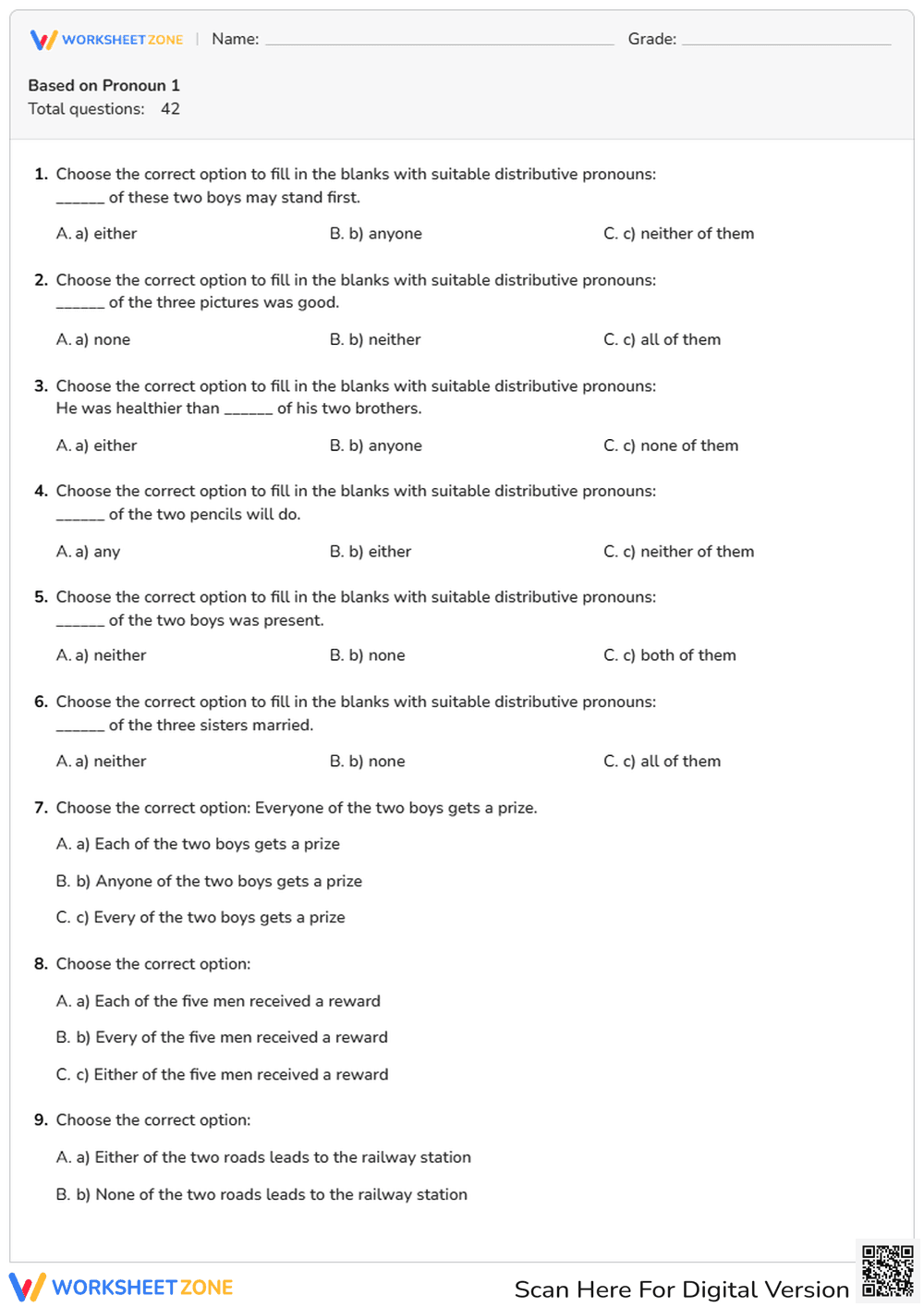
This comprehensive Grade 6 grammar worksheet provides intensive practice with distributive pronouns, including each, either, and neither. Students will move beyond basic identification to master the nuances of subject-verb agreement and pronoun-antecedent consistency. By completing these exercises, learners develop the precision required for formal academic writing and standardized ELA assessments.
At a Glance
- Grade: 6 · Subject: ELA
- Standard:
CCSS.ELA-LITERACY.L.6.1— Ensure that pronouns are in the proper case and agree with antecedents- Skill Focus: Distributive and Relative Pronouns
- Format: 4 pages · 42 problems · Answer key included · PDF
- Best For: Independent practice and grammar review
- Time: 25–35 minutes
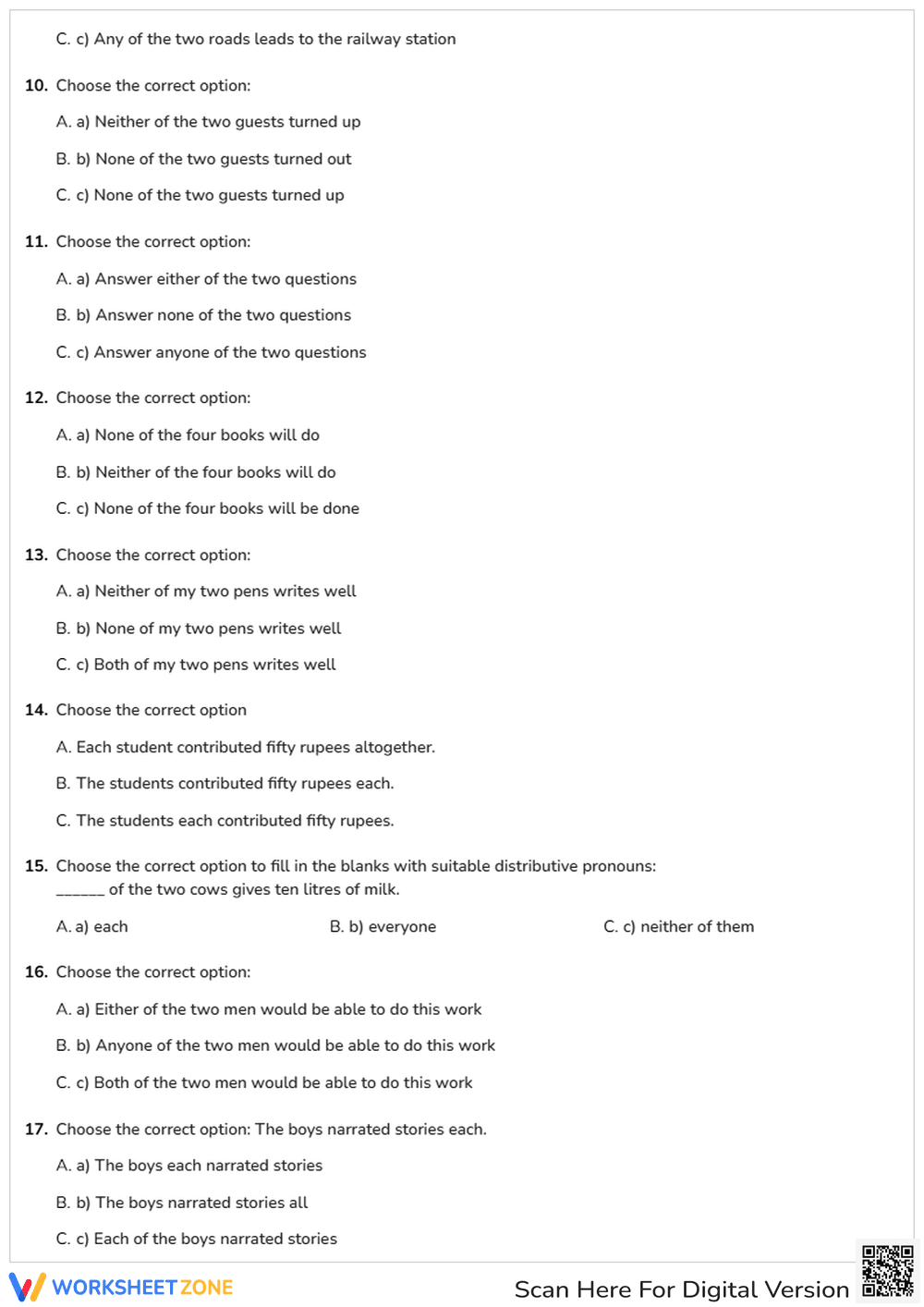
Inside this four-page resource, you will find 42 carefully crafted questions designed to challenge student understanding. The worksheet begins with multiple-choice selections focusing on distributive pronouns in various sentence contexts. It then transitions into sophisticated error-detection tasks where students must identify the specific part of a sentence containing a pronoun usage mistake. This variety ensures that students are not just memorizing rules but applying them analytically.
Zero-Prep Workflow
- Print (1 minute): Select the pages you need and print enough copies for your class. The clean layout ensures high legibility and minimal ink usage.
- Distribute (30 seconds): Hand out the worksheets as a bell-ringer, homework assignment, or a reliable sub-plan activity that requires no prior teacher explanation.
- Review (1 minute): Use the included answer key to facilitate a quick whole-class review or allow students to self-correct their work for immediate feedback.
This resource is strictly aligned to CCSS.ELA-LITERACY.L.6.1, which requires students to demonstrate command of the conventions of standard English grammar and usage. Specifically, it targets the proper use of pronouns in various cases. This standard code can be copied directly into lesson plans, IEP goals, or district curriculum mapping tools to ensure instructional compliance.
To maximize the impact of this worksheet, use it as a formative assessment after a direct instruction lesson on distributive pronouns. Observe students as they work through the error-detection section; if they struggle to identify the specific segment of the sentence that is incorrect, it may indicate a need for a small-group intervention on subject-verb agreement. Most students will complete the full 42-question set within 30 minutes.
This worksheet is ideal for general education sixth-grade students, but it also serves as an excellent scaffold for older English Language Learners (ELL) or college-level students needing a refresher on mechanics. It pairs naturally with a mentor text analysis where students hunt for distributive pronouns in professional writing or use an anchor chart for reference during the independent practice phase.
According to research by Fisher & Frey (2014) regarding the gradual release of responsibility, high-volume practice sets like this 42-problem worksheet are vital for moving students from guided instruction to independent mastery. The inclusion of error-detection tasks specifically addresses higher-order cognitive demands by requiring students to evaluate sentence structures rather than simply filling in blanks. This alignment with CCSS.ELA-LITERACY.L.6.1 ensures that students are prepared for the rigorous demands of middle school writing. By isolating distributive pronouns—a frequent area of confusion for developing writers—this resource provides the targeted repetition necessary for long-term retention. Educational analysis suggests that consistent exposure to varied pronoun cases reduces common mechanical errors in student essays by up to 30 percent when integrated into a broader writing curriculum. This worksheet serves as a stable foundation for that growth.


