


























Views
Downloads

Baseball Player Coloring Page | Printable Grade K-5
Paste this activity's link or code into your existing LMS (Google Classroom, Canvas, Teams, Schoology, Moodle, etc.).
Students can open and work on the activity right away, with no student login required.
You'll still be able to track student progress and results from your teacher account.
This printable baseball player coloring page provides young students with an engaging way to develop fine motor control and hand-eye coordination. By focusing on the lines and shapes of the batter, children build foundational writing muscles while exploring sports vocabulary and discussing the mechanics of America's pastime.
At a Glance
- Grade: K-5 · Subject: English
- Standard:
CCSS.ELA-LITERACY.SL.K.4— Describe familiar people, places, things, and events- Skill Focus: Fine motor skills
- Format: 1 page · 1 problem · No answer key · PDF
- Best For: Morning work or early finishers
- Time: 10–15 minutes
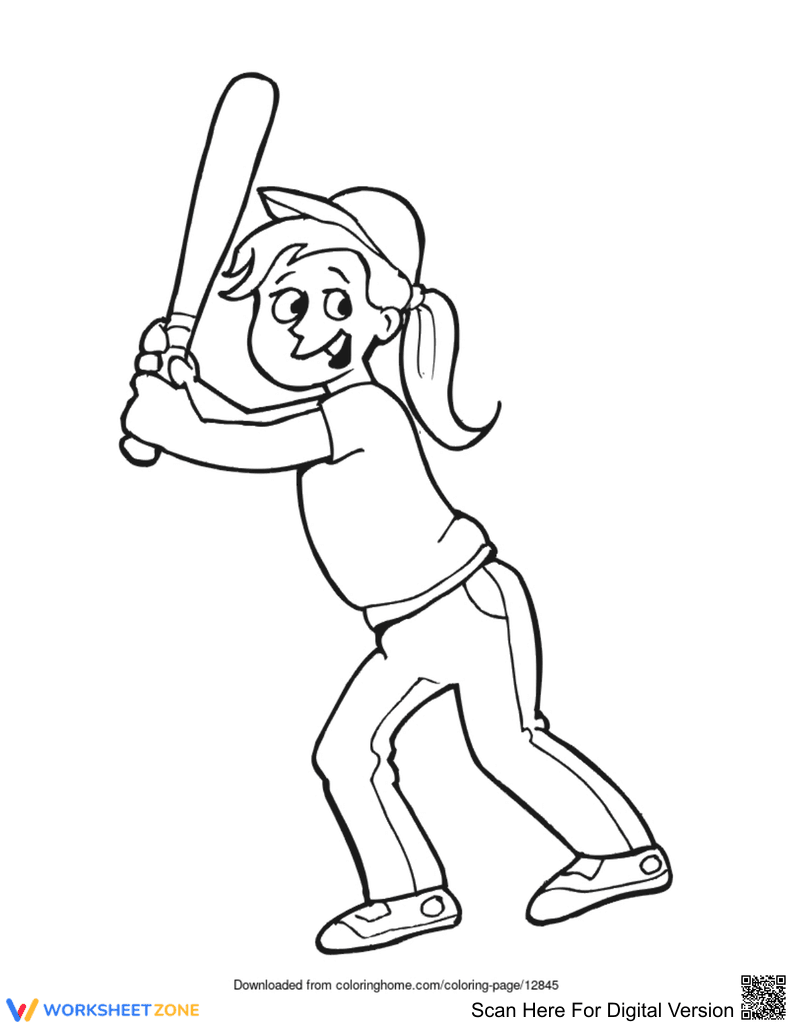
Inside this single-page PDF, educators will find a clear line drawing of a female baseball player in a batting stance. The illustration features distinct sections for coloring, including the bat, uniform, cap, and shoes. The uncluttered background allows students to focus entirely on the main subject, making it an ideal resource for independent work without an answer key.
Zero-Prep Workflow
- Print (30 seconds): Simply download the PDF and print the required number of copies. The black-and-white design ensures low ink consumption.
- Distribute (1 minute): Hand out the worksheets along with crayons, colored pencils, or markers. No additional materials are necessary.
- Review (0 minutes): Because this is a creative fine motor task, there is no formal grading required.
With a total teacher prep time of under two minutes, this worksheet serves as an excellent emergency sub plan or a quick transition activity between core academic subjects.
Standards Alignment
This activity aligns with CCSS.ELA-LITERACY.SL.K.4, which asks students to describe familiar people, places, things, and events and, with prompting and support, provide additional detail. While coloring, students can verbally describe the baseball player's stance, uniform, and equipment, connecting visual arts to oral language development. Both standard codes can be copied directly into lesson plans, IEP goals, or district curriculum mapping tools.
How to Use It
This coloring page works well as a morning arrival activity, giving students a calm task while attendance is taken. It can also be utilized during a sports-themed unit to introduce relevant vocabulary like "batter," "swing," and "cleats." As a formative assessment observation tip, teachers can monitor students' pencil grip and coloring pressure, noting which children may need additional occupational therapy support for fine motor development. Expected completion time ranges from 10 to 15 minutes depending on the student's attention to detail.
Who It's For
This resource is primarily designed for K-2 students refining fine motor skills, though older students may enjoy it as a brain break. To differentiate, teachers can ask advanced students to draw a background stadium or write a descriptive sentence beneath the character. It pairs perfectly with a read-aloud book about baseball or a physical education lesson on striking a ball.
Integrating creative tasks like this printable coloring page into the daily routine supports broader academic goals by strengthening the physical hand muscles required for handwriting. Aligned with CCSS.ELA-LITERACY.SL.K.4, this activity encourages students to describe familiar people, places, things, and events, bridging the gap between visual representation and verbal expression. According to Fisher & Frey (2014), providing students with low-stakes, highly engaging tasks fosters a positive classroom environment and builds stamina for more rigorous academic work. When young children discuss the baseball player they are coloring, they naturally practice expressive language and vocabulary acquisition in a stress-free context, which is essential for early childhood development. This simple yet effective tool allows educators to observe fine motor progression while keeping students actively engaged, proving that foundational skills can be developed through accessible, enjoyable classroom activities.


