


























Views
Downloads
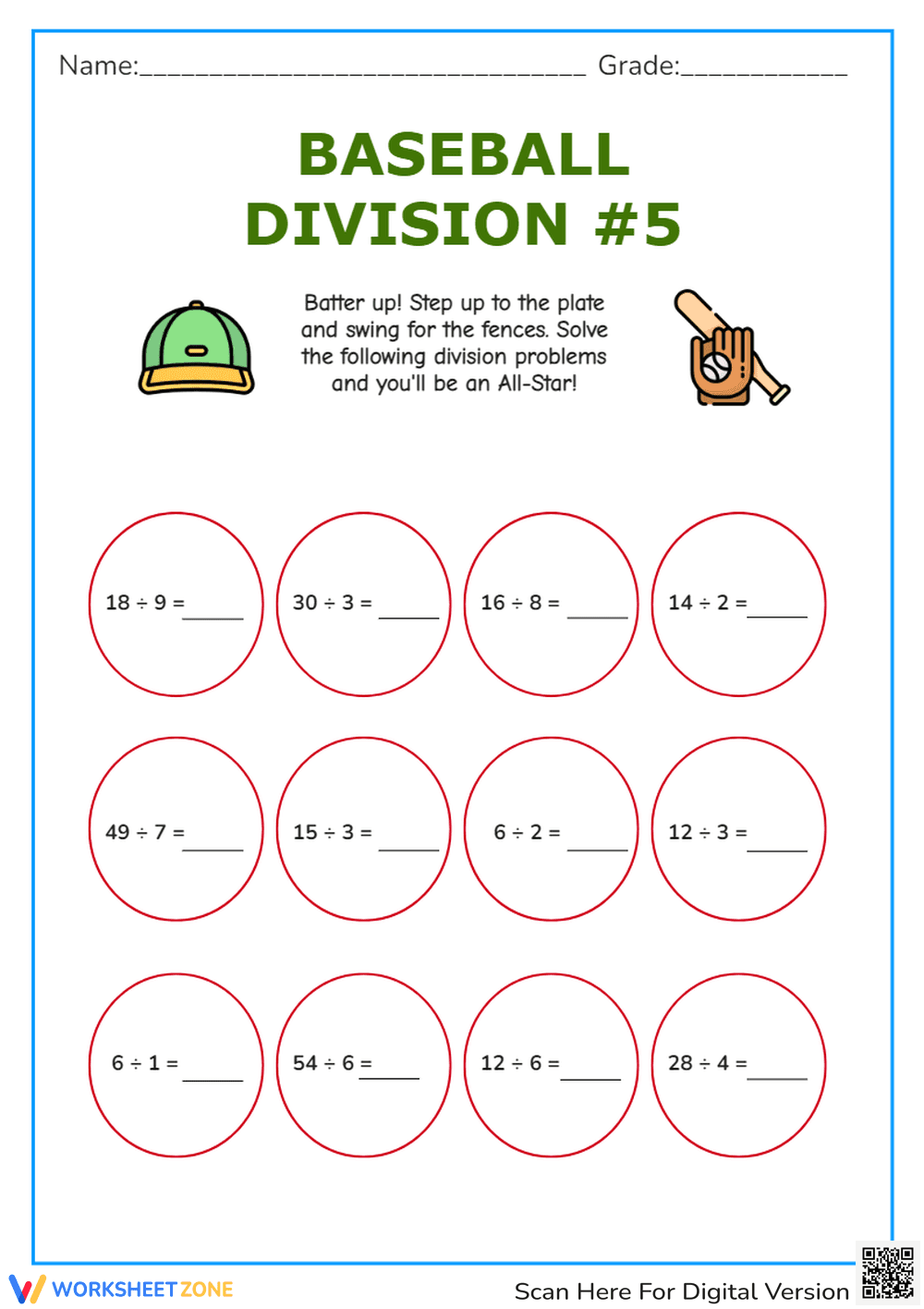

Grade 3 Division Facts — Printable No-Prep Worksheet
Paste this activity's link or code into your existing LMS (Google Classroom, Canvas, Teams, Schoology, Moodle, etc.).
Students can open and work on the activity right away, with no student login required.
You'll still be able to track student progress and results from your teacher account.
This baseball-themed math worksheet provides Grade 3 students with focused practice on basic division facts. By solving these equations, learners build computational fluency and strengthen their understanding of equal groups. The engaging sports theme helps maintain student interest while they work toward mastering essential arithmetic skills.
At a Glance
- Grade: 3 · Subject: Math
- Standard:
CCSS.MATH.CONTENT.3.OA.C.7— Fluently divide within 100 using mental strategies- Skill Focus: Division Facts
- Format: 1 page · 12 problems · Answer key included · PDF
- Best For: Independent practice and review
- Time: 10–15 minutes
Inside this resource, educators will find a single-page activity featuring 12 straightforward division problems presented within baseball graphics. The layout is clean and uncluttered, providing ample space for students to write their answers directly on the page. A complete answer key is included to ensure accurate and efficient grading for teachers or self-checking for students.
This resource is designed for immediate classroom implementation with a highly efficient workflow. First, print the required number of copies (under 1 minute). Next, distribute the pages to students as a warm-up or independent task (1 minute). Finally, review the answers as a whole class or collect for grading (3 minutes). The total teacher preparation time is under two minutes, making this an excellent, reliable option for emergency substitute plans or unexpected schedule changes.
This activity is directly aligned to CCSS.MATH.CONTENT.3.OA.C.7, which requires students to fluently multiply and divide within 100, using strategies such as the relationship between multiplication and division. It also supports foundational algebraic thinking by reinforcing fact families. Both standard codes can be copied directly into lesson plans, IEP goals, or district curriculum mapping tools.
Teachers can utilize this worksheet during the core math block as independent practice immediately following direct instruction on division strategies. Alternatively, it serves as an effective morning work assignment to activate prior knowledge before introducing more complex word problems. While students complete the 12 equations, teachers should observe whether learners are relying on counting strategies or demonstrating true automaticity. Expected completion time ranges from 10 to 15 minutes depending on the student's current fluency level.
This resource is primarily designed for third-grade students developing their division fluency. It is also appropriate for fourth-grade students requiring targeted intervention or review of basic facts. For differentiation, teachers might provide manipulatives or a multiplication chart for learners needing additional support. This worksheet pairs perfectly with hands-on grouping lessons or visual anchor charts demonstrating the inverse relationship between multiplication and division.
Developing automaticity with basic arithmetic operations is a critical milestone in elementary mathematics. This worksheet targets CCSS.MATH.CONTENT.3.OA.C.7, helping students fluently divide within 100 using mental strategies. According to a recent EdReports 2024 analysis, students who achieve computational fluency with single-digit facts are significantly better equipped to tackle multi-step word problems and advanced algebraic concepts in later grades. Without this foundational automaticity, cognitive load becomes overwhelmed during complex tasks, leading to increased frustration and errors. By providing targeted, repetitive practice in an accessible format, educators can help learners transition from slow, strategy-based calculation to rapid memory retrieval. This focused repetition builds the necessary neural pathways for long-term retention, ensuring students have the cognitive resources available for higher-order mathematical reasoning and problem-solving applications.


