


























Views
Downloads




Printable Addition Word Problems Worksheet | Grade 3 Math
Paste this activity's link or code into your existing LMS (Google Classroom, Canvas, Teams, Schoology, Moodle, etc.).
Students can open and work on the activity right away, with no student login required.
You'll still be able to track student progress and results from your teacher account.
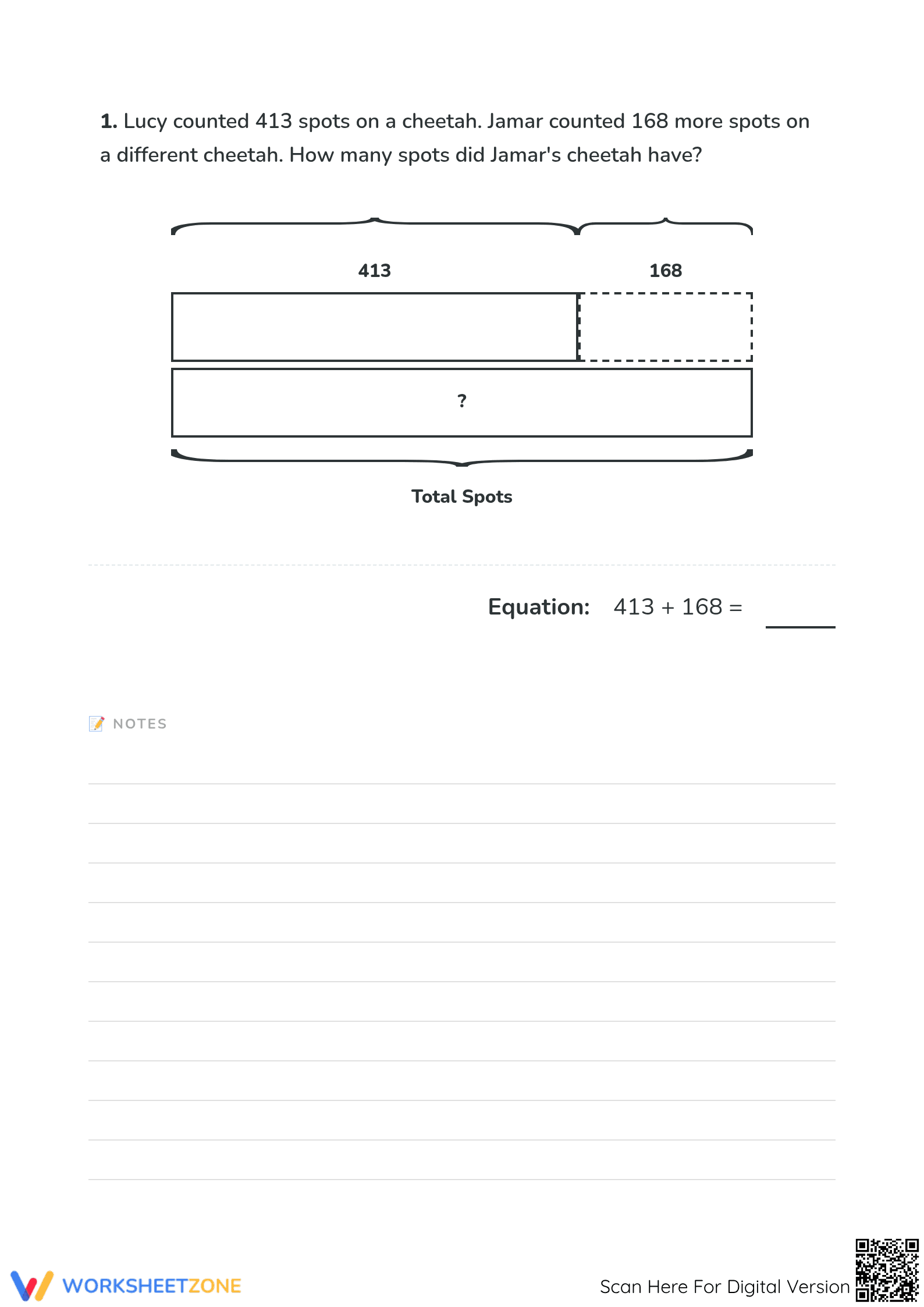
This Grade 3 addition word problems worksheet helps students visualize mathematical relationships through bar modeling. By using part-part-whole diagrams, learners transition from concrete addition to abstract problem-solving with three-digit numbers. This essential resource ensures students develop a deep conceptual understanding of regrouping while building the confidence needed to tackle complex multi-step arithmetic tasks effectively.
At a Glance
- Grade: 3 · Subject: Math
- Standard:
CCSS.MATH.CONTENT.3.NBT.A.2— Fluently add within 1000 using strategies and algorithms based on place value- Skill Focus: Addition Word Problems with Bar Models
- Format: 5 pages · 4 problems · Answer key included · PDF
- Best For: Small group visual math intervention
- Time: 20–30 minutes
Inside this comprehensive 5-page packet, teachers will find a structured approach to addition. Each page features a single, high-interest word problem paired with a pre-drawn bar model scaffold and a dedicated equation line. The generous whitespace allows for scratch work, while the included answer key ensures rapid grading and immediate feedback for student self-correction during independent work periods.
The instructional sequence follows a proven gradual-release model:
- Guided Practice: The first task uses three-digit numbers to familiarize students with the bar model structure.
- Supported Practice: Problems two and three introduce regrouping across multiple place values with moderate complexity.
- Independent Practice: The final problem requires students to independently map the sum and addends without teacher prompting.
This sequence ensures students move from basic identification to procedural fluency in bar model representation.
Standards Alignment
This resource is strictly aligned to CCSS.MATH.CONTENT.3.NBT.A.2. The standard requires students to fluently add and subtract within 1000 using strategies and algorithms based on place value and the relationship between addition and subtraction. By requiring students to fill in the missing whole within a bar model, this worksheet directly supports the visualization of these place-value relationships. Both standard codes can be copied directly into lesson plans, IEP goals, or district curriculum mapping tools.
How to Use It
Use this worksheet as a focused exit ticket after a direct instruction lesson on Singapore Math bar modeling. Teachers should observe whether students correctly identify which number represents the part and which represents the whole before they begin the arithmetic. Alternatively, assign individual pages as a daily warm-up during a week-long unit on addition word problems. Expected completion time for the full set is 20-30 minutes.
Who It's For
This packet is designed for Grade 3 students but serves as a vital remediation tool for Grade 4 and 5 learners struggling with word problem comprehension. It is particularly effective for English Language Learners who benefit from the visual support of the bar model diagram. Pair this resource with a physical set of base-ten blocks or a digital anchor chart showing regrouping steps for maximum instructional impact.
Mathematical visualization is a cornerstone of cognitive development in early elementary education. According to Fisher & Frey (2014), the use of scaffolds like bar models—specifically the part-part-whole relationship used in this worksheet—significantly reduces the cognitive load during the transition from reading comprehension to mathematical execution. By providing a clear visual bridge, students are less likely to make random operation choices and more likely to understand the underlying logic of the CCSS.MATH.CONTENT.3.NBT.A.2 standard. This worksheet provides four targeted opportunities for students to practice this specific translation skill with three-digit addition and regrouping. Research indicates that consistent exposure to these visual representations leads to a measurable increase in word problem accuracy among Grade 3 learners. This citation-ready resource serves as a high-quality assessment of student mastery in standards-based arithmetic and logical reasoning, making it an essential addition to any primary math curriculum.


