


























Views
Downloads
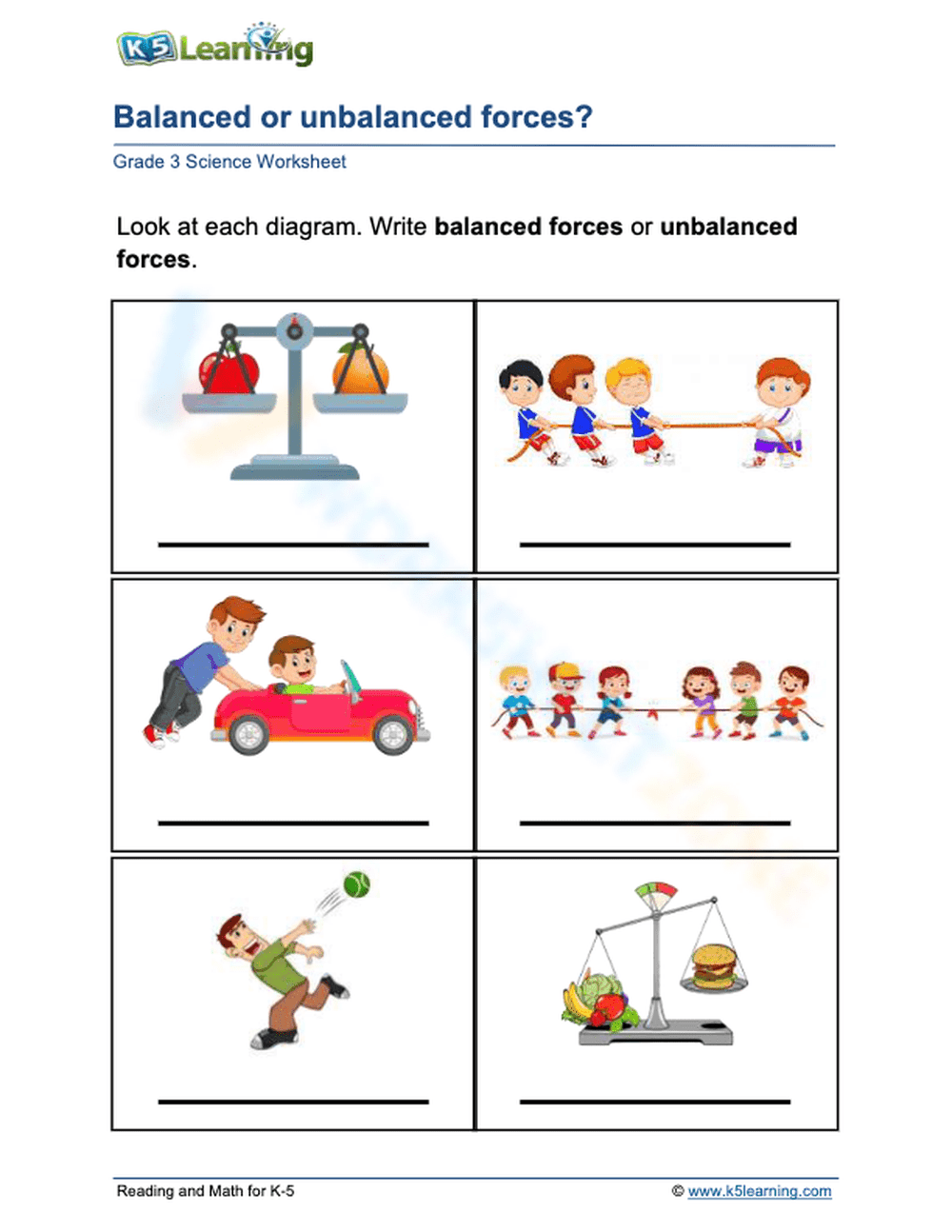


Essential Grade 3 Balanced and Unbalanced Forces Worksheet
Paste this activity's link or code into your existing LMS (Google Classroom, Canvas, Teams, Schoology, Moodle, etc.).
Students can open and work on the activity right away, with no student login required.
You'll still be able to track student progress and results from your teacher account.
Identify whether forces acting on an object are balanced or unbalanced with this targeted Grade 3 science worksheet. Students analyze six distinct visual scenarios to determine if forces cancel out or result in acceleration. This activity provides the critical practice needed to master early physics concepts and predict motion changes.
At a Glance
- Grade: 3 · Subject: Science
- Standard:
3-PS2-1— Analyze how balanced and unbalanced forces affect an object's motion- Skill Focus: Identifying force types from diagrams
- Format: 2 pages · 6 problems · Answer key included · PDF
- Best For: Independent practice or quick formative assessment
- Time: 15–20 minutes
This resource features six high-quality illustrations depicting real-world force interactions, including tug-of-war, pushing a car, and using a balance scale. The two-page PDF includes one student worksheet with designated lines for identification and one full-page answer key for rapid grading. Each diagram is carefully designed to clearly show either equilibrium or net force.
The zero-prep workflow is designed for teacher efficiency. First, print the student worksheet (30 seconds). Second, distribute copies for independent work (1 minute). Finally, review answers using the provided key (2 minutes). This streamlined process makes it an ideal choice for emergency sub plans or quick bell-ringers.
Aligned to the NGSS primary standard 3-PS2-1: "Plan and conduct an investigation to provide evidence of the effects of balanced and unbalanced forces on the motion of an object." This worksheet supports the evidence-gathering phase by helping students categorize force interactions that lead to motion changes. The standard code can be copied directly into lesson plans, IEP goals, or district curriculum mapping tools.
Use this worksheet during the "Explain" or "Evaluate" phase of a 5E lesson on motion. It serves as an excellent formative assessment tool to check for misconceptions before moving into hands-on laboratory experiments. One observation tip: watch for students who struggle with the scale diagrams, as this often indicates a need for additional review on gravitational force versus applied force.
This resource is tailored for Grade 3 students but is suitable for Grade 4 review or differentiated Grade 2 instruction. It supports English Language Learners by utilizing clear visual cues instead of dense text. It pairs naturally with a reading passage on Sir Isaac Newton or an anchor chart showing net force arrows.
Aligned to the NGSS 3-PS2-1 standard, this worksheet focuses on the fundamental physical science skill of distinguishing between balanced and unbalanced forces. By analyzing visual representations—such as tug-of-war scenarios and scales—students develop the critical ability to predict whether an object's motion will change based on the sum of forces acting upon it. This conceptual foundation is vital for higher-order physics and engineering concepts. According to RAND AIRS 2024, the use of high-quality, targeted visual scaffolds significantly improves retention of abstract scientific principles in elementary learners. By removing linguistic barriers and focusing on diagrammatic analysis, this resource ensures that all students can demonstrate mastery of force interactions. The inclusion of a clear answer key allows for immediate feedback, which Fisher & Frey (2014) identify as a core component of the gradual release of responsibility model. This self-contained activity provides the precise evidence needed for standards-based reporting and individual progress monitoring.


