


























Views
Downloads
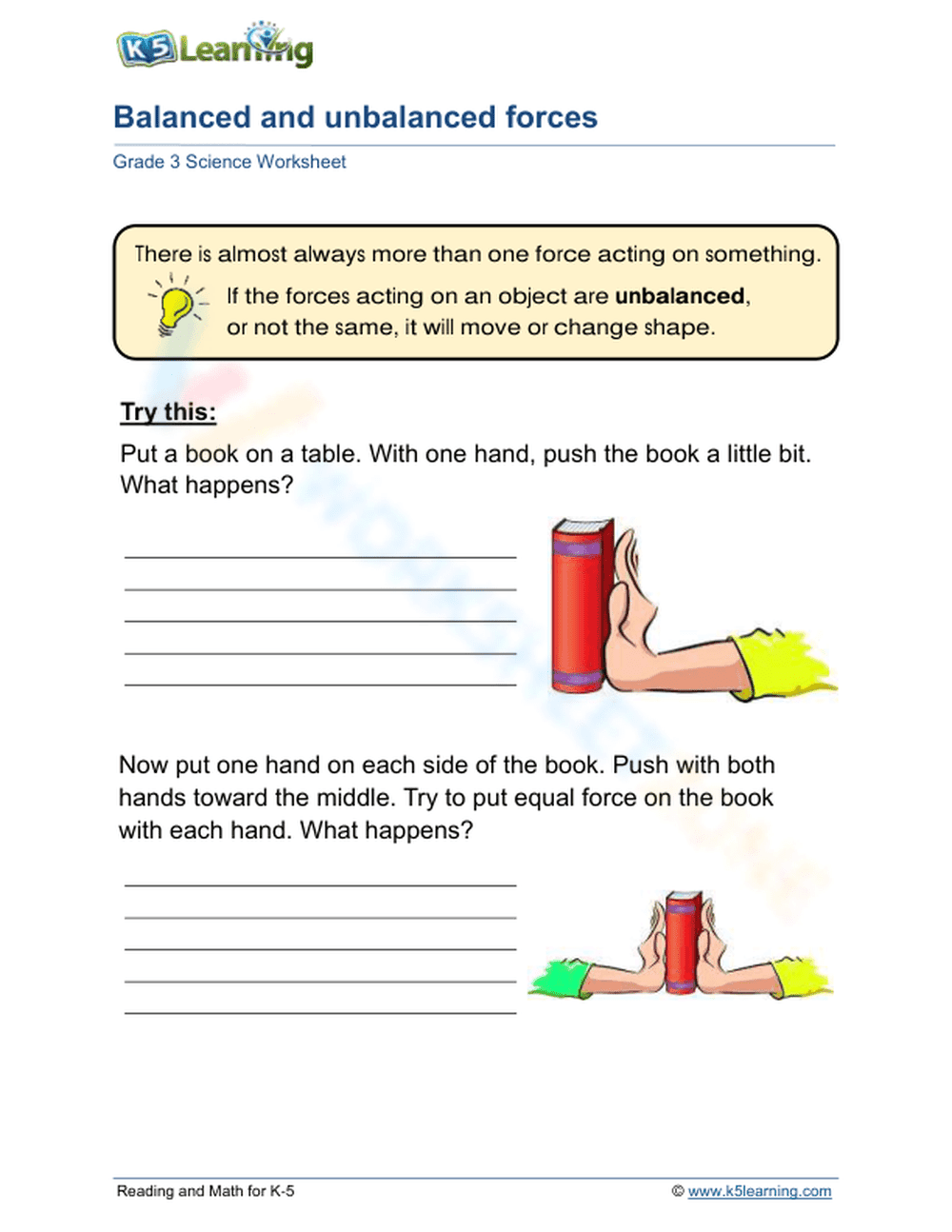

Printable Balanced and Unbalanced Forces Worksheet Grade 3
Paste this activity's link or code into your existing LMS (Google Classroom, Canvas, Teams, Schoology, Moodle, etc.).
Students can open and work on the activity right away, with no student login required.
You'll still be able to track student progress and results from your teacher account.
This Grade 3 science worksheet helps students identify the visible effects of balanced and unbalanced forces through hands-on experimentation with everyday objects. By observing how a book reacts to different physical inputs, learners build a conceptual foundation for physics, specifically how net forces dictate an object's state of motion or rest.
At a Glance
- Grade: 3 · Subject: Science
- Standard:
3-PS2-1— Plan and conduct investigations to provide evidence of effects of balanced and unbalanced forces- Skill Focus: Force and Motion Observation
- Format: 1 page · 2 problems · Answer key included · PDF
- Best For: Introduction to physical science concepts
- Time: 15–20 minutes
The resource contains a structured 1-page investigation designed for immediate classroom application. It features a clear instructional header defining unbalanced forces, followed by two "Try This" observation tasks. Students use a book and a table to simulate single-hand and dual-hand force applications, recording their results on dedicated writing lines. A full answer key is provided to streamline the grading process.
The zero-prep workflow is designed for maximum efficiency. Teachers can print the PDF in seconds and distribute it immediately. The setup requires only a textbook and a flat surface, meaning zero material prep. Students complete the reading, experiment, and reflections in under 20 minutes, making it an ideal choice for sub plans or quick science rotations.
This activity is strictly aligned to the Next Generation Science Standard `3-PS2-1`. Students engage directly in the practice of planning and conducting investigations to provide evidence of the effects of balanced and unbalanced forces on the motion of an object. This standard code can be copied directly into lesson plans, IEP goals, or district curriculum mapping tools to ensure pedagogical compliance.
Use this worksheet as a "hook" during the engagement phase of a 5E lesson on motion. Before providing formal definitions, allow students to discover the properties of forces through the "Try This" prompts. For formative assessment, observe if students can differentiate between the book's acceleration in the first task and its static state in the second. This takes approximately 15 minutes of instructional time.
This resource is tailored for Grade 3 students and works effectively in general education, resource rooms, or homeschool settings. The visual cues and simplified language support English Language Learners and students with processing needs. It pairs naturally with a classroom anchor chart showing force arrows or a short reading passage about Isaac Newton’s laws of motion.
According to the ScienceDirect TpT Analysis, effective elementary science instruction relies on "doing" to cement long-term conceptual retention. This worksheet mirrors the research-backed approach of tactile learning, where students manipulate physical objects to see 3-PS2-1 principles in action. By requiring students to describe what happens when forces are unequal, the activity bridges vocabulary and physical reality. The 2 tasks provide enough data for a valid classroom conclusion without overwhelming younger learners. This alignment with evidence-based inquiry ensures Grade 3 students are not just memorizing definitions but are actively constructing knowledge through observable evidence. This instructional design supports critical thinking skills required for physics and ensures mastery of core curriculum requirements through repeated interaction with physical phenomena.


