


























Views
Downloads

Printable Backward Counting 20-11 Worksheet | Grade K-1
Paste this activity's link or code into your existing LMS (Google Classroom, Canvas, Teams, Schoology, Moodle, etc.).
Students can open and work on the activity right away, with no student login required.
You'll still be able to track student progress and results from your teacher account.
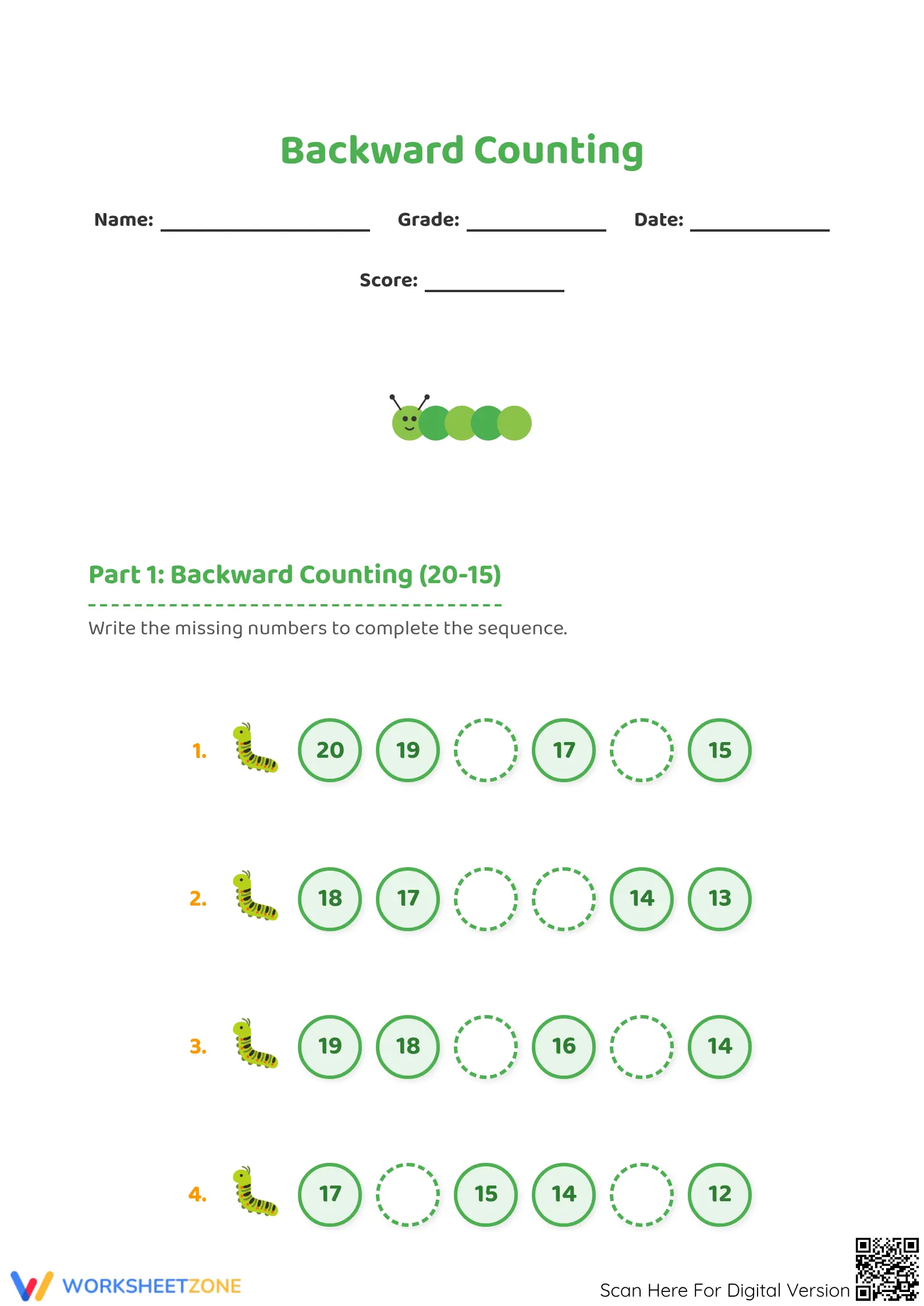
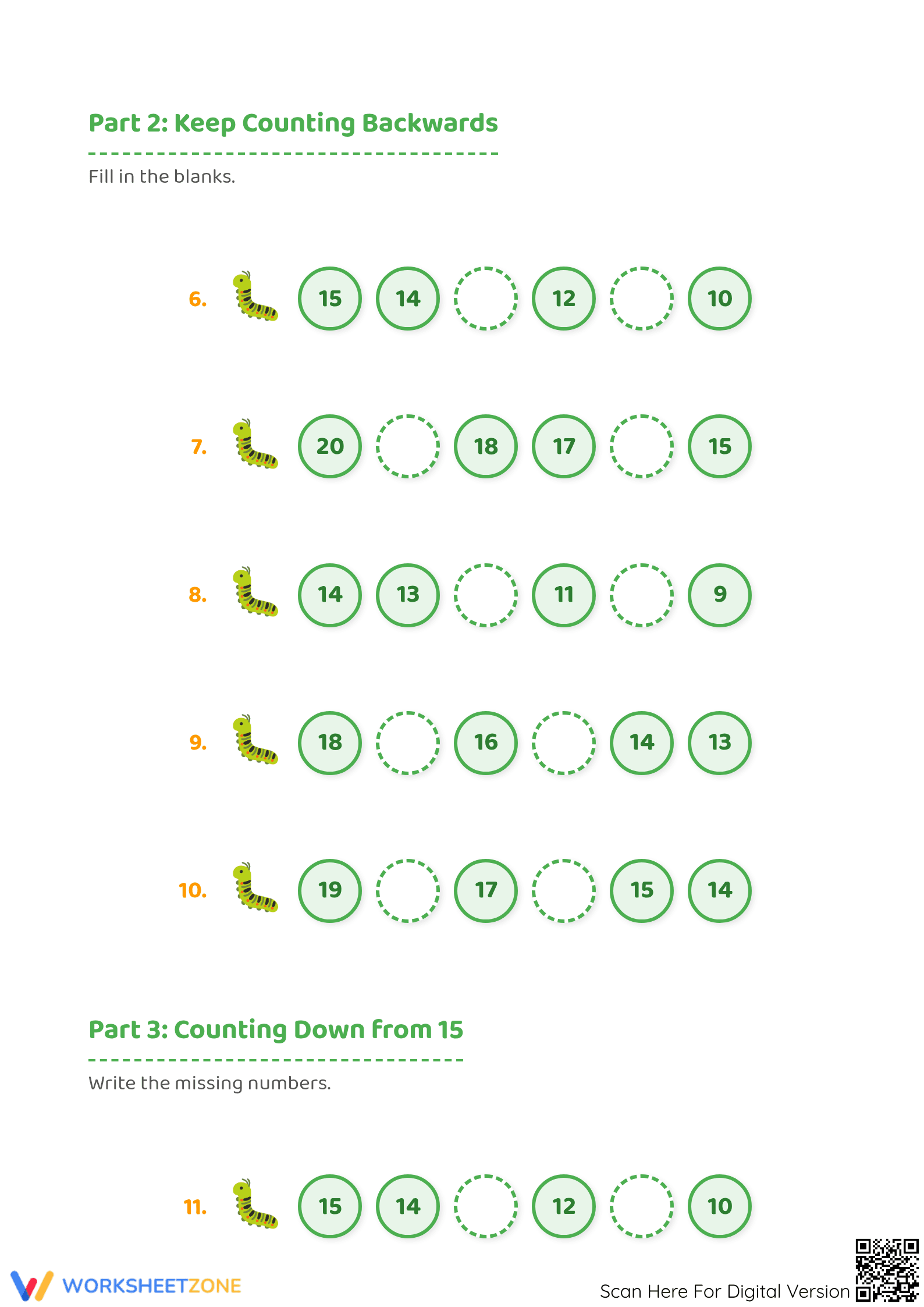
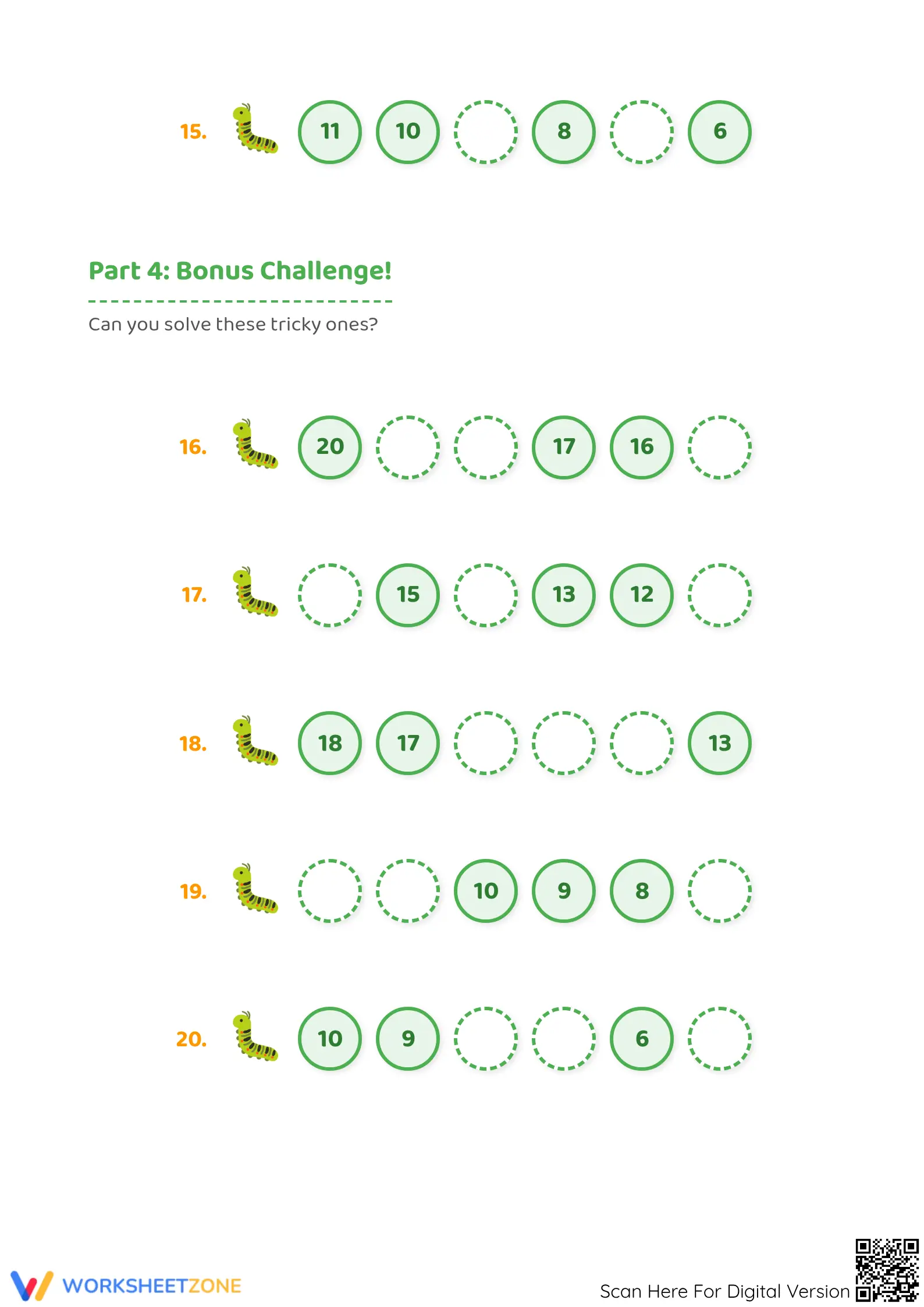
This Grade K-1 math worksheet provides a structured approach to mastering backward counting within the crucial 20 to 11 range. By filling in missing numbers across three pages of engaging visual sequences, students strengthen their mental number line and build the foundations for subtraction and arithmetic operations. It is an essential tool for early numerical fluency.
At a Glance
- Grade: Kindergarten · Subject: Math
- Standard:
CCSS.MATH.CONTENT.K.CC.A.3— Write numbers from 0 to 20 to represent a number of objects- Skill Focus: Backward counting from 20 to 11
- Format: 3 pages · 30 problems · Answer key included · PDF
- Best For: Independent math centers and morning work
- Time: 10–15 minutes
Inside this resource, you will find three distinct pages of backward counting activities. Each page features three horizontal sequences modeled as caterpillars, trains, and winding paths where several numbers are omitted. Students must identify the pattern and write the correct numerals in the blanks. The three-page format ensures ample practice, while the included full-size answer key allows for quick self-correction or rapid teacher grading.
The zero-prep workflow for this worksheet is designed for maximum teacher efficiency. First, print the three pages for your class in thirty seconds. Second, distribute the worksheets during your morning transition or as a focused math center activity. Finally, review the completed work using the provided answer key to identify students who may need additional intervention. Total preparation and assessment time remains under five minutes.
This activity is directly aligned to `CCSS.MATH.CONTENT.K.CC.A.3`, which requires students to write numbers from 0 to 20. While the primary focus is on numeral formation, the backward sequence specifically addresses number order and cardinality, supporting the broader Kindergarten counting strand. This standard code can be copied directly into lesson plans, IEP goals, or district curriculum mapping tools to ensure instructional consistency.
Use this worksheet during the independent practice phase of a lesson on number order. It serves as an excellent formative assessment tool; observe whether students hesitate at bridging numbers like 20 to 19 or 16 to 15. Alternatively, assign one page per day as a bell ringer to reinforce rote counting skills. Expect most Kindergarten students to complete one page in approximately ten to fifteen minutes.
This resource is designed for Kindergarten and Grade 1 students who are developing their early number sense. It is particularly effective for learners requiring targeted support or those who need additional scaffolding in numeral writing. Pair this worksheet with a physical number line or a 1-20 anchor chart to provide visual support for students who struggle with the cognitive load of counting in reverse.
Mastering backward counting is a critical milestone in early mathematical development, serving as a prerequisite for understanding subtraction as counting back. According to Fisher & Frey (2014), the gradual release of responsibility in number sense activities—moving from teacher-led counting to independent completion of missing sequences—is essential for long-term retention. This worksheet targets the `CCSS.MATH.CONTENT.K.CC.A.3` standard, focusing on the specific range of 20 to 11 to bridge the gap between teen numbers and the base-ten transition. Research from the NAEP highlights that students with strong early counting fluency are significantly more likely to achieve proficiency in higher-order arithmetic by the end of second grade. By providing 30 targeted practice opportunities with immediate feedback via an answer key, this resource ensures that students internalize the logical progression of numbers in reverse. This capsule provides a comprehensive summary for curriculum audits.


