


























Views
Downloads
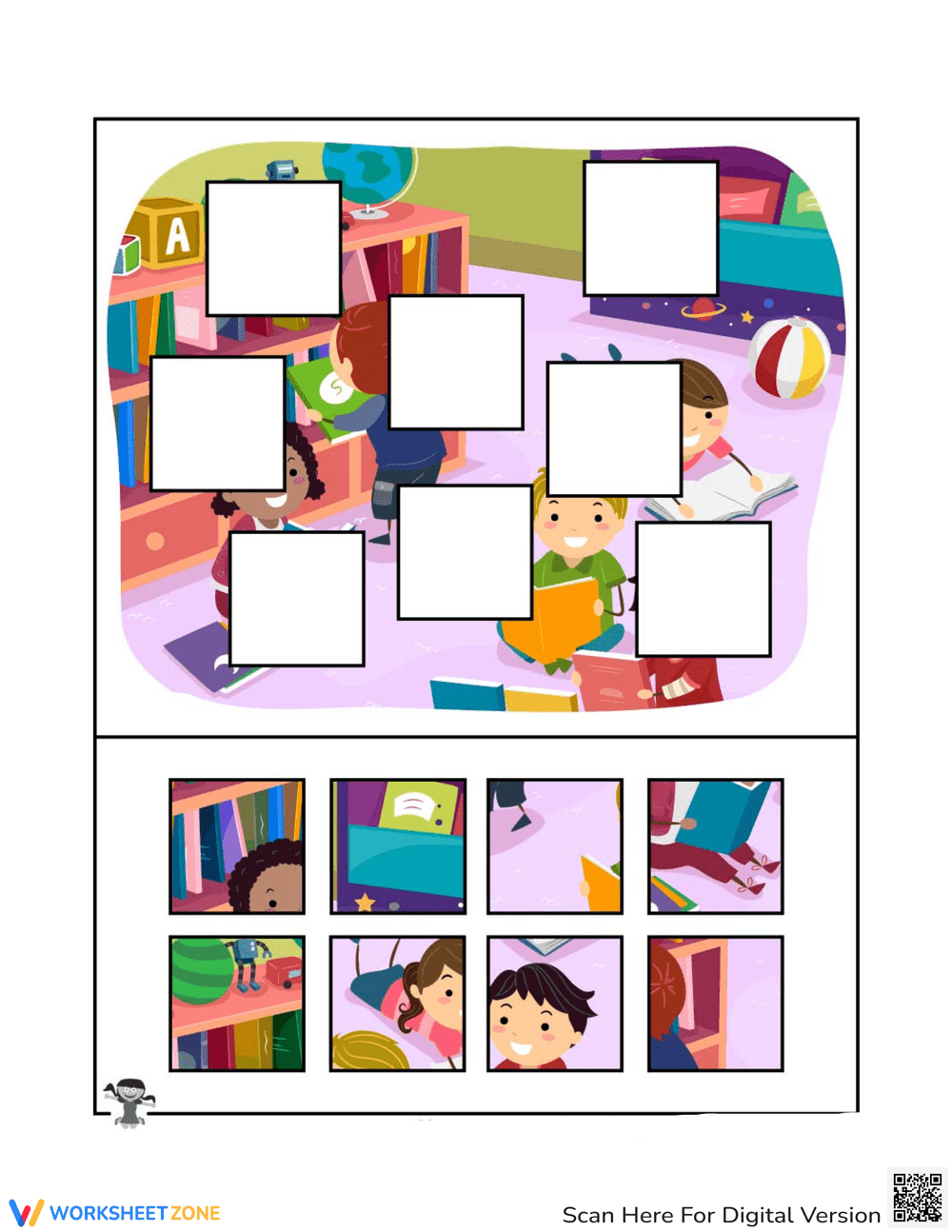

Grade K-1 Cut and Paste — Printable No-Prep Worksheet
Paste this activity's link or code into your existing LMS (Google Classroom, Canvas, Teams, Schoology, Moodle, etc.).
Students can open and work on the activity right away, with no student login required.
You'll still be able to track student progress and results from your teacher account.
This early learning cut-and-paste worksheet helps young students develop essential fine motor skills and visual-spatial reasoning. By cutting out eight distinct puzzle pieces and matching them to the correct locations on a vibrant classroom scene, children strengthen hand-eye coordination while completing an engaging back-to-school activity.
At a Glance
- Grade: K-1 · Subject: Early Learning
- Standard:
CCSS.MATH.CONTENT.K.G.A.1— Describe relative positions of objects in space- Skill Focus: Fine motor skills and spatial reasoning
- Format: 1 page · 8 problems · No answer key · PDF
- Best For: Morning work or centers
- Time: 15–20 minutes
Inside this single-page resource, educators will find a colorful classroom scene featuring eight blank squares. Below the main image is a cutting strip containing eight corresponding puzzle pieces. Students must snip out each square and use visual clues to determine where each piece belongs. The self-correcting picture puzzle provides immediate feedback without requiring a separate answer key.
This resource is designed for immediate classroom implementation with an efficient zero-prep workflow:
- Print (1 minute): Send the single-page PDF to the printer. No special paper is required.
- Distribute (1 minute): Hand out the sheets along with scissors and glue sticks. The visual instructions are intuitive for early readers.
- Review (1 minute): Quickly check completed pictures as students finish. The total teacher prep time is under two minutes, making this an excellent, stress-free option for emergency sub plans or unexpected schedule changes.
This activity aligns with CCSS.MATH.CONTENT.K.G.A.1: Describe objects in the environment using names of shapes, and describe the relative positions of these objects using terms such as above, below, beside, in front of, behind, and next to. While primarily a fine motor task, placing the puzzle pieces requires students to analyze spatial relationships and part-to-whole connections. Both standard codes can be copied directly into lesson plans, IEP goals, or district curriculum mapping tools.
Teachers can utilize this worksheet effectively during morning arrival to help students transition smoothly into the school day. It serves as an excellent independent center activity while the teacher conducts small group reading instruction. As a formative assessment observation tip, watch how students handle their scissors and rotate the paper; this provides valuable baseline data on their fine motor development and bilateral coordination. Expected completion time ranges from fifteen to twenty minutes depending on the child's scissor proficiency.
This resource is ideal for kindergarten and first-grade students, as well as preschoolers preparing for formal schooling. For differentiation, teachers can pre-cut the pieces for students who struggle with scissor skills, allowing them to focus solely on the spatial reasoning and pasting aspects. It pairs wonderfully with a read-aloud of a classic back-to-school picture book or a direct instruction lesson on classroom rules and routines.
Developing early spatial awareness and fine motor control is a critical foundation for later academic success. This activity targets CCSS.MATH.CONTENT.K.G.A.1 by asking students to describe relative positions of objects in space. According to an EdReports 2024 analysis, integrating physical manipulation with spatial reasoning tasks improves cognitive mapping in primary grades. When children cut, rotate, and place puzzle pieces, they engage sensory pathways that reinforce part-to-whole relationships. This hands-on approach ensures foundational skills are practiced in a developmentally appropriate format. By combining scissor practice with visual discrimination, educators efficiently support physical and cognitive milestones.


