


























Views
Downloads
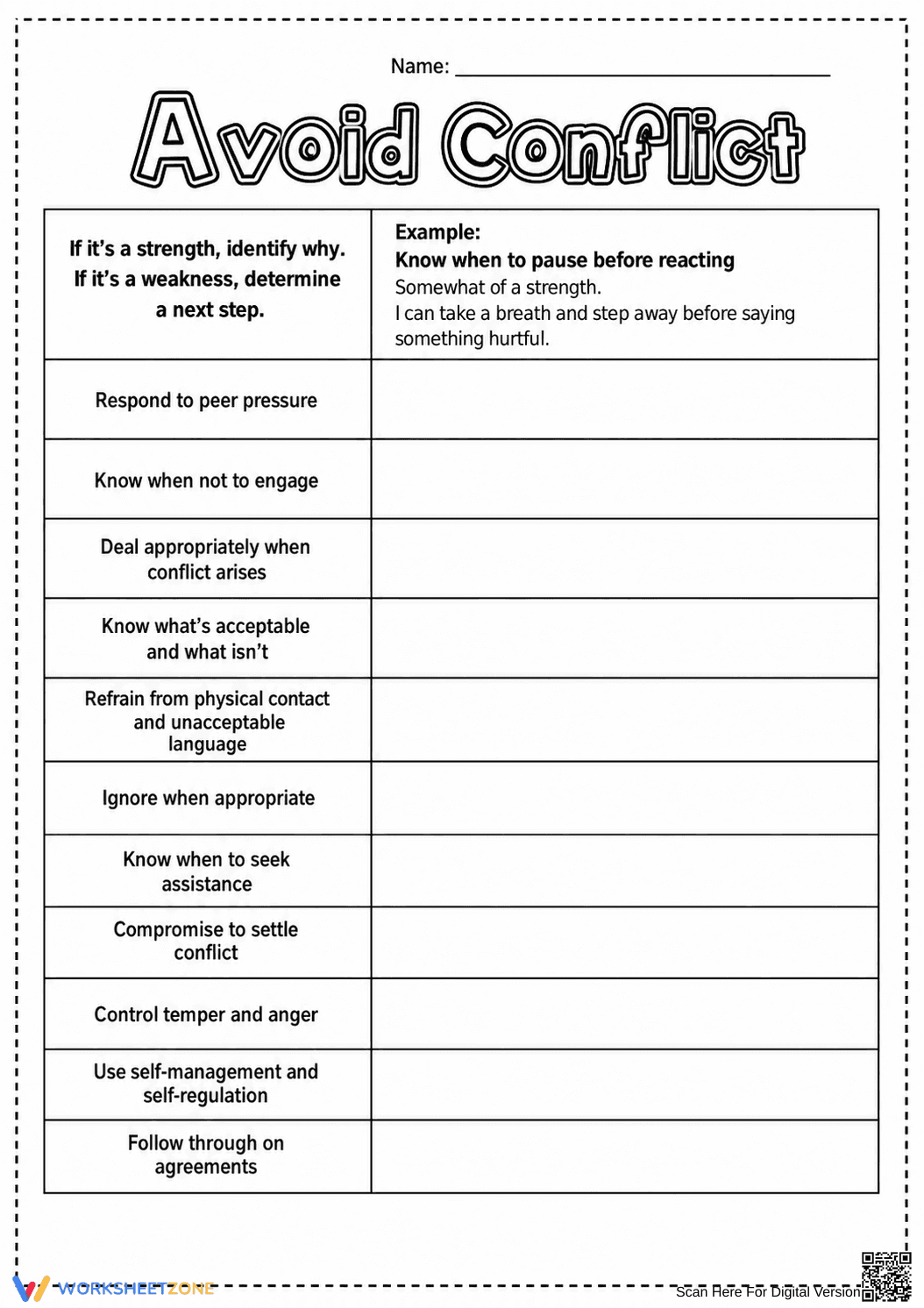

Essential Conflict Resolution Worksheet | Grades 6-9
Paste this activity's link or code into your existing LMS (Google Classroom, Canvas, Teams, Schoology, Moodle, etc.).
Students can open and work on the activity right away, with no student login required.
You'll still be able to track student progress and results from your teacher account.
This Grade 6-9 conflict resolution worksheet helps students self-evaluate their social-emotional strengths and weaknesses. By reflecting on 11 specific behavioral scenarios, learners identify actionable steps to improve their interpersonal communication and self-regulation. It provides a structured framework for students to analyze their responses to peer pressure and anger management effectively.
At a Glance
- Grade: 6-9 · Subject: Social Skills
- Standard:
CCSS.ELA-LITERACY.SL.7.1— Engage effectively in collaborative discussions and express ideas clearly- Skill Focus: Conflict Resolution & Self-Regulation
- Format: 1 page · 11 reflection tasks · No-prep · PDF
- Best For: SEL lessons and behavioral intervention
- Time: 15–20 minutes
What's Inside
The resource features a clean, single-page layout containing a comprehensive reflection table. It includes 11 distinct behavioral prompts ranging from "knowing when not to engage" to "following through on agreements." A clear worked example is provided at the top to model how students should identify strengths or determine next steps for growth.
Zero-Prep Workflow
- Print: Generate copies of the single-page PDF for the entire class in under one minute.
- Distribute: Hand out the sheets and read the provided example aloud to ensure students understand the strength/weakness reflection format (1 minute).
- Review: Collect and review student responses individually or in small groups to identify common areas needing behavioral support.
This workflow is ideal for substitute plans or morning meetings where teacher preparation time is limited.
Standards Alignment
This worksheet aligns with CCSS.ELA-LITERACY.SL.7.1, which requires students to engage effectively in a range of collaborative discussions and express their own ideas clearly. By analyzing their own communication patterns, students prepare for the self-regulation required in complex social interactions. Both standard codes can be copied directly into lesson plans, IEP goals, or district curriculum mapping tools.
How to Use It
Use this worksheet during a dedicated Social-Emotional Learning (SEL) block or as a restorative justice tool after a classroom disagreement. As a formative assessment, observe which students struggle to identify "next steps" for their weaknesses, as this indicates a need for more direct instruction in specific coping strategies. Completion typically takes 15 to 20 minutes depending on the depth of student reflection.
Who It's For
This resource is designed for middle school students in grades 6 through 9, including those in general education, special education (IEP), or behavioral intervention programs. It pairs naturally with an anchor chart on de-escalation strategies or a direct instruction lesson on active listening and compromise.
According to the RAND AIRS 2024 report, structured self-reflection tools are vital for developing adolescent social-emotional competencies, particularly in conflict resolution and self-management. This worksheet addresses CCSS.ELA-LITERACY.SL.7.1 by prompting students to articulate their internal behavioral processes, a prerequisite for effective collaborative discussion. Research from Fisher & Frey (2014) emphasizes that metacognitive tasks—like identifying personal strengths and weaknesses in social settings—bridge the gap between theoretical knowledge and real-world application. By providing 11 specific behavioral prompts, this resource allows educators to collect qualitative data on student self-perception, which is essential for tracking progress in behavioral intervention plans (BIPs). The inclusion of a worked example ensures that students understand the expected depth of reflection, supporting the gradual release of responsibility in social-emotional learning contexts across middle school grade levels.


