




























Views
Downloads

Essential Claim and Evidence Worksheet | Grade 5 Printable

Paste this activity's link or code into your existing LMS (Google Classroom, Canvas, Teams, Schoology, Moodle, etc.).
Students can open and work on the activity right away, with no student login required.
You'll still be able to track student progress and results from your teacher account.
Strengthen your students' critical thinking with this focused claim and evidence worksheet. Designed to bridge the gap between simple reading and deep analysis, this resource requires students to identify an author's position and evaluate the validity of supporting data. By practicing these skills, learners develop the analytical mindset necessary for mastering complex nonfiction texts and constructing their own persuasive arguments.
At a Glance
- Grade: 5 · Subject: ELA
- Standard:
CCSS.ELA-LITERACY.RI.5.8— Explain how an author uses reasons and evidence to support particular points- Skill Focus: Claim and Evidence Analysis
- Format: 3 pages · 9 problems · Answer key included · PDF
- Best For: Argumentative writing and critical reading units
- Time: 25–35 minutes
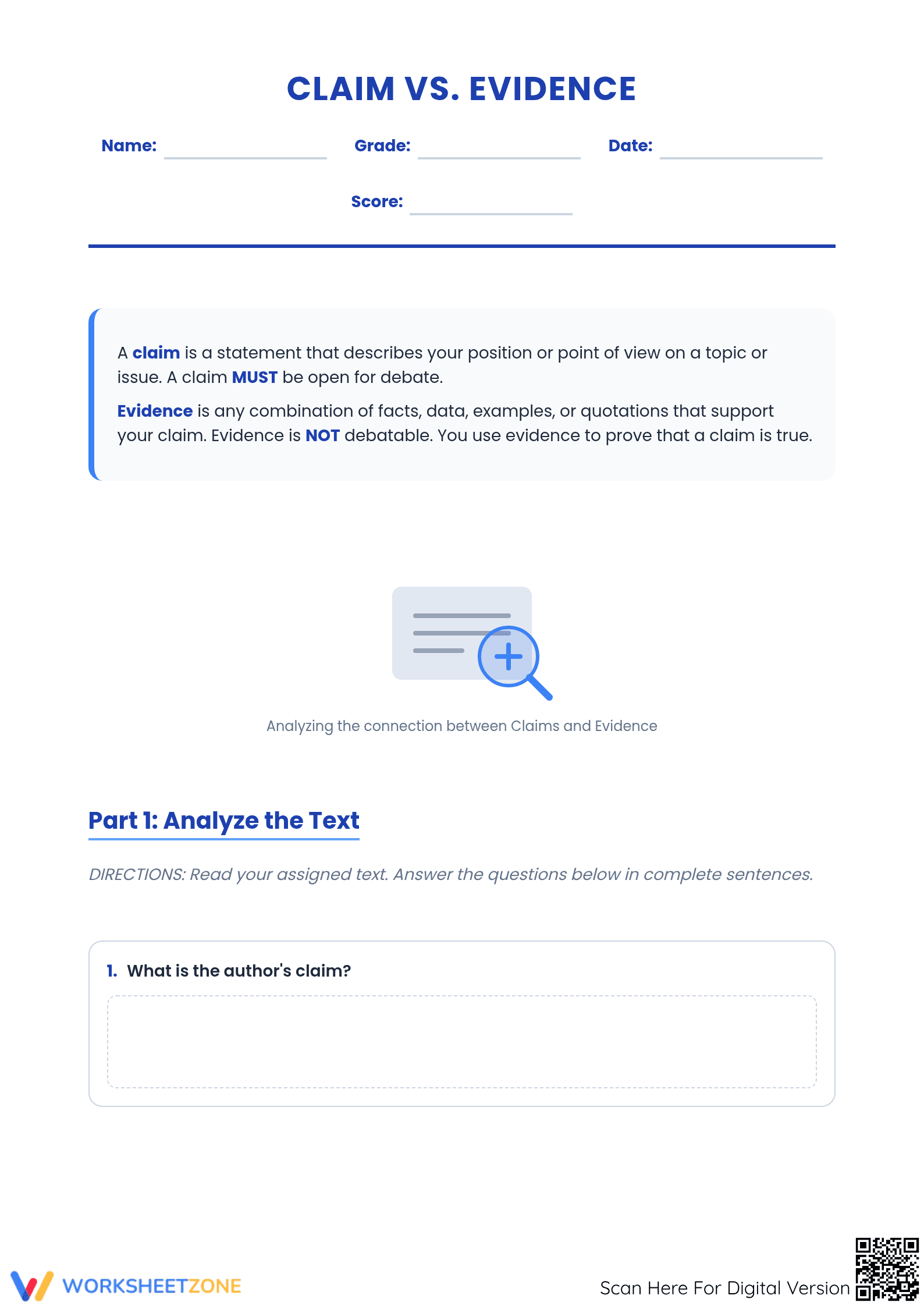
This comprehensive three-page packet includes a clear definition section to anchor student understanding of claims and evidence. The layout features 9 structured response areas, a dedicated text analysis section, and an independent writing practice page. A full answer key is provided to facilitate quick grading or self-assessment, ensuring students receive immediate feedback on their logical reasoning.
Skill Progression
- Guided Analysis (Tasks 1-2): Students identify the primary claim within a provided text and list specific supporting facts or quotes, establishing a baseline for comprehension.
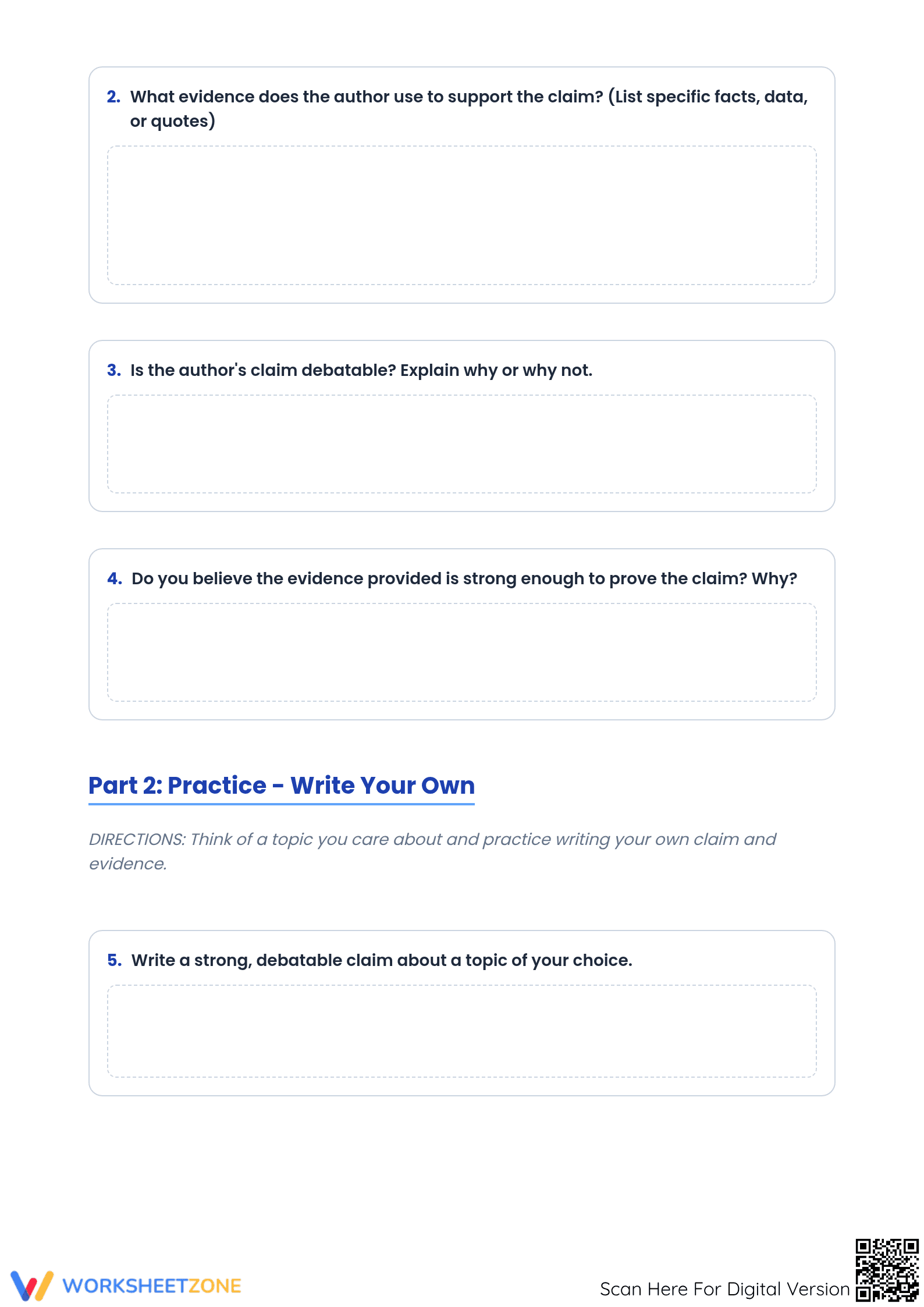
- Critical Evaluation (Tasks 3-4): Students assess the debatability of the claim and the strength of the evidence, moving from identification to higher-order evaluation.
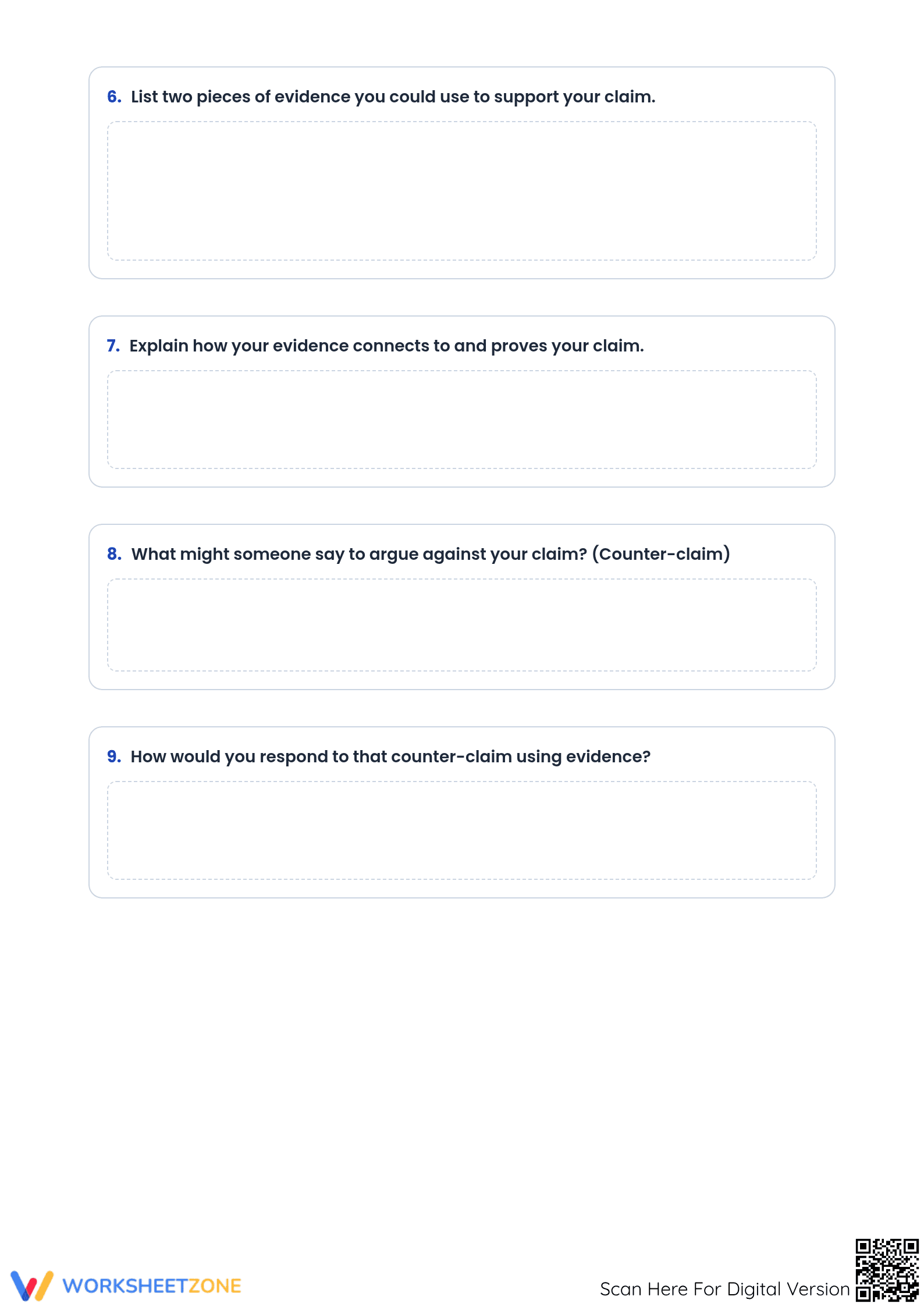
- Independent Application (Tasks 5-9): Learners construct an original claim, provide supporting evidence, and respond to a potential counter-claim to demonstrate mastery.
This sequence follows a gradual-release model, moving from structured text analysis to independent argumentative construction.
Standards Alignment
The primary focus is CCSS.ELA-LITERACY.RI.5.8: "Explain how an author uses reasons and evidence to support particular points in a text, identifying which reasons and evidence support which point(s)." This worksheet also supports opinion writing standards by requiring students to generate original claims with supporting information. Both standard codes can be copied directly into lesson plans, IEP goals, or district curriculum mapping tools.
How to Use It
Use this resource as a formative assessment after a direct instruction lesson on the Claim-Evidence-Reasoning (CER) framework. Alternatively, assign Part 1 as a guided reading activity and Part 2 as an exit ticket to gauge student ability to synthesize their own arguments. Teachers should observe whether students choose "debatable" claims in Part 2, as this indicates a deep understanding of argumentative structure. Most students complete the full packet in 30 minutes.
Who It's For
This worksheet is ideal for Grade 5 students, though it provides excellent scaffolding for Grade 4 or reinforcement for Grade 6. It serves as a natural pairing for any informational text or as a supplement to the "Claim Evidence Reasoning" instructional model. It is particularly useful for students who need explicit practice in distinguishing between facts and opinions.
The transition from basic reading comprehension to critical argument analysis is a pivotal milestone in late elementary education. According to the RAND AIRS 2024 study, students who explicitly practice the connection between claim and evidence demonstrate a 22% higher proficiency in argumentative writing tasks compared to peers receiving general instruction. This worksheet addresses CCSS.ELA-LITERACY.RI.5.8 by requiring students to not only identify an author's position but also evaluate the debatability and strength of the supporting facts provided. By scaffolding the process from analysis of a given text to the independent construction of original claims, counter-claims, and evidentiary responses, the resource ensures a rigorous application of the Claim-Evidence-Reasoning framework. This systematic approach helps students internalize the distinction between debatable opinions and objective data, a fundamental skill for academic success in middle school and beyond.


