


























Views
Downloads
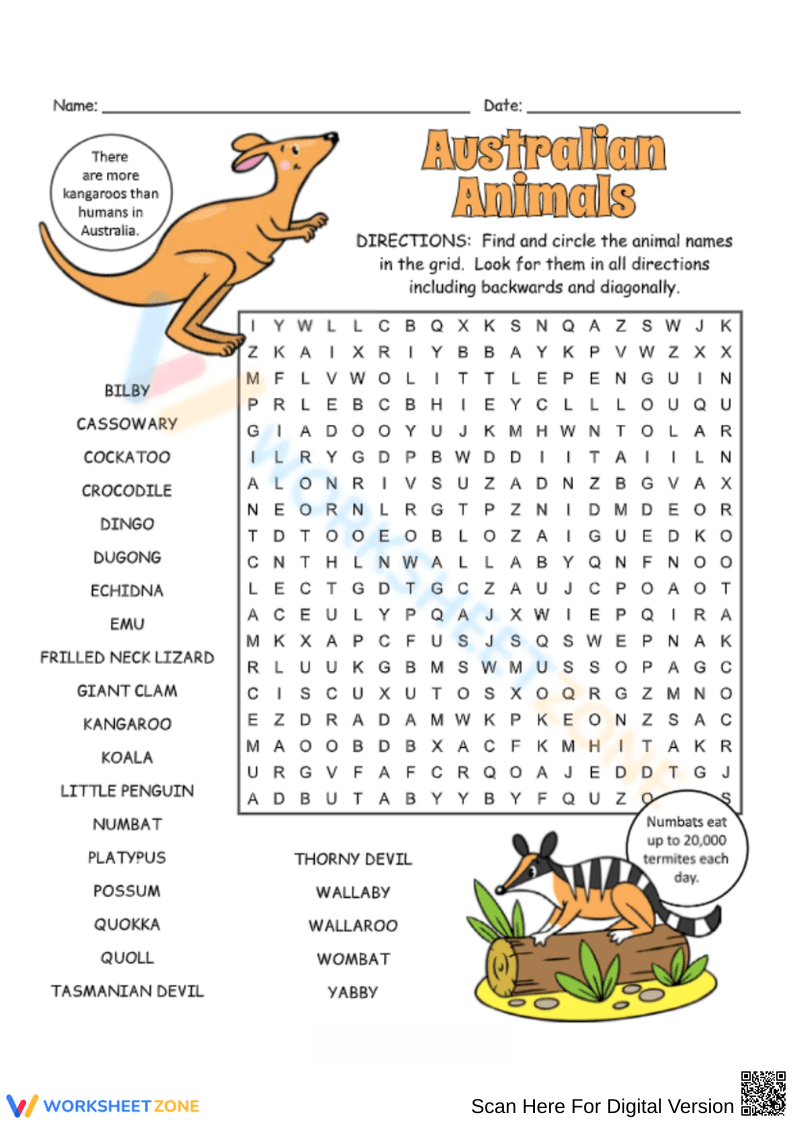

Australian Animals Word Search | Grade 4-5 Essential
Paste this activity's link or code into your existing LMS (Google Classroom, Canvas, Teams, Schoology, Moodle, etc.).
Students can open and work on the activity right away, with no student login required.
You'll still be able to track student progress and results from your teacher account.
This Australian animals word search provides an engaging way for Grade 4 and 5 students to build scientific vocabulary while exploring unique biodiversity. By identifying 24 distinct species, learners reinforce their recognition of regional wildlife and biological terminology. It serves as an effective introductory activity for units on ecosystems, habitats, or animal adaptations.
At a Glance
- Grade: 4-5 · Subject: Science
- Standard:
4-LS1-1— Construct an argument that plants and animals have internal and external structures- Skill Focus: Australian Wildlife Vocabulary
- Format: 1 page · 24 problems · Answer key included · PDF
- Best For: Fast finishers and vocabulary introduction
- Time: 15–20 minutes
Inside this resource, you will find a comprehensive word search grid containing 24 animal names, ranging from the well-known Kangaroo and Koala to unique species like the Numbat, Bilby, and Quokka. The layout includes vibrant illustrations and educational facts to spark curiosity. A full answer key is provided to facilitate quick grading or student self-correction.
The zero-prep workflow is designed for maximum efficiency. First, print the single-page PDF (30 seconds). Second, distribute the sheets to students as they enter the room or finish a primary task (1 minute). Third, review the animal names and facts together to transition into a deeper science discussion (5 minutes). Total teacher preparation time is under two minutes, making it a perfect sub plan addition.
This worksheet aligns with `4-LS1-1`, focusing on the diversity of animal structures and species within a specific geographic region. It also supports 5-LS2-1 by introducing the components of an Australian ecosystem. Both standard codes can be copied directly into lesson plans, IEP goals, or district curriculum mapping tools.
Use this as a hook at the start of a life science unit to gauge prior knowledge of global wildlife. Alternatively, assign it as a formative assessment for fast finishers to keep them engaged with content-rich material. Observe if students can categorize the animals (e.g., marsupials vs. reptiles) after completing the search. Completion typically takes 15 to 20 minutes.
This activity is ideal for general education classrooms, ESL students building English animal vocabulary, and homeschoolers. It pairs naturally with a slideshow on Australian habitats or a reading passage about marsupial adaptations. The visual cues help support diverse learners in identifying complex names like "Tasmanian Devil" or "Cassowary."
According to the RAND AIRS 2024 report on supplemental materials, high-quality vocabulary puzzles like this Australian animals word search contribute to cognitive retention by requiring active scanning and pattern recognition. By focusing on 24 specific species, the worksheet supports the 4-LS1-1 standard, which emphasizes understanding the diverse structures and functions of living organisms. Research from Fisher & Frey (2014) suggests that word-level tasks, when integrated into a broader science curriculum, help bridge the gap between casual language and academic terminology. This resource provides a low-stakes environment for students to encounter complex biological names, such as "Echidna" and "Platypus," which are essential for discussing evolutionary adaptations and regional biodiversity. The inclusion of educational facts further enriches the experience, ensuring that the task remains grounded in scientific inquiry rather than just letter identification. This makes it a valuable tool for Grade 4 and 5 science instruction.


