


























Views
Downloads


Essential Grade 3 Attractive Alloys Science Worksheet
Paste this activity's link or code into your existing LMS (Google Classroom, Canvas, Teams, Schoology, Moodle, etc.).
Students can open and work on the activity right away, with no student login required.
You'll still be able to track student progress and results from your teacher account.
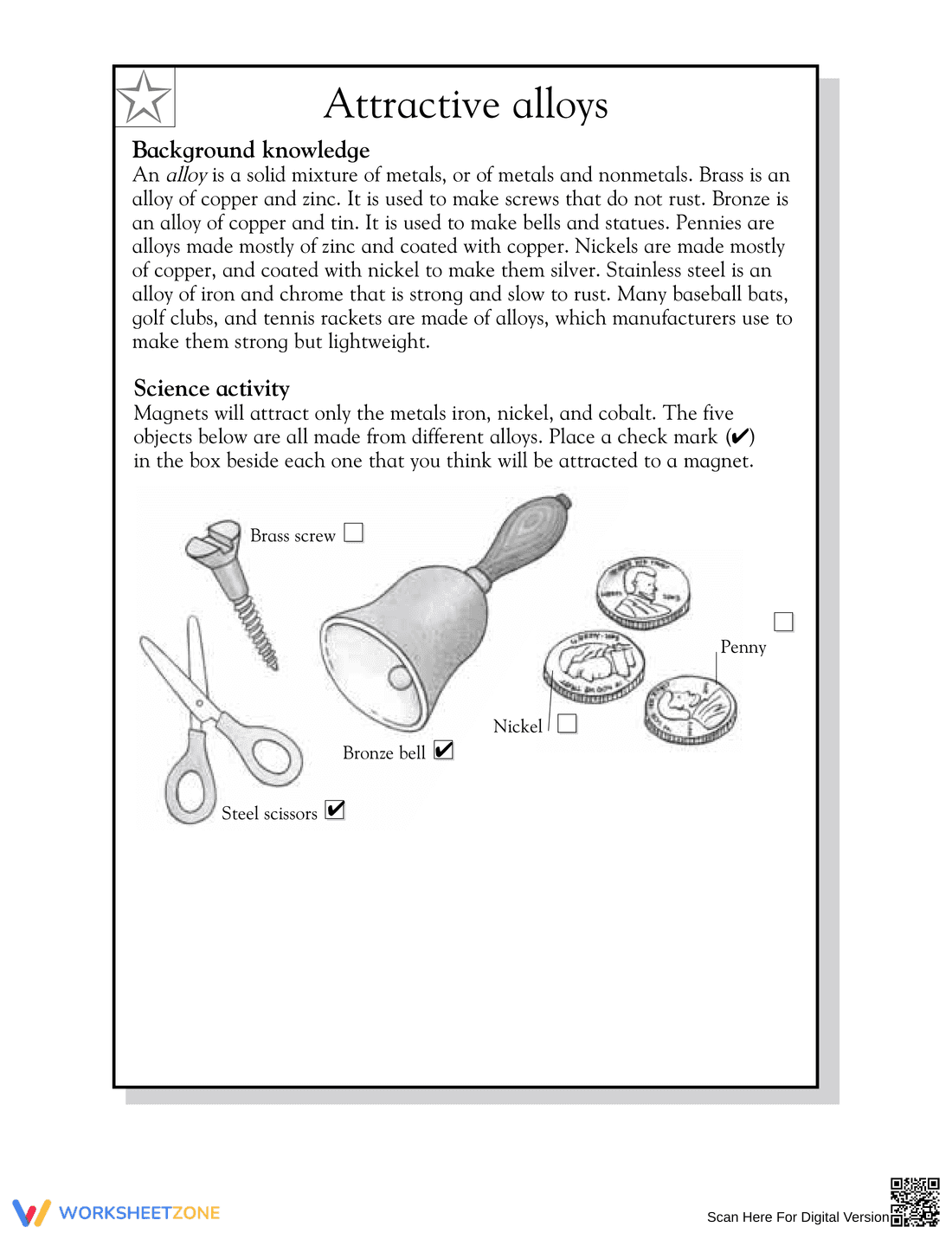
This Essential Grade 3 science worksheet introduces students to the properties of magnets and alloys. Students explore why magnets only attract iron, nickel, and cobalt while testing knowledge on common items. This activity ensures mastery of physical science principles through observation and critical thinking.
At a Glance
- Grade: 3 · Subject: Science
- Standard:
3-PS2-3— Determine cause and effect relationships of magnetic interactions between two objects- Skill Focus: Magnetic Properties of Alloys
- Format: 2 pages · 6 problems · Answer key included · PDF
- Best For: Introduction to magnetism and metallic properties
- Time: 15–20 minutes
The worksheet features a two-page layout. Section one provides background knowledge defining alloys and explaining compositions of brass, bronze, and steel. The core activity presents five illustrated objects—a brass screw, bronze bell, steel scissors, nickel, and penny—for analysis. A "Science Investigation" section prompts students to record observations in a data table. A complete answer key is included.
Zero-Prep Workflow
This printable resource is optimized for zero-prep, requiring under two minutes of teacher preparation. First, print the worksheet (1 minute). Next, students read the background text and complete the identification task (5 minutes). Finally, review answers using the included key as a whole-class check (5 minutes). Its self-explanatory nature makes it ideal for sub plans or independent science centers where teacher intervention is minimal.
Standards Alignment
This resource aligns with 3-PS2-3, requiring students to determine cause and effect relationships of magnetic interactions. By identifying which alloys contain magnetic elements, students build a foundational understanding of material properties. This standard code can be copied directly into lesson plans, IEP goals, or district curriculum mapping tools.
How to Use It
Use this during the "Explain" phase of a magnetism lesson. It bridges hands-on hunting with formal assessment. For a formative-assessment tip, observe students distinguishing between metals like aluminum and stainless steel. Completion usually takes 20 minutes.
Who It's For
Designed for Grade 3, this is adaptable for Grade 4 review or Grade 2 enrichment. Background knowledge supports ELLs and students needing reading help. It pairs naturally with magnets and real metal objects to turn the activity into a live lab experience.
According to the RAND AIRS 2024 study on science education, integrating background knowledge with predictive tasks enhances a student's ability to retain concepts like magnetic attraction. This worksheet addresses 3-PS2-3 by asking students to determine cause and effect relationships of magnetic interactions. By focusing on the plain-English skill of identifying magnetic properties in alloys, the resource provides a pathway toward scientific literacy. Fisher & Frey (2014) emphasize that such guided practice is essential for moving students toward independent inquiry. This resource ensures learners are not just memorizing facts but applying understanding of iron, nickel, and cobalt to real-world objects. The data-recording investigation aligns with best practices for formative assessment, ensuring a comprehensive experience. This structured approach helps Grade 3 students bridge the gap between simple observation and the complex reasoning required for physical science mastery.


