


























Views
Plays
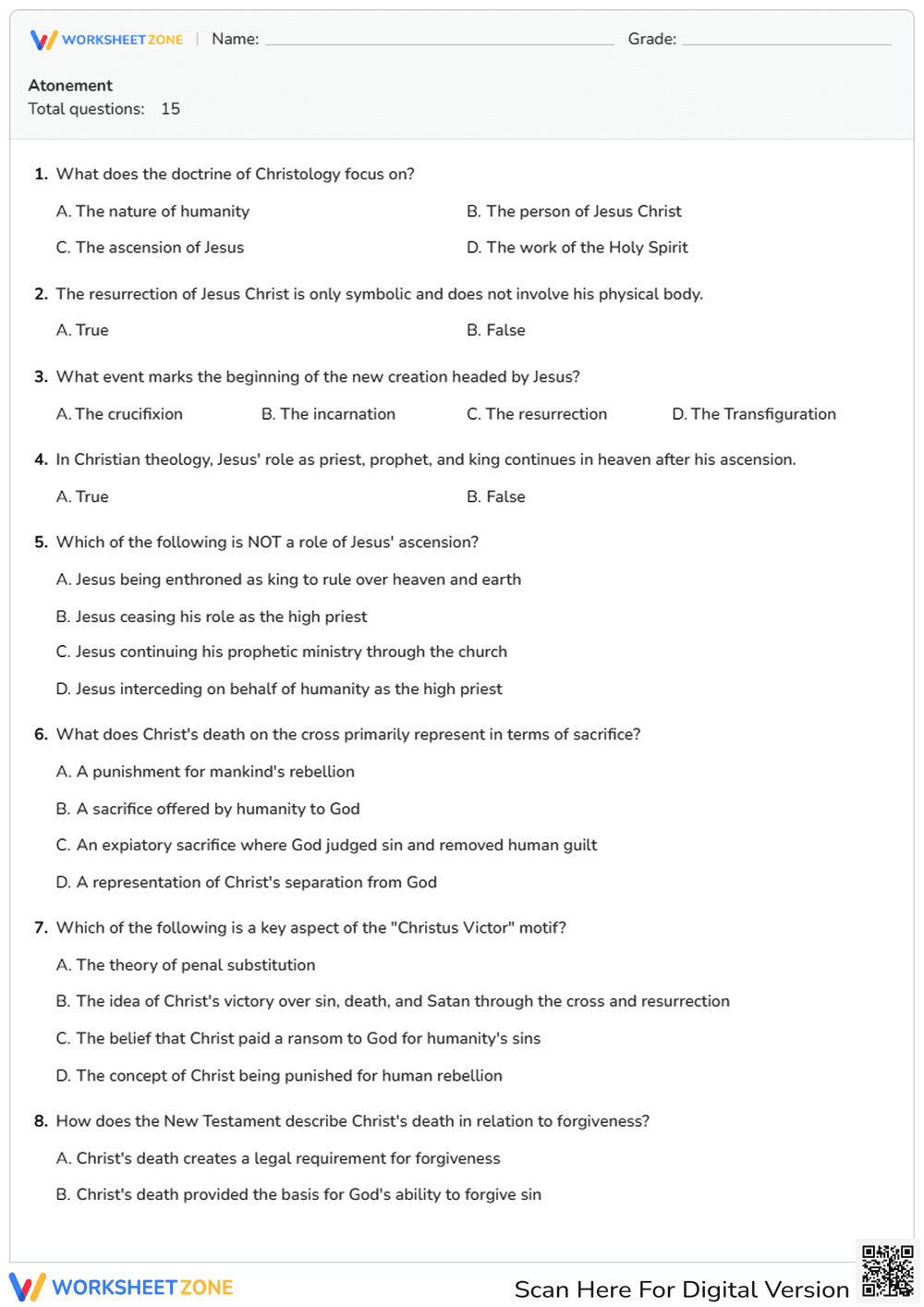

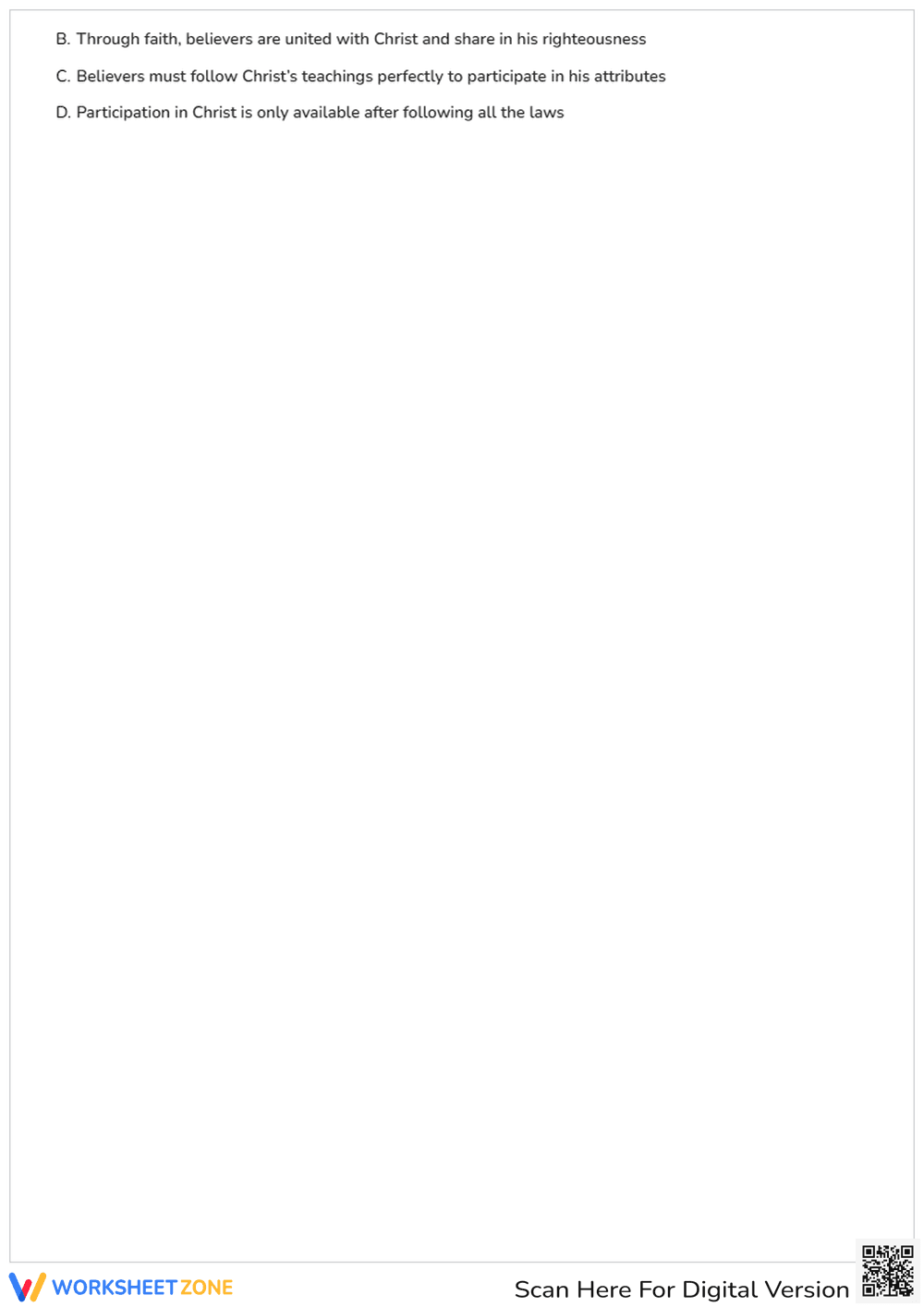

Atonement Quiz: Essential Grade 12 Social Studies
Paste this activity's link or code into your existing LMS (Google Classroom, Canvas, Teams, Schoology, Moodle, etc.).
Students can open and work on the activity right away, with no student login required.
You'll still be able to track student progress and results from your teacher account.
This Grade 12 Social Studies worksheet provides a comprehensive assessment of the doctrine of Atonement and Christology. Students will demonstrate their understanding of complex theological frameworks, including the resurrection, ascension, and various motifs of sacrifice. This resource ensures learners can accurately define and apply specialized terminology within the context of World Religions and the history of ideas.
At a Glance
- Grade: 12 · Subject: Social Studies
- Standard:
CCSS.ELA-LITERACY.RH.11-12.4— Determine the meaning of specialized religious and historical terminology in context- Skill Focus: Atonement and Christology doctrines
- Format: 3 pages · 15 problems · Answer key included · PDF
- Best For: Unit quiz or formative assessment
- Time: 15–20 minutes
What's Inside: This 3-page assessment features 15 carefully constructed tasks, including multiple-choice questions and true-false statements. The worksheet covers critical concepts such as the "Christus Victor" motif, justification, reconciliation, and the roles of Jesus as priest, prophet, and king. A full answer key is provided to facilitate quick grading and immediate student feedback.
Zero-Prep Workflow
- Print: Select the 3-page PDF and print enough copies for your class in under 30 seconds.
- Distribute: Hand out the assessment as a quiet, independent activity requiring zero teacher setup.
- Review: Use the included answer key to grade the 15 questions or conduct a peer-review session in 10 minutes.
This streamlined process allows for efficient data collection on student mastery without increasing teacher workload.
Standards Alignment
This resource is primary aligned to `CCSS.ELA-LITERACY.RH.11-12.4`: Determine the meaning of words and phrases as they are used in a text, including analyzing how an author uses and refines the meaning of a key term over the course of a text. Both standard codes can be copied directly into lesson plans, IEP goals, or district curriculum mapping tools.
How to Use It
Assign this worksheet as a summative quiz following a unit on World Religions or Christian History. It also serves as an excellent formative assessment during direct instruction to check for misconceptions regarding specific doctrines. Expect students to complete the 15 tasks within 20 minutes. Observe whether students struggle with the distinction between justification and reconciliation to guide your next review session.
Who It's For
This resource is designed for Grade 11, Grade 12, and introductory College students. It is particularly effective for AP European History, World History, or Philosophy electives. It pairs naturally with primary source readings from theological texts or an anchor chart detailing the different theories of atonement.
This educational resource focuses on the complex theological framework of Atonement and Christology, aligned with CCSS.ELA-LITERACY.RH.11-12.4. By requiring students to distinguish between nuanced concepts like justification, reconciliation, and the 'Christus Victor' motif, the worksheet promotes high-level cognitive processing of abstract historical and religious terminology. According to Fisher & Frey (2014), the use of structured assessments in the social sciences helps bridge the gap between initial exposure to complex vocabulary and long-term conceptual retention. This 15-question instrument provides a reliable metric for evaluating student mastery of the specific student action: determining the meaning of words and phrases as they are used in a specialized text. The inclusion of multiple-choice and true-false formats ensures that learners can demonstrate their understanding of the person and work of Jesus Christ within a historical and doctrinal context, making it a vital tool for secondary and post-secondary religious studies curriculum mapping.


