


























Views
Downloads
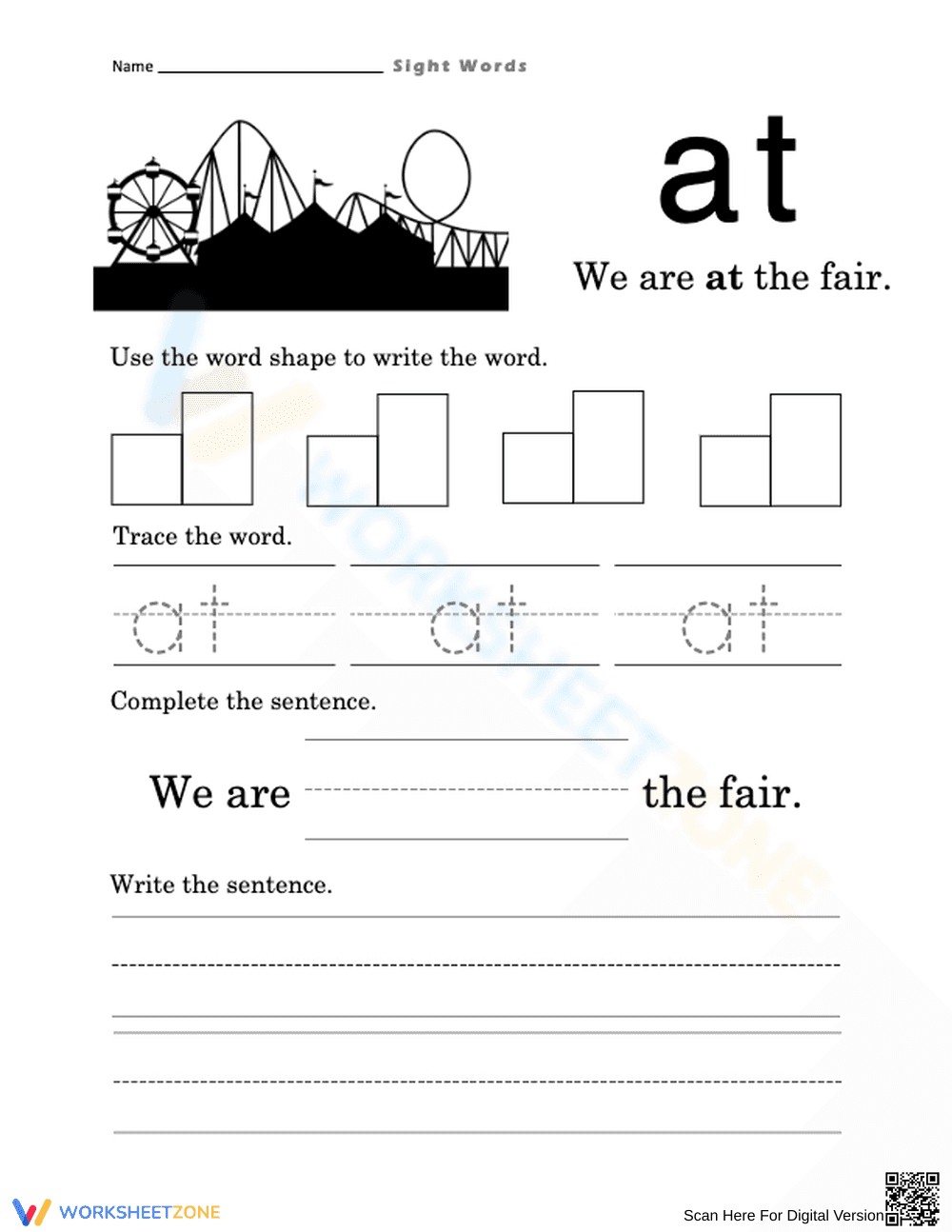

at Sight Word Worksheet | Grade 1 Essential Practice
Paste this activity's link or code into your existing LMS (Google Classroom, Canvas, Teams, Schoology, Moodle, etc.).
Students can open and work on the activity right away, with no student login required.
You'll still be able to track student progress and results from your teacher account.
This Grade 1 sight word worksheet provides focused practice for the high-frequency word "at" through a multi-sensory approach. Students strengthen their word recognition and fine motor skills by tracing, writing, and applying the word in context. This resource ensures early readers build the automaticity needed for reading fluency and confident sentence construction in daily writing.
At a Glance
- Grade: 1 · Subject: English
- Standard:
CCSS.ELA-LITERACY.RF.1.3.G— Recognize and read grade-appropriate irregularly spelled high-frequency words- Skill Focus: Sight word recognition and writing
- Format: 1 page · 10 tasks · Answer key included · PDF
- Best For: Literacy centers and independent morning work
- Time: 10–15 minutes
What's Inside
This single-page PDF features 10 targeted tasks designed to reinforce the sight word "at." The layout includes a visual word shape activity, a tracing section with guided dashed lines, a sentence completion prompt featuring a "fair" theme, and dedicated space for independent sentence writing. A full answer key is provided to facilitate quick grading or student self-correction.
Skill Progression
- Guided Practice: Students trace the word three times using dashed guides to establish correct letter formation and muscle memory.
- Supported Practice: Four word-shape boxes provide visual scaffolding, helping students internalize the word's physical structure and letter heights.
- Independent Practice: Learners complete a sentence and then write it independently on primary-ruled lines to demonstrate mastery.
This resource utilizes a gradual release model, moving students from heavy scaffolding to independent application.
Standards Alignment
The worksheet is primary aligned to `CCSS.ELA-LITERACY.RF.1.3.G`, which requires students to recognize and read grade-appropriate irregularly spelled words. It also supports `CCSS.ELA-LITERACY.L.1.2.E` by encouraging phonetic spelling and correct word usage in written sentences. Both standard codes can be copied directly into lesson plans, IEP goals, or district curriculum mapping tools.
How to Use It
Assign this worksheet during the independent practice phase of a direct instruction lesson on high-frequency words. Teachers can observe students during the tracing phase to identify fine motor difficulties or letter reversal tendencies. It serves as an excellent formative assessment tool; a quick review of the final sentence writing task reveals if the student can transfer word recognition to active production.
Who It's For
This resource is designed for first-grade students and kindergarteners ready for more advanced writing. It is ideal for Tier 2 intervention groups needing extra repetition with core vocabulary. Pair this worksheet with a decodable text or an anchor chart featuring common prepositions to deepen the student's understanding of the word's function in sentences.
The effective acquisition of sight words like "at" is a fundamental component of early literacy, as these high-frequency words often do not follow standard phonetic rules. According to Fisher & Frey (2014), the gradual release of responsibility—transitioning from guided tracing to independent sentence writing—is a proven instructional strategy that leads to long-term skill retention. This worksheet leverages that pedagogical framework by providing ten structured tasks that move the student through visual recognition, physical tracing, and contextual application. By focusing on the CCSS.ELA-LITERACY.RF.1.3.G standard, the resource ensures that Grade 1 learners develop the automaticity required for fluent reading. Research from RAND AIRS 2024 indicates that consistent, focused practice with core vocabulary significantly reduces cognitive load during complex reading tasks, allowing students to focus on comprehension rather than decoding. This printable PDF serves as a reliable tool for classroom teachers and literacy specialists aiming for measurable student growth in foundational ELA skills.


