




























Views
Downloads
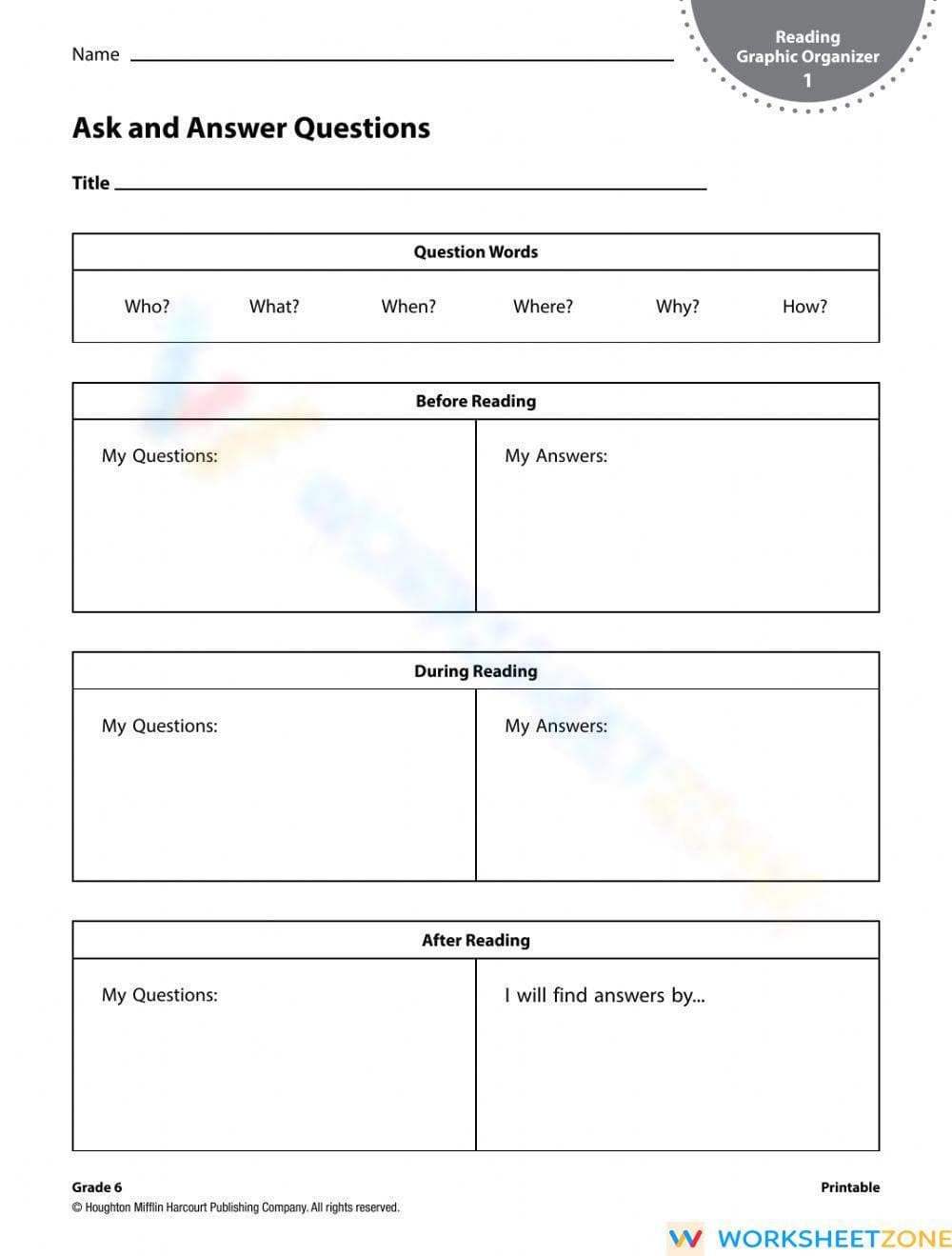

Ready-to-Print: Ask & Answer Questions Organizer (Grade 6)

Paste this activity's link or code into your existing LMS (Google Classroom, Canvas, Teams, Schoology, Moodle, etc.).
Students can open and work on the activity right away, with no student login required.
You'll still be able to track student progress and results from your teacher account.
This printable Grade 6 graphic organizer helps students actively engage with any text by asking and answering critical questions before, during, and after reading. By identifying specific question words like who, what, and why, learners develop deeper comprehension and monitoring skills. This tool effectively bridges the gap between passive reading and active evidence-based analysis for middle school students.
At a Glance
- Grade: 6 · Subject: English Language Arts
- Standard:
CCSS.ELA-LITERACY.RI.6.1— Cite textual evidence to support analysis and answer questions about text- Skill Focus: Strategic questioning and comprehension monitoring
- Format: 1 page · 3 sections · No-prep printable · PDF
- Best For: Literacy centers and independent reading response
- Time: 20–30 minutes
What's Inside
This resource features a structured one-page layout designed for immediate classroom use. It includes a dedicated "Question Words" reference box listing who, what, when, where, why, and how to scaffold student inquiry. The body of the worksheet is divided into three logical phases: Before Reading, During Reading, and After Reading. Each section provides ample space for students to record their own questions and the corresponding answers they discover within the text.
Zero-Prep Workflow
Implementing this graphic organizer requires minimal effort from the instructor. First, print the single-page PDF for your class, which takes less than one minute. Next, distribute the sheets and explain the inquiry-based prompts, requiring approximately two minutes of instruction. Finally, review student responses to assess comprehension, adding only minutes to your feedback loop. This workflow is perfectly suited for emergency sub plans or routine literacy stations.
Standards Alignment
The primary alignment for this resource is CCSS.ELA-LITERACY.RI.6.1, which requires students to cite textual evidence to support analysis of what the text says explicitly. By prompting students to formulate questions and seek answers within the document, it directly supports the development of evidence-based inquiry. Both standard codes can be copied directly into lesson plans, IEP goals, or district curriculum mapping tools.
How to Use It
Use this organizer as a guided note-taking tool during your next informational text unit. Introduce it after direct instruction on question-answer relationships (QAR) to provide a concrete framework for student practice. A great formative assessment tip is to walk around during the "During Reading" phase and observe which students are struggling to find answers, signaling a need for a small-group intervention. Expect students to complete the full cycle in 20 to 30 minutes.
Who It's For
This worksheet is designed for Grade 6 students but is versatile enough for Grade 5 or Grade 7 learners who need structured comprehension support. It is particularly effective for English Language Learners (ELLs) and students with IEPs who benefit from the visual scaffolding of question words and clear temporal boundaries. Pair this resource with a short informational passage or an anchor chart on active reading strategies for a complete lesson.
Aligned with `CCSS.ELA-LITERACY.RI.6.1`, this graphic organizer targets asking and answering questions for deep textual analysis. Research emphasizes that "questioning is the engine of comprehension." This structured before-during-after model helps students develop meta-cognitive habits. By focusing on "who, what, where" alongside "how and why," students move from basic recall to higher-order critical thinking. This printable resource supports the gradual release of responsibility, allowing students to internalize the inquiry process. Educators can use this tool to gather evidence of student mastery in identifying key details and citing evidence, aligning with the NAEP reading framework and state assessments.


