


























Views
Downloads

Essential Arthropod Classification Worksheet | Grade 1 Ready
Paste this activity's link or code into your existing LMS (Google Classroom, Canvas, Teams, Schoology, Moodle, etc.).
Students can open and work on the activity right away, with no student login required.
You'll still be able to track student progress and results from your teacher account.
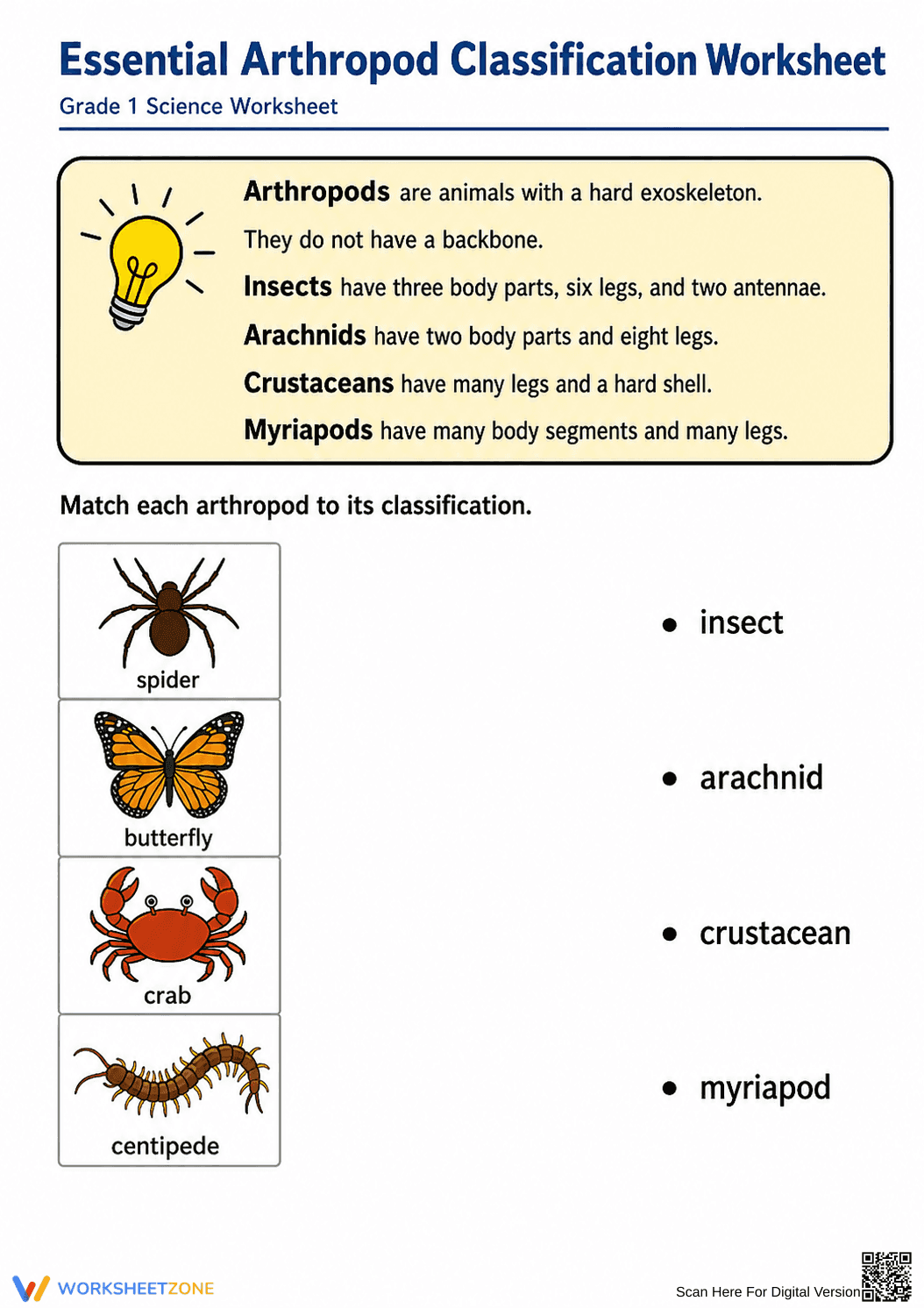
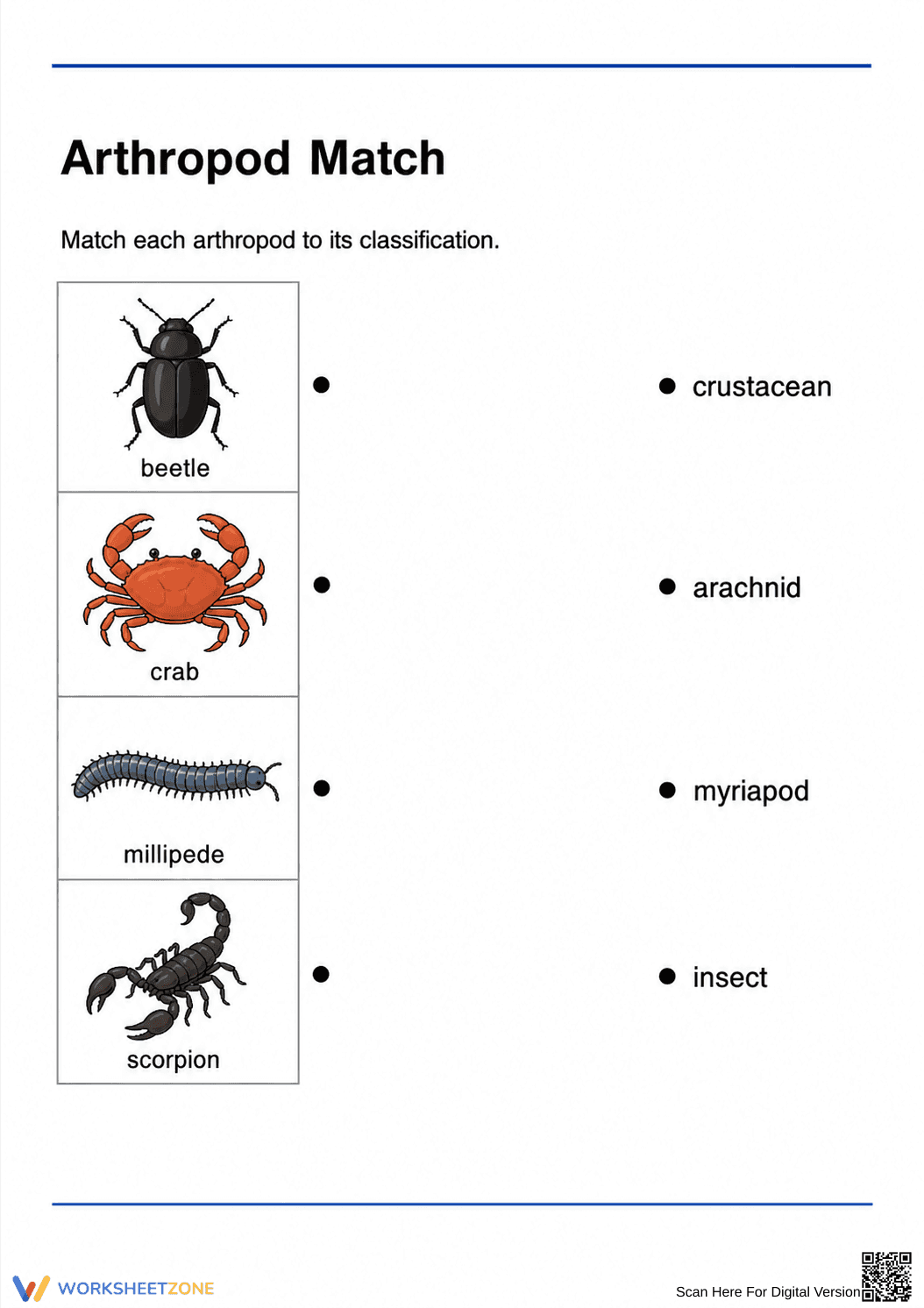
This Grade 1 science worksheet introduces students to arthropods through observation-based classification. Students identify insects, arachnids, crustaceans, and myriapods by matching visual examples to categories based on physical traits like leg count and body segments. It is a foundational life science resource for early learners.
At a Glance
- Grade: 1 · Subject: Science
- Standard:
1-LS1-1— Use observations of external parts to classify animals into diverse biological groups- Skill Focus: Arthropod Classification
- Format: 2 pages · 8 problems · Answer key included · PDF
- Best For: Quick science review or morning work
- Time: 10–15 minutes
What's Inside
This 2-page PDF features an informational header defining four arthropod groups, followed by an 8-item matching task. The worksheet includes illustrations of a spider, butterfly, crab, centipede, beetle, and scorpion. A complete answer key is provided for immediate feedback and easy grading.
Zero-Prep Workflow
- Print: 30 seconds to send the PDF to the printer.
- Distribute: 1 minute to hand out copies to the entire class.
- Review: 1 minute to check responses using the included answer key.
Total teacher prep time is under 2 minutes, making this an ideal resource for sub plans, transition periods, or as a supplement to a larger unit on living things.
Standards Alignment
The worksheet aligns with 1-LS1-1, focusing on how animals use external parts—exoskeletons, legs, and segments—to survive. Students observe these characteristics to differentiate biological classes. Both standard codes can be copied directly into lesson plans, IEP goals, or district curriculum mapping tools.
How to Use It
Use this as a formative assessment after a lesson on invertebrates. Observe students counting legs on the spider versus the butterfly to gauge understanding of classification criteria. It works well as a "Science Center" activity for independent practice during literacy rotations. Completion typically takes 10 to 15 minutes.
Who It's For
Designed for Grade 1 learners studying animal diversity. It provides visual supports for English Language Learners and pairs well with an animal-themed passage or anchor chart detailing specific traits of arthropod groups. It is appropriate for general education and special education settings.
This Grade 1 science resource supports the biological classification requirements outlined in 1-LS1-1, enabling students to categorize arthropods based on observable external structures. According to the RAND AIRS 2024 analysis of primary science curricula, early exposure to taxonomic thinking through visual matching helps develop foundational scientific reasoning and observation skills. By identifying specific traits—such as the three body parts of insects or the multiple legs of myriapods—students move beyond general "bug" labels toward precise biological identification. This worksheet facilitates a scaffolded approach to life science, ensuring that young learners can distinguish between different phyla with confidence. The inclusion of an answer key allows for immediate verification of student hypotheses, which aligns with research suggesting that timely feedback is critical for mastering classification systems in the early elementary years. It is a high-utility tool for classroom teachers.


