


























Views
Downloads


Essential Arrays and Multiplication Worksheet | Grade 3 Math
Paste this activity's link or code into your existing LMS (Google Classroom, Canvas, Teams, Schoology, Moodle, etc.).
Students can open and work on the activity right away, with no student login required.
You'll still be able to track student progress and results from your teacher account.
Mastering multiplication starts with a solid understanding of how objects are organized into equal groups. This comprehensive arrays worksheet helps Grade 3 students visualize the relationship between repeated addition and multiplication sentences. By working through structured visual models, learners develop the conceptual foundation necessary for fluency with basic math facts and problem-solving strategies.
At a Glance
- Grade: 3 · Subject: Math
- Standard:
CCSS.MATH.CONTENT.3.OA.A.1— Interpret products of whole numbers as the total number of objects in equal groups- Skill Focus: Arrays and Multiplication Sentences
- Format: 3 pages · 8 problems · Answer key included · PDF
- Best For: Introduction to early multiplication concepts
- Time: 25–35 minutes
This three-page instructional resource contains 8 high-quality tasks divided into four strategic sections. Students interact with visual arrays of buttons, stars, triangles, and squares to identify rows and columns. The packet includes traditional repeated addition sentences, row-column identification frames, and word problems that require students to translate a narrative into a mathematical model. A dedicated drawing section allows for creative application of concepts.
- Guided Practice: Students begin with two problems focused on repeated addition, using 2x4 and 3x3 arrays to bridge their prior knowledge of addition to new multiplication concepts.
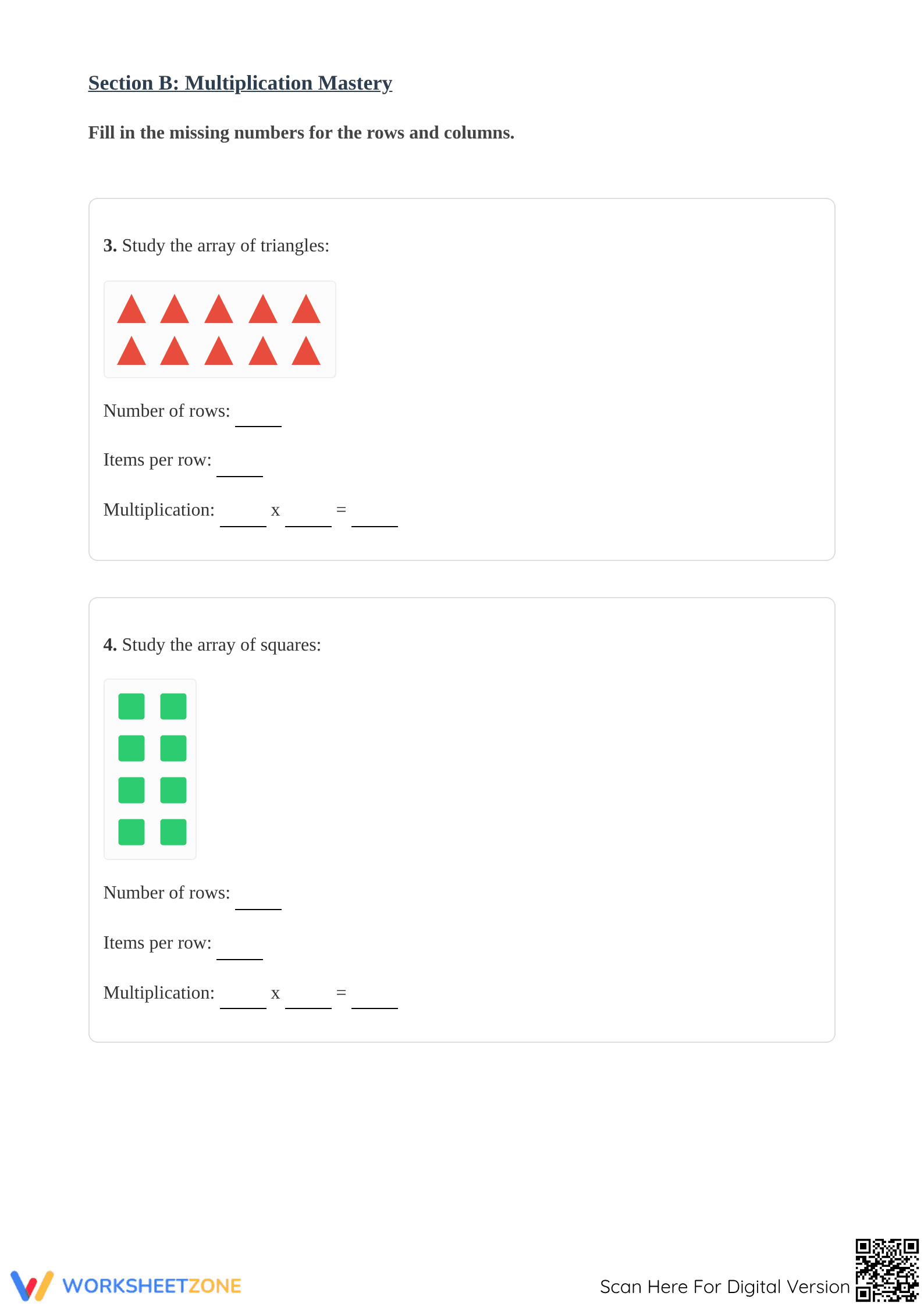
- Supported Practice: Section B provides two tasks where students explicitly identify the number of rows and items per row, filling in structured multiplication frames for 2x5 and 4x2 configurations.
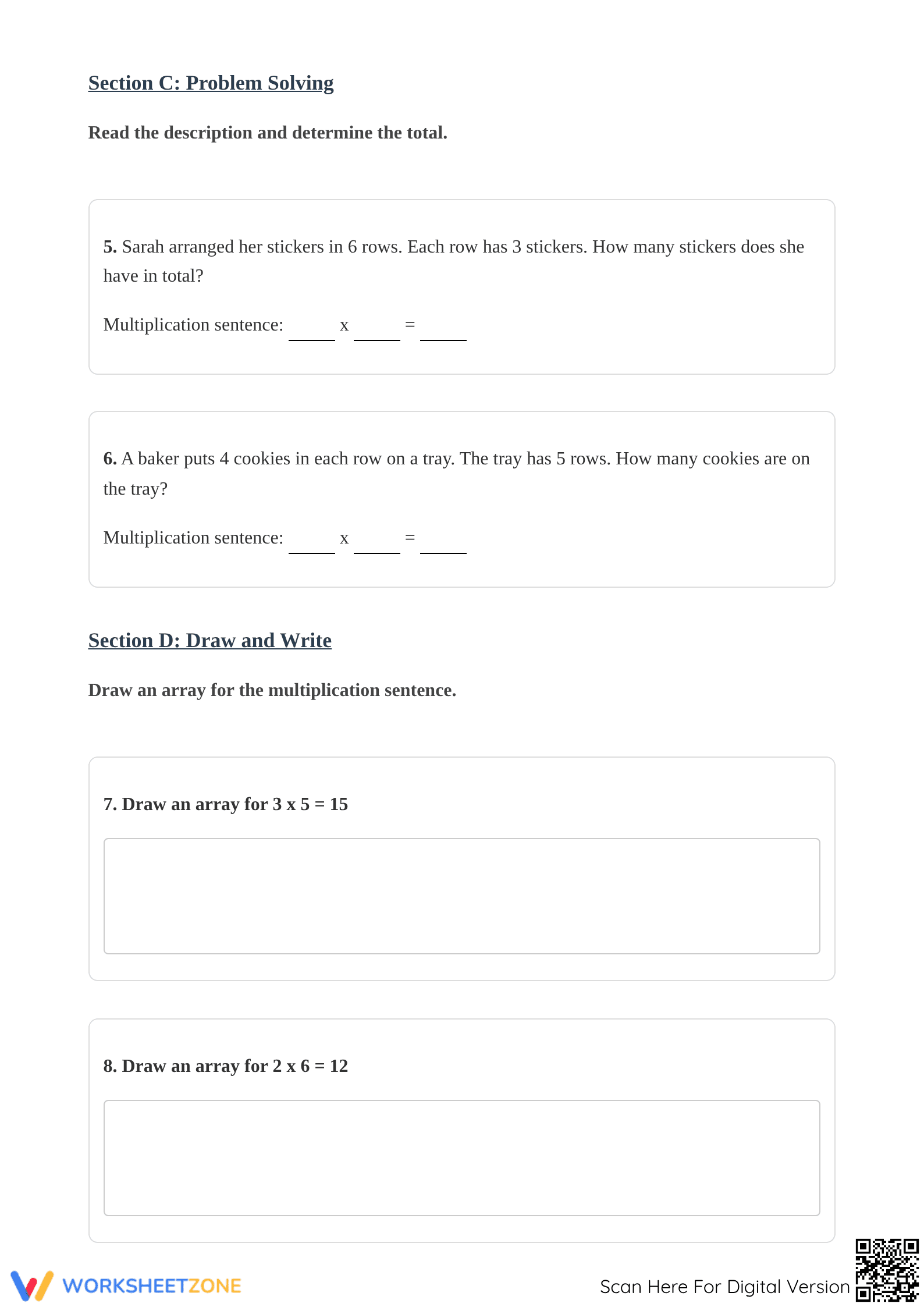
- Independent Practice: The final four tasks challenge students to solve real-world word problems and draw their own arrays for sentences like 3x5 and 2x6, demonstrating total conceptual mastery.
This resource utilizes a gradual-release model, moving from concrete visual support to abstract numerical representation.
The primary focus of this worksheet is `CCSS.MATH.CONTENT.3.OA.A.1`, which requires students to interpret products of whole numbers by viewing arrays as rows and columns. Additionally, it supports `CCSS.MATH.CONTENT.2.OA.C.4` by reinforcing the use of addition to find totals in rectangular arrangements. Both standard codes can be copied directly into lesson plans, IEP goals, or district curriculum mapping tools.
Introduce this worksheet immediately after a hands-on manipulative lesson with counters or tiles. It serves as an excellent bridge between concrete exploration and symbolic math. During instruction, observe how students count rows versus columns; those who struggle with the row identification field often benefit from using a physical ruler to block off lines of objects. Expect completion in roughly 30 minutes.
This resource is designed for Grade 3 students entering their multiplication unit, though it is highly effective for Grade 2 enrichment or Grade 4-5 intervention. It pairs naturally with a short-story passage about grouping objects or a multiplication anchor chart that defines rows and columns. The clear visual layout provides necessary scaffolding for English Language Learners and students with processing needs.
According to the CCSS.MATH.CONTENT.3.OA.A.1 framework, interpreting multiplication through arrays is a critical milestone for developing algebraic thinking. Students must move beyond simple counting to recognize the multiplicative structure of equal groups. Research from EdReports 2024 emphasizes that high-quality visual models, such as the 8 tasks provided here, are essential for deep conceptual understanding. By asking students to draw their own models and solve contextual word problems, this worksheet aligns with best practices for the concrete-representational-abstract instructional sequence. Educators can use these structured pages to collect formative data on a student's ability to relate addition to multiplication. The inclusion of three distinct pages ensures that the cognitive load is managed effectively, allowing students to focus on one sub-skill at a time before moving to independent application.


