


























Views
Downloads

Printable Area Mastery Worksheet: Grades 4-6 Math Pack
Paste this activity's link or code into your existing LMS (Google Classroom, Canvas, Teams, Schoology, Moodle, etc.).
Students can open and work on the activity right away, with no student login required.
You'll still be able to track student progress and results from your teacher account.
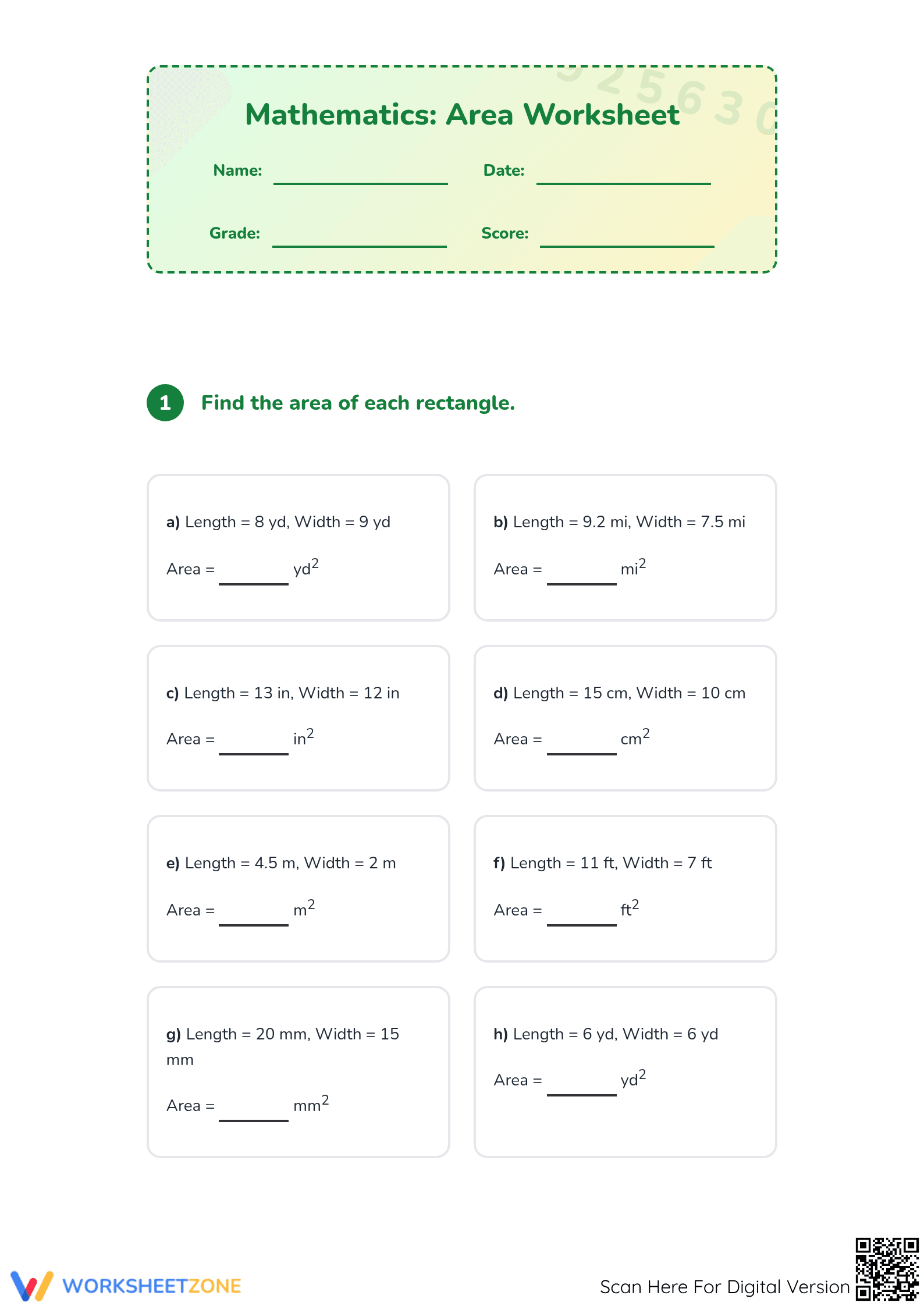
This comprehensive Mathematics: Area Worksheet provides Grade 4, 5, and 6 students with a structured environment to master the calculation of area across a variety of geometric shapes. Students move from basic rectangle calculations to complex polygons and real-world word problems, ensuring a deep understanding of spatial measurement and formula application.
At a Glance
- Grade: 4-6 · Subject: Math
- Standard:
CCSS.MATH.CONTENT.6.G.A.1— Find the area of triangles, quadrilaterals, and polygons by decomposing into basic shapes- Skill Focus: Multi-shape area calculation
- Format: 4 pages · 26 problems · Answer key included · PDF
- Best For: Independent practice and skills assessment
- Time: 45–60 minutes
What's Inside
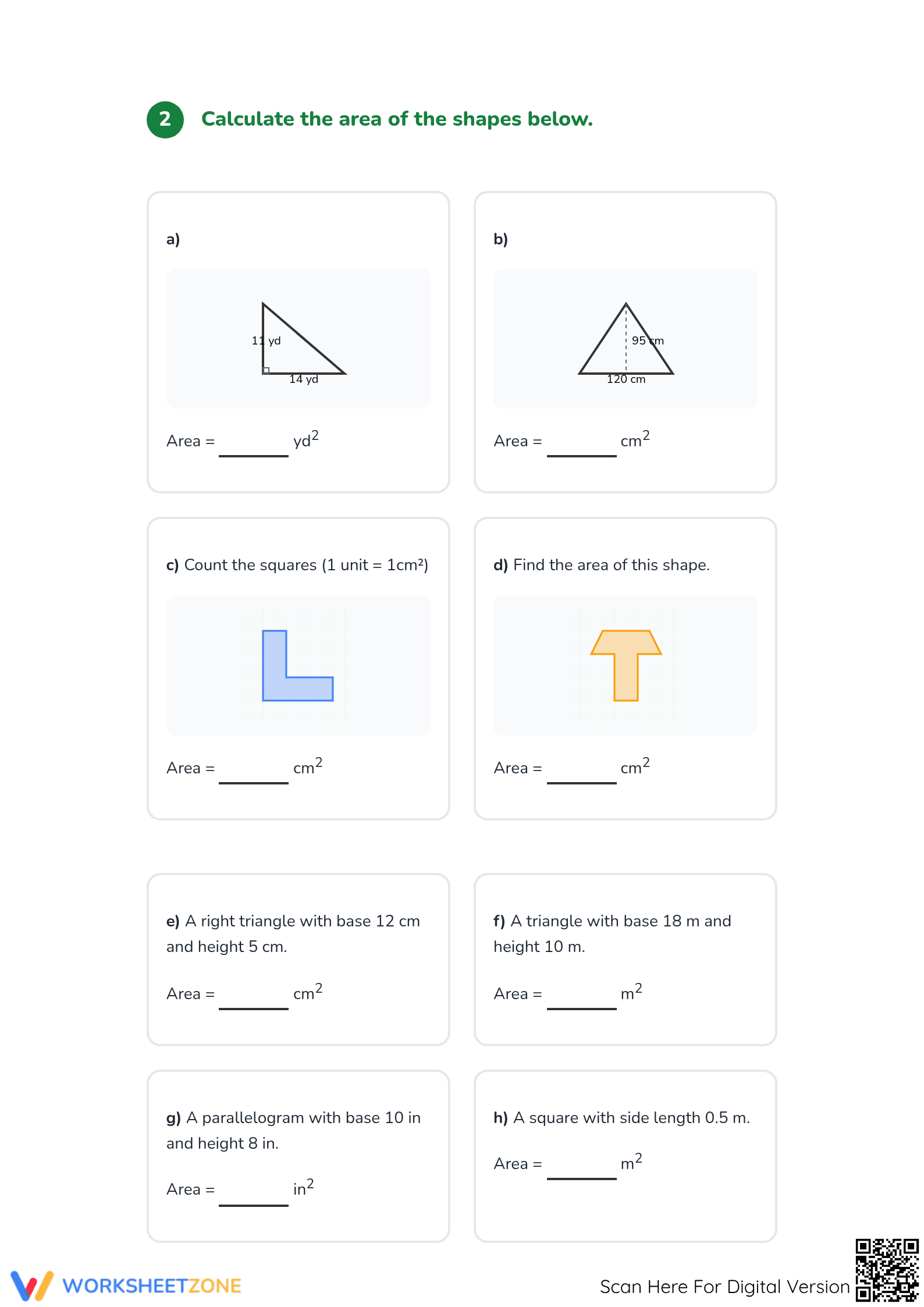
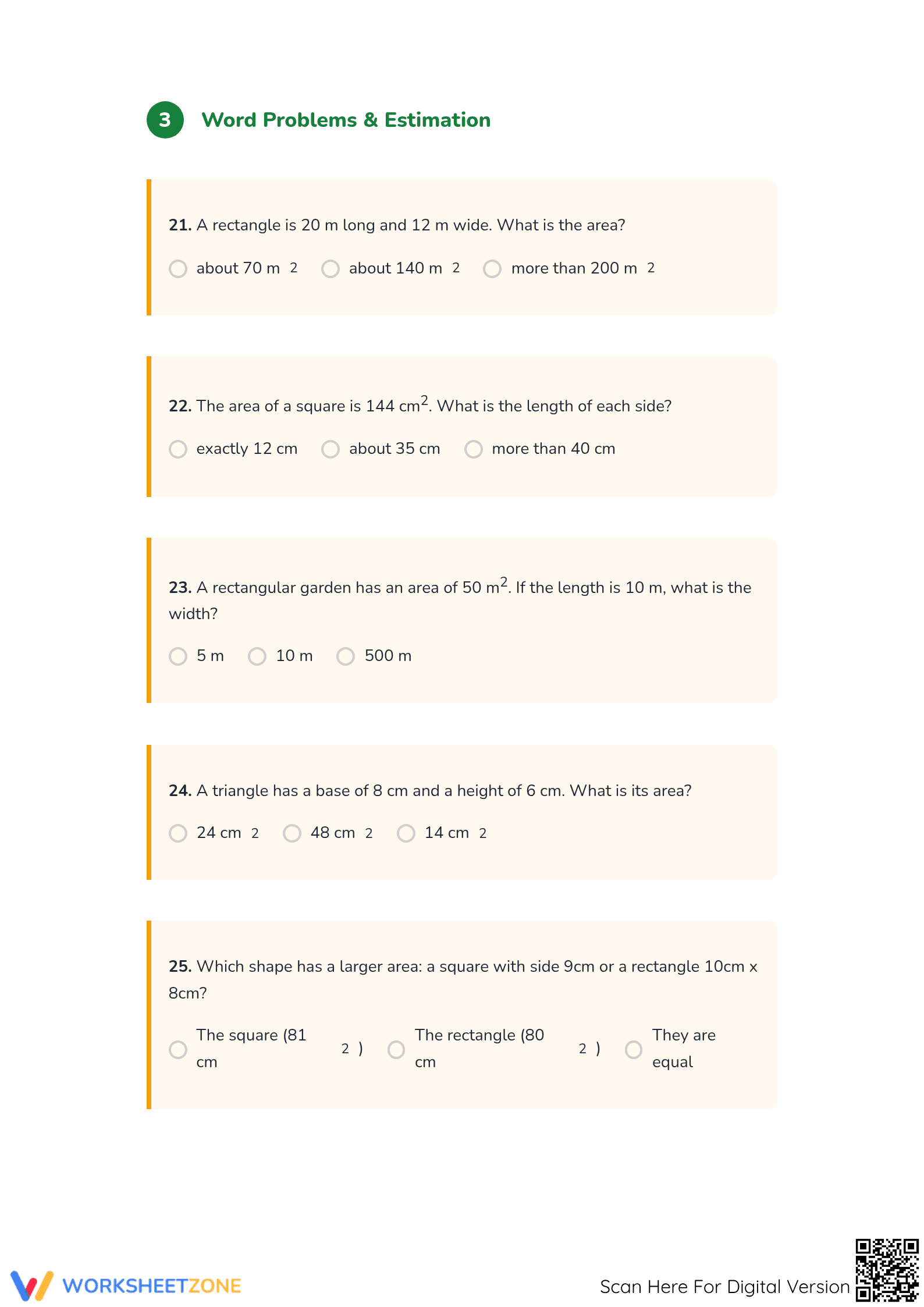
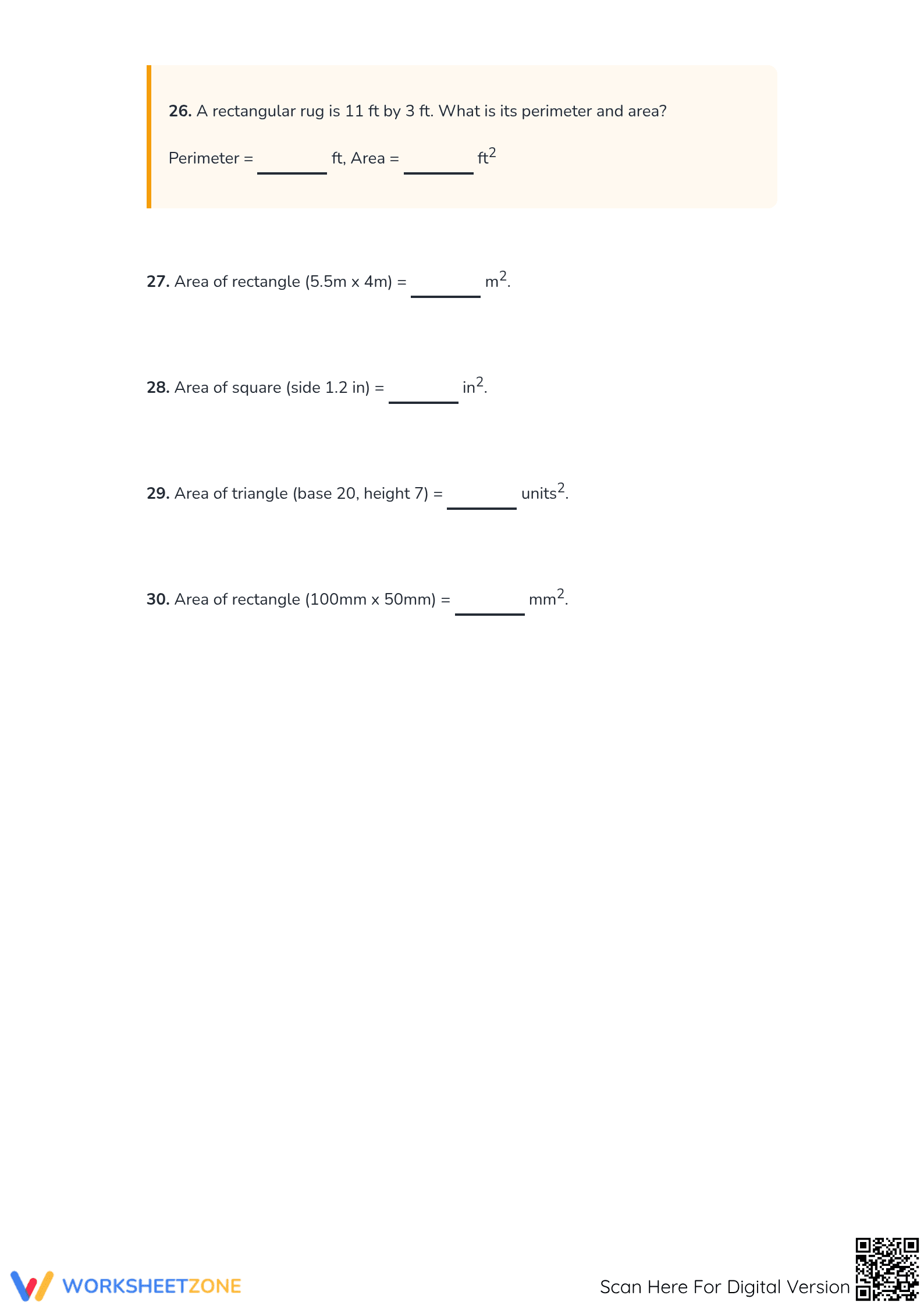
This 4-page instructional pack contains 26 targeted tasks designed to build geometric fluency. The worksheet begins with eight computational problems focusing on rectangles with both integer and decimal dimensions. It then progresses to eight problems involving triangles, squares, and irregular L-shapes that require square counting or formulaic decomposition. The final sections challenge students with 10 complex word problems and estimation tasks. A full answer key is provided to facilitate rapid grading or student self-correction.
Zero-Prep Workflow
- Print (1 minute): Select all four pages for a complete unit or pick specific pages for targeted practice.
- Distribute (0 minutes): The self-explanatory layout requires no teacher introduction, making it ideal for independent desk work.
- Review (5 minutes): Use the clear answer key to verify calculations across all 26 problems.
Total teacher prep time is under two minutes, making this an excellent choice for emergency sub plans or last-minute homework assignments.
Standards Alignment
The primary alignment for this resource is CCSS.MATH.CONTENT.6.G.A.1, which requires students to find the area of triangles, special quadrilaterals, and polygons by composing or decomposing shapes. Additionally, it supports 4.MD.A.3 regarding area formulas for rectangles in mathematical problems. Both standard codes can be copied directly into lesson plans or curriculum mapping tools.
How to Use It
This worksheet serves as an excellent summative assessment following a direct instruction unit on geometric measurement. Teachers can assign the computational pages to observe students' procedural accuracy with formulas. Use the word problems on the final pages to check for conceptual transfer and literacy-based math application. Observation of the square-counting task provides a quick formative check on conceptual area understanding.
Who It's For
Designed for upper elementary and middle school students, this resource is suited for general education classrooms in grades 4 through 6. It offers scaffolding for Grade 4 learners while providing rigorous multi-step problems for Grade 6. The variety of task formats supports diverse learning styles and ensures that students with different linguistic backgrounds can access core mathematical concepts effectively.
According to recent analysis by EdReports 2024, the integration of multi-format practice problems is essential for developing procedural fluency in middle-grade geometry. This worksheet aligns with those findings by bridging the gap between abstract formula application and visual spatial reasoning. By requiring students to calculate areas for CCSS.MATH.CONTENT.6.G.A.1 across varying levels of complexity—from simple rectangles to L-shaped polygons—the resource ensures that learners internalize the additive properties of area. Research indicates that when students move systematically through these "low-floor, high-ceiling" tasks, they are more likely to retain geometric concepts across different grade levels. The inclusion of estimation and word problems further reinforces the practical utility of these mathematical skills in daily life. This evidence-based approach makes the worksheet a reliable tool for classroom educators seeking to improve student outcomes in geometric measurement and data analysis.


