


























Views
Downloads

Essential Area Unit Squares Worksheet | Grade 3-4
Paste this activity's link or code into your existing LMS (Google Classroom, Canvas, Teams, Schoology, Moodle, etc.).
Students can open and work on the activity right away, with no student login required.
You'll still be able to track student progress and results from your teacher account.
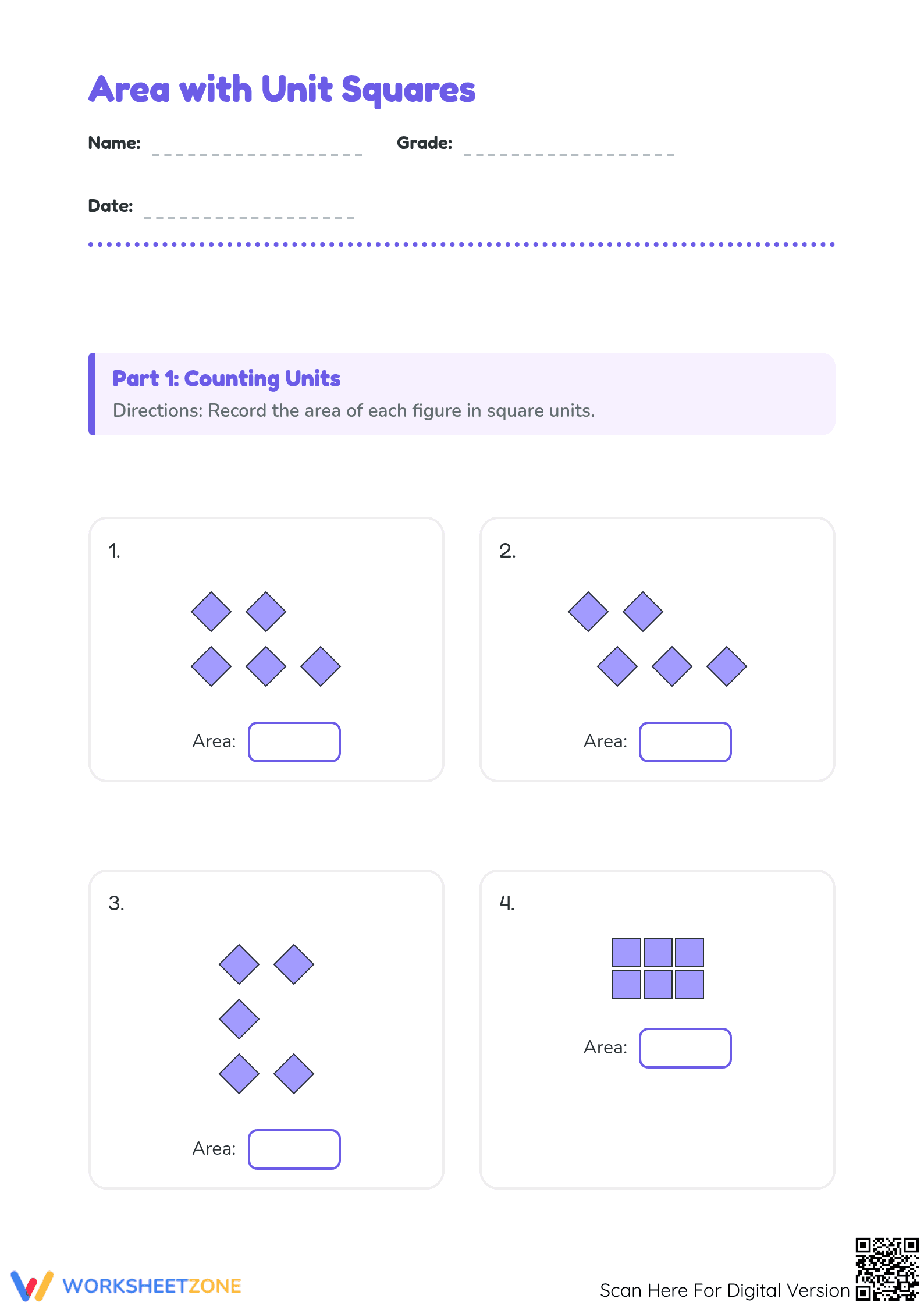
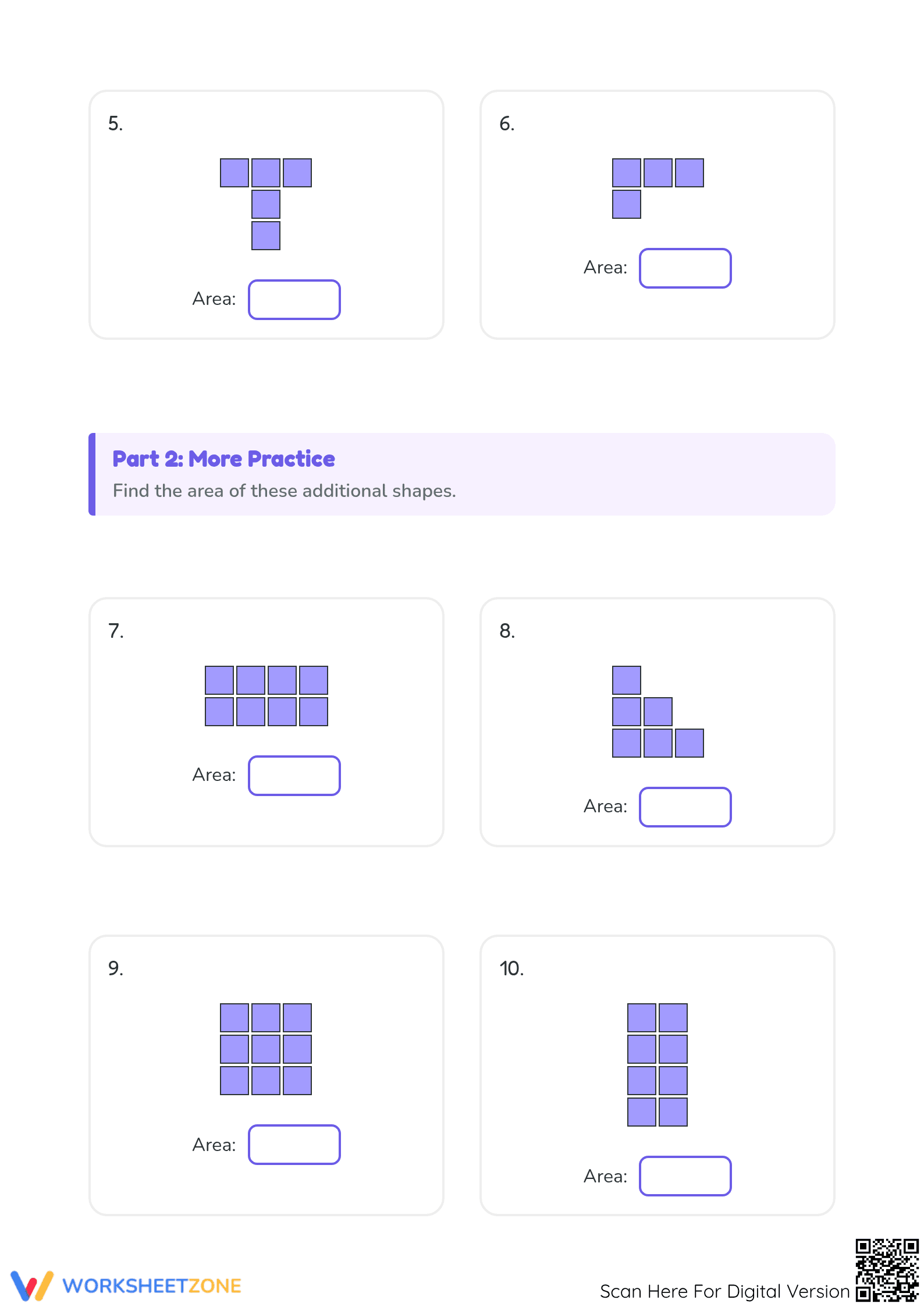
This Grade 3 and Grade 4 Math worksheet provides a structured approach to understanding area through counting unit squares. By engaging with visual representations, students develop the foundational skills necessary for more complex geometric measurements. The variety of tasks ensures that learners move beyond simple rote counting toward a conceptual grasp of spatial units and comparative area analysis.
At a Glance
- Grade: 3–4 · Subject: Math
- Standard:
CCSS.MATH.CONTENT.3.MD.C.6— Measure areas by counting unit squares including square centimeters and improvised units- Skill Focus: Geometric measurement using unit squares
- Format: 3 pages · 13 problems · Answer key included · PDF
- Best For: Independent practice and formative assessment
- Time: 20–30 minutes
What's Inside
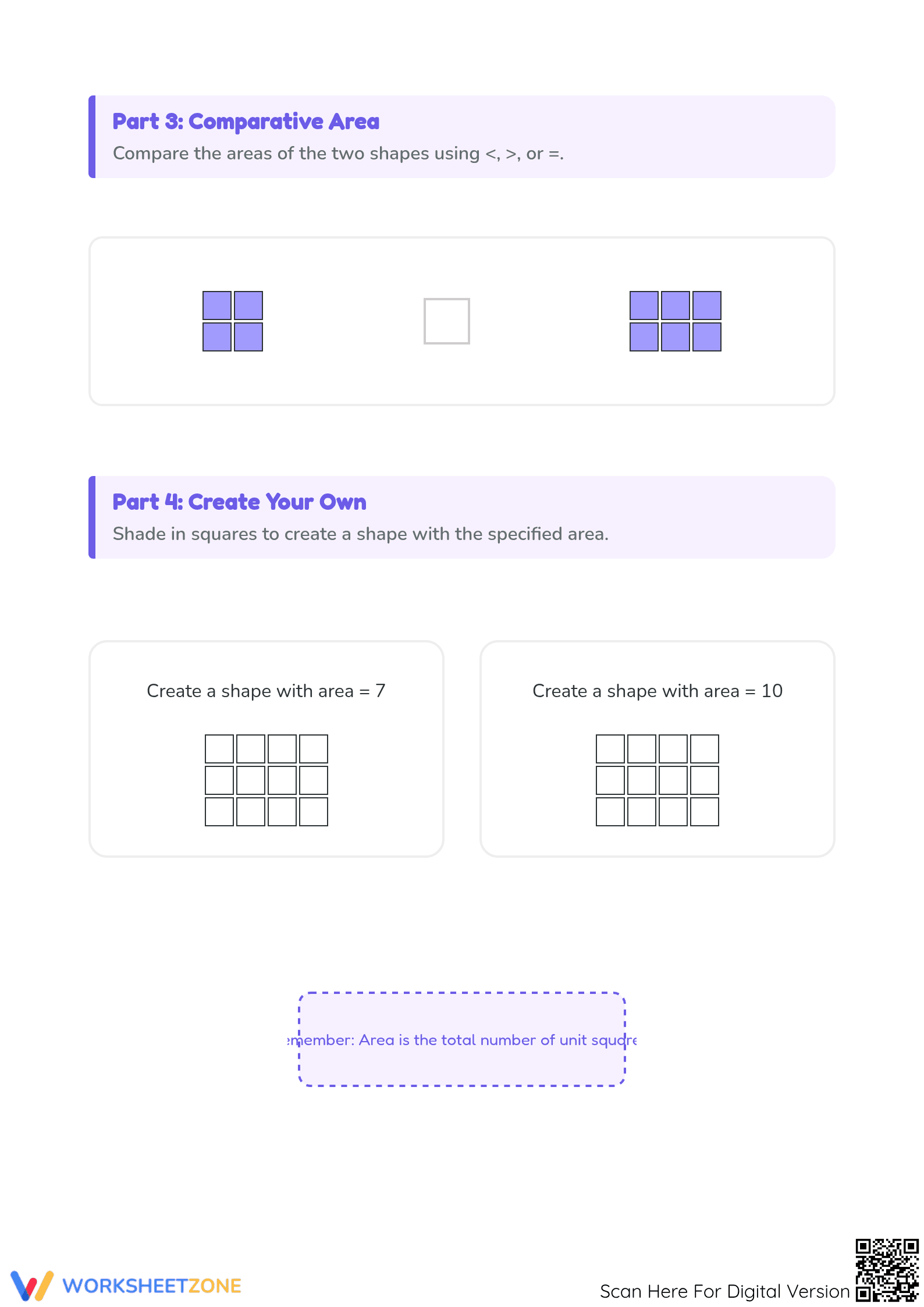
This comprehensive 3-page worksheet contains 13 unique tasks designed to build geometric mastery. Students begin with 10 problems counting unit squares to determine the area of diverse polygons. Part 3 introduces comparative area using inequality symbols, while Part 4 challenges students to shade their own figures to match specific area targets of 7 and 10 units. A full answer key is included.
Zero-Prep Workflow
This resource is designed for immediate classroom implementation with a simple three-step workflow. First, print the three-page PDF in about 30 seconds. Second, distribute the copies and review the directions for Part 1 in under a minute. Finally, use the included answer keys for rapid review or peer-grading. Total teacher preparation time is less than two minutes, making this ideal for sub plans.
Standards Alignment
The primary alignment is `CCSS.MATH.CONTENT.3.MD.C.6`, which requires students to measure areas by counting unit squares. It also supports `CCSS.MATH.CONTENT.3.MD.C.5` regarding concepts of area measurement. Both standard codes can be copied directly into lesson plans, IEP goals, or district curriculum mapping tools to ensure instructional compliance and tracking.
How to Use It
Assign this worksheet during the independent practice phase of a geometry lesson. For a formative assessment, observe students during the creation phase in Part 4 to see if they understand that different shapes can share the same area. It also works as a math center activity where students work in pairs to verify their counts. Expect a 20-minute completion time for most learners.
Who It's For
This resource is perfect for third and fourth-grade students beginning their journey into area measurement. It provides sufficient scaffolding for struggling learners through clear visual grids while offering extension opportunities in the comparative and creative sections. It pairs naturally with anchor charts showing unit square definitions or introductory area passages.
This Grade 3-4 resource focuses on CCSS.MATH.CONTENT.3.MD.C.6, where students measure areas by counting unit squares. With thirteen tasks across four parts, the worksheet scaffolds the transition from counting to comparative analysis and active creation. According to RAND AIRS 2024, providing concrete visual models like unit square grids is essential for developing conceptual understanding of spatial attributes before moving to abstract formulas. The sequence of tasks—counting, comparing, and creating—aligns with evidence-based practices for geometric measurement, ensuring students internalize the relationship between individual units and total area. This resource supports the gradual release of responsibility by moving from guided counting to independent shading. Research highlights that students mastering improvised unit counting show higher proficiency in later multiplicative area calculations (Fisher & Frey, 2014). This self-contained PDF serves as a robust tool for formative assessment and mastery-based practice.


