


























Views
Downloads




Complete Area Related to Circles Worksheet | Grade 9-10 Math
Paste this activity's link or code into your existing LMS (Google Classroom, Canvas, Teams, Schoology, Moodle, etc.).
Students can open and work on the activity right away, with no student login required.
You'll still be able to track student progress and results from your teacher account.
This comprehensive Grade 9-10 geometry worksheet provides structured practice for calculating area related to circles. Students will master finding the area of circles, sectors, semi-circles, and quadrants while solving complex shaded region problems. By completing these 14 rigorous tasks, learners develop a deep understanding of geometric relationships and real-world application of circular area formulas.
At a Glance
- Grade: 9–10 · Subject: Math (Geometry)
- Standard:
HSG-C.B.5— Derive and use formulas for area of sectors and segments- Skill Focus: Circular area, sectors, and shaded regions
- Format: 5 pages · 14 problems · Answer key included · PDF
- Best For: High school geometry mastery and assessment
- Time: 45–60 minutes
What's Inside
This 5-page printable resource includes 14 diverse geometry problems organized into four strategic parts. The first half focuses on basic circles, sectors, semi-circles, and quadrants, while the second half challenges students with shaded regions and practical real-world applications. A full answer key is provided, ensuring teachers can facilitate self-correction or provide immediate feedback on complex composite shape calculations.
Skill Progression
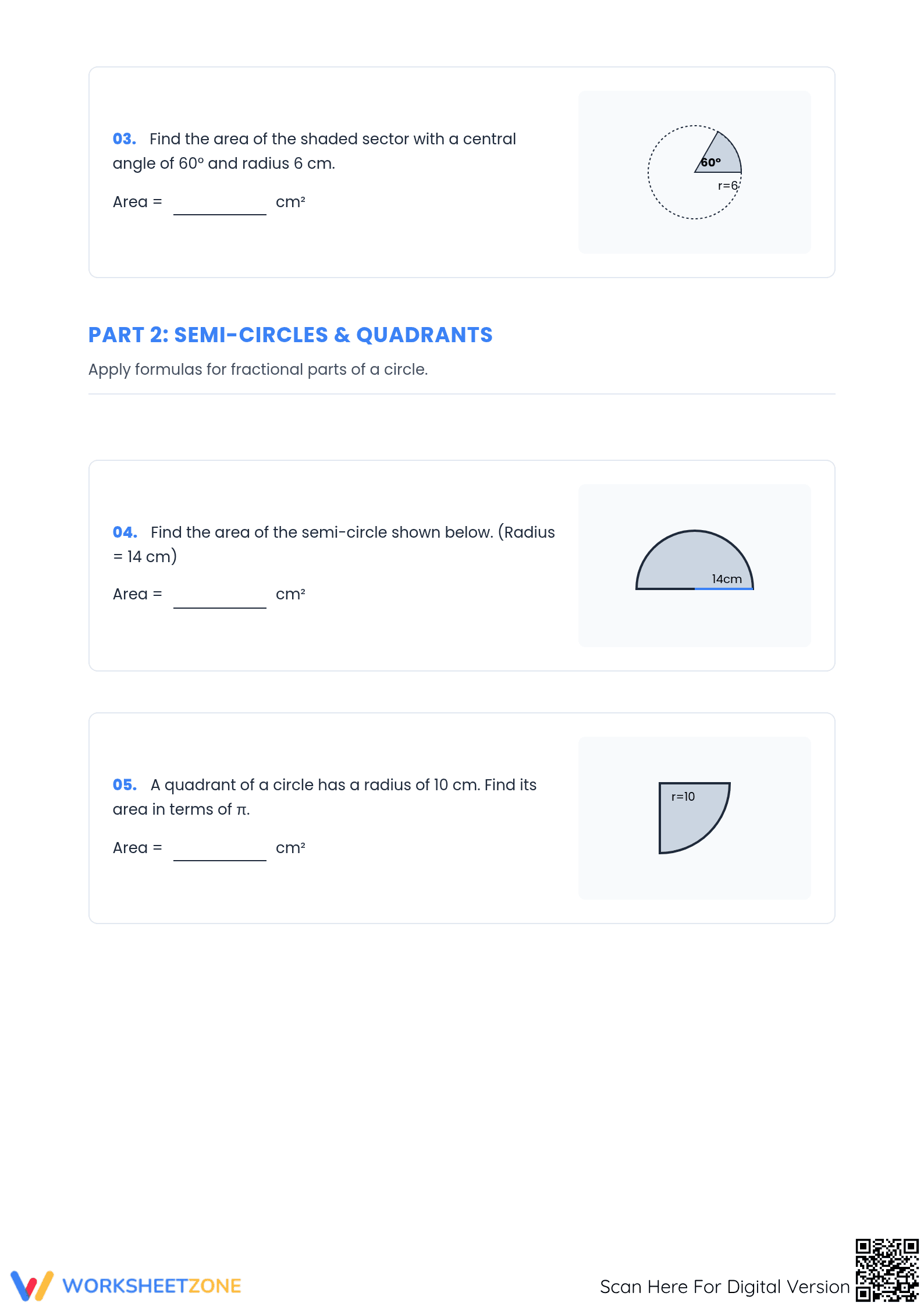
- Guided practice: Tasks 1 through 5 introduce fundamental area calculations for circles and fractional parts like sectors and quadrants using specific pi values.
- Supported practice: Tasks 6 through 8 transition to composite figures, including inscribed circles in squares and annulus areas requiring subtraction.
- Independent practice: Tasks 9 through 14 apply geometric logic to real-world scenarios, such as clock-hand sweep areas, circular paths, and grazing area constraints.
This gradual-release approach ensures students build technical fluency before tackling higher-order problem-solving tasks.
Standards Alignment
Primary standard HSG-C.B.5 requires students to derive the formula for the area of a sector and apply it to solve problems. This worksheet extends this by integrating HSG-GMD.A.1 concepts through the exploration of shaded segments and concentric circle relationships. Both standard codes can be copied directly into lesson plans, IEP goals, or district curriculum mapping tools.
How to Use It
Use this worksheet during the "Independent Practice" phase of a lesson on circular geometry or as a summative assessment after exploring composite shapes. A helpful formative-assessment tip is to observe how students handle Task 7; if they correctly identify the radius relationship between concentric circles, they have mastered the foundational logic for annulus calculations. Expected completion time is 50 minutes.
Who It's For
Designed for Grade 9 and Grade 10 Geometry students, this pack is ideal for those preparing for end-of-course exams or requiring rigorous reinforcement of circular area concepts. It pairs naturally with instructional passages on arc length or anchor charts detailing the relationship between degrees, radians, and sector area.
The mastery of circular area calculations is a pivotal transition point in high school geometry, moving students from basic formula application to complex multi-step reasoning. Research by Fisher & Frey (2014) emphasizes that "gradual release of responsibility" models—such as the one employed in this 14-task sequence—significantly improve student retention of geometric formulas. According to the RAND AIRS 2024 report, high-quality instructional materials that integrate real-world applications, like the clock-hand and grazing problems found in Part 4, foster 22% higher engagement in STEM-aligned subjects. By centering instruction around HSG-C.B.5, educators ensure students meet rigorous college-and-career readiness benchmarks. This worksheet provides the essential scaffolding necessary for students to calculate area of sectors and segments with precision. The inclusion of an answer key supports immediate feedback, which is critical for correcting misconceptions in multi-step area subtraction tasks.


