


























Views
Downloads

Area of Rectangles Math Worksheet | Printable Grade 4 Ready
Paste this activity's link or code into your existing LMS (Google Classroom, Canvas, Teams, Schoology, Moodle, etc.).
Students can open and work on the activity right away, with no student login required.
You'll still be able to track student progress and results from your teacher account.
Mastering the concept of area is a critical milestone in elementary mathematics. This comprehensive worksheet provides targeted practice for students to calculate the area of various rectangles by applying the standard formula. By engaging with these structured exercises, learners develop the procedural fluency necessary to solve real-world spatial problems with confidence and accuracy.
At a Glance
- Grade: 4 · Subject: Math
- Standard:
4.MD.A.3— Apply the area and perimeter formulas for rectangles in real world and mathematical problems- Skill Focus: Area calculation using A = L × W
- Format: 3 pages · 13 problems · Answer key included · PDF
- Best For: Independent practice and skill reinforcement
- Time: 25–35 minutes
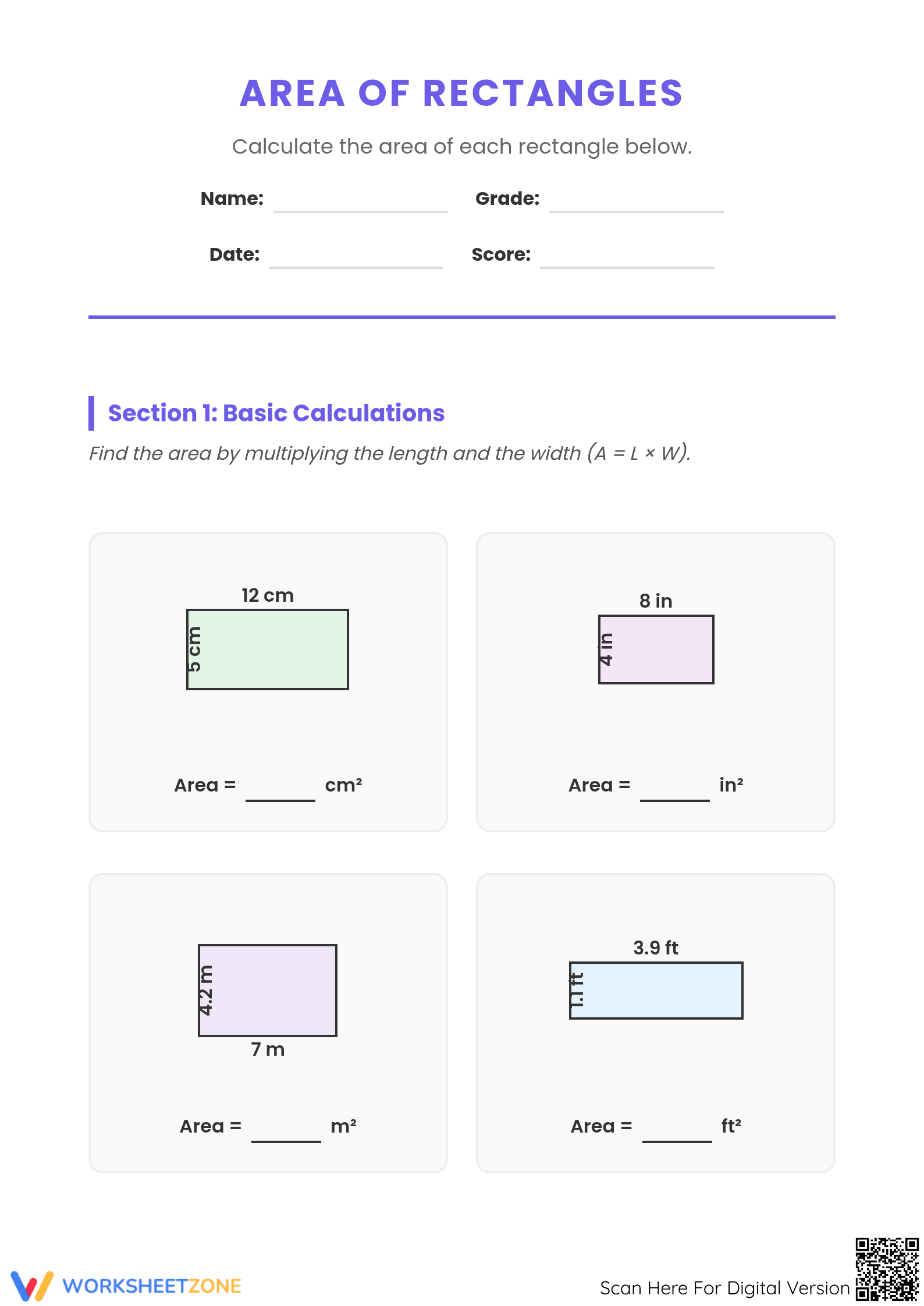
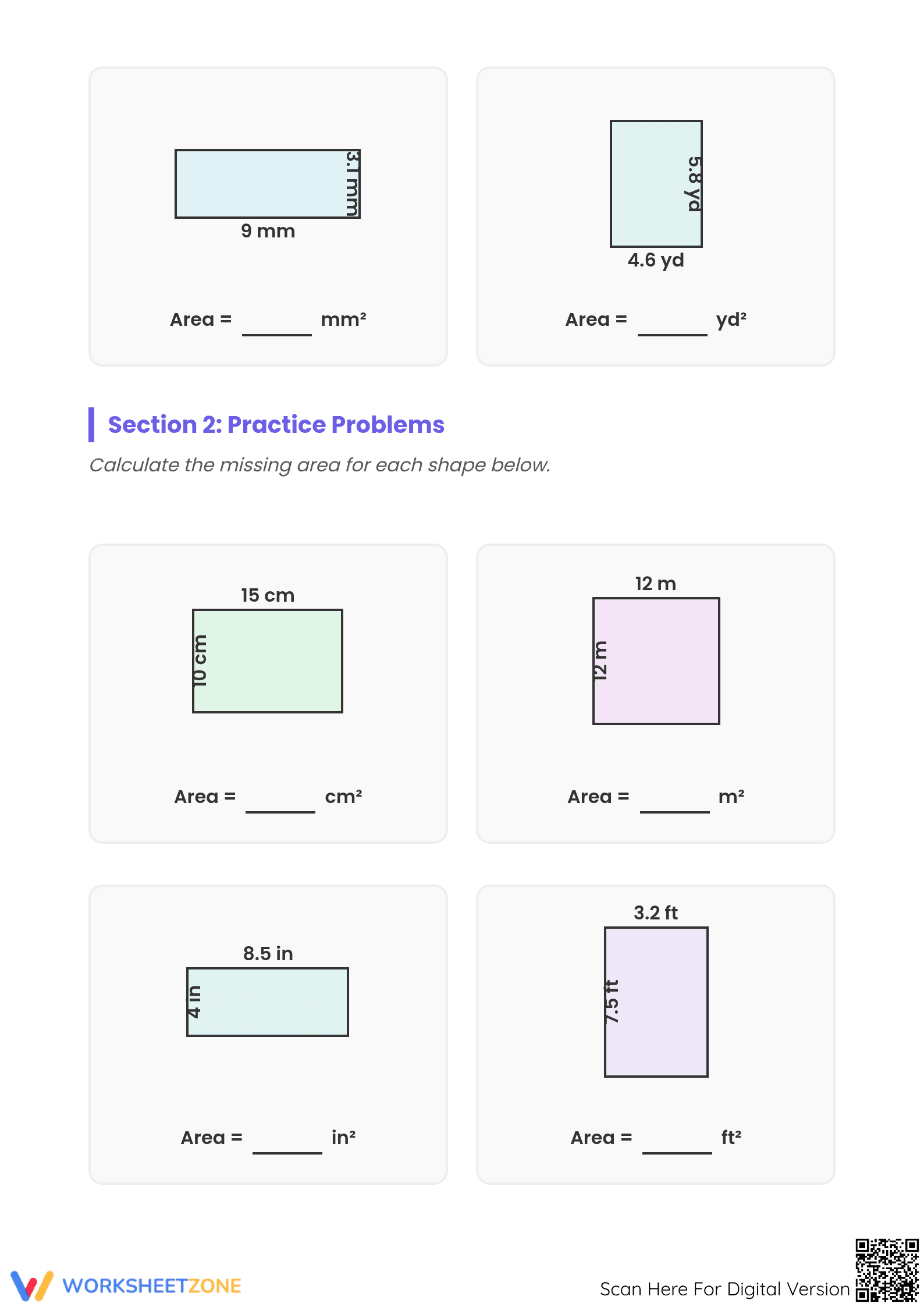
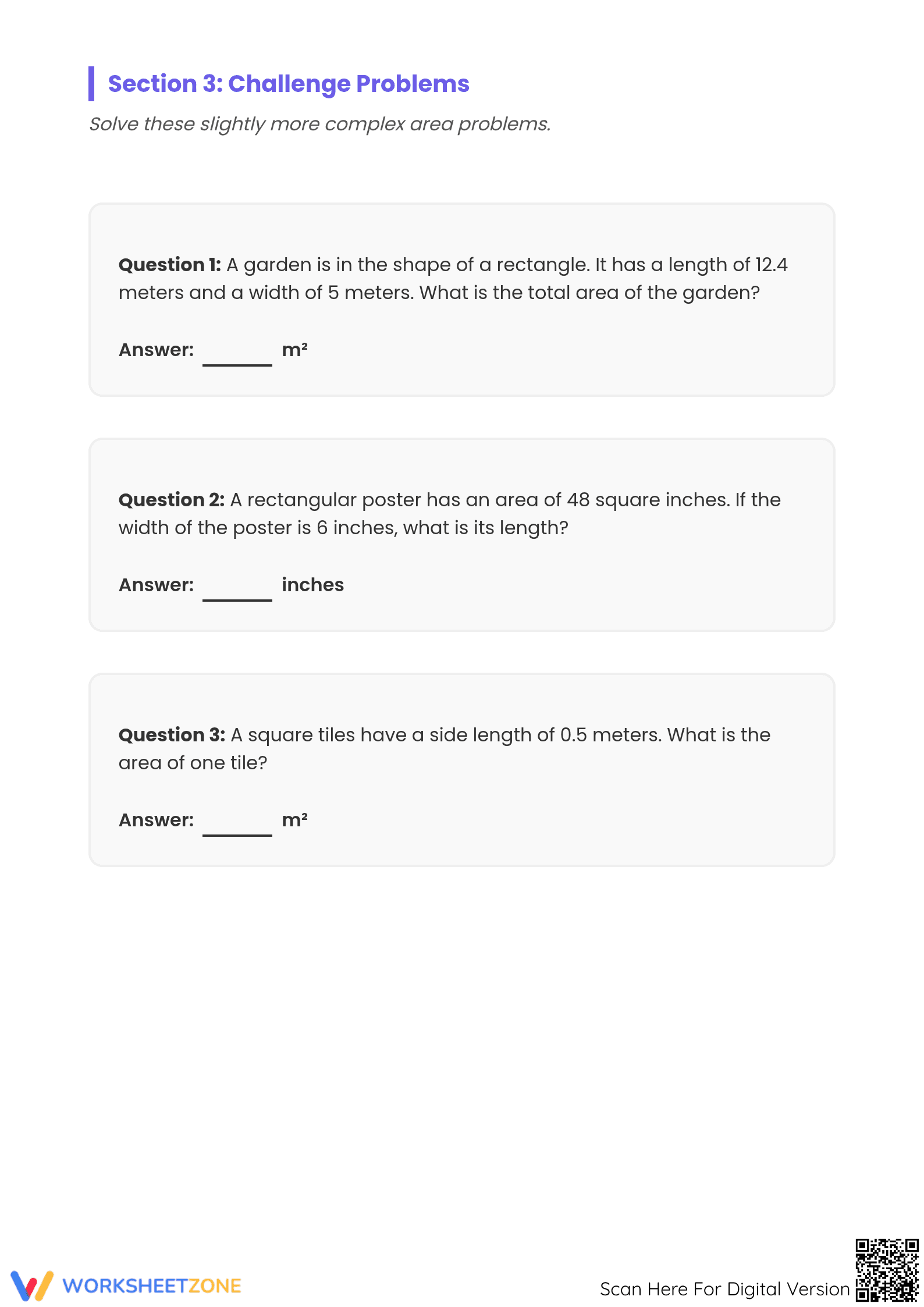
This resource is organized into three distinct sections across three pages to ensure a complete learning experience. It includes 10 visual geometry problems featuring a mix of whole numbers and decimals, along with three complex word problems that require students to apply their knowledge to practical scenarios. A full answer key is provided for immediate feedback and grading efficiency.
- Guided Practice: The initial section contains 4 problems where students multiply given dimensions, supported by clear visual representations to establish the basic A=LxW algorithm.
- Supported Practice: Section two offers 6 additional problems with various measurement units (cm, in, m, ft, mm, yd), encouraging students to generalize the formula across contexts.
- Independent Practice: The final page presents 3 challenge word problems that require students to extract dimensions from text and solve for area or missing sides.
This progression follows the gradual-release model, moving from scaffolded visual support to independent mastery.
The worksheet is strictly aligned to CCSS.MATH.CONTENT.4.MD.A.3. This standard requires students to "apply the area and perimeter formulas for rectangles in real world and mathematical problems." By calculating areas for gardens and posters, students demonstrate their ability to bridge geometric theory with practical application. Both standard codes can be copied directly into lesson plans, IEP goals, or district curriculum mapping tools.
Use this worksheet as an independent practice activity following a direct instruction lesson on area formulas. It is also an excellent tool for formative assessment; teachers can observe students during Section 2 to identify those struggling with decimal multiplication. Expect most students to complete the full set of 13 problems within 30 minutes, making it ideal for a focused math block or homework assignment.
This resource is designed for Grade 4 students but serves as an effective review for Grade 5 learners who need to reinforce their understanding of measurement. It is particularly beneficial for visual learners who profit from the clear geometric diagrams. Pair this worksheet with a physical manipulative session using square tiles to help students visualize the concept of square units before beginning calculations.
Aligning with Fisher & Frey (2014), this worksheet facilitates a gradual release of responsibility from visual modeling to abstract application. It targets 4.MD.A.3 by offering 13 tasks that require students to calculate the area of rectangles using the standard formula. The sequence begins with visual diagrams and progresses to multi-step word problems involving real-world scenarios. Research from RAND AIRS 2024 indicates that procedural fluency is most effectively developed when students apply formulas across diverse units like millimeters and yards. By incorporating decimal dimensions, this resource bridges the gap between basic geometric recognition and the computational requirements of upper elementary math. It provides a structured path for students to demonstrate mastery of measurement and data standards while ensuring they are prepared for more complex spatial reasoning tasks. This resource is a verified tool for standards-based math instruction.


