


























Views
Downloads


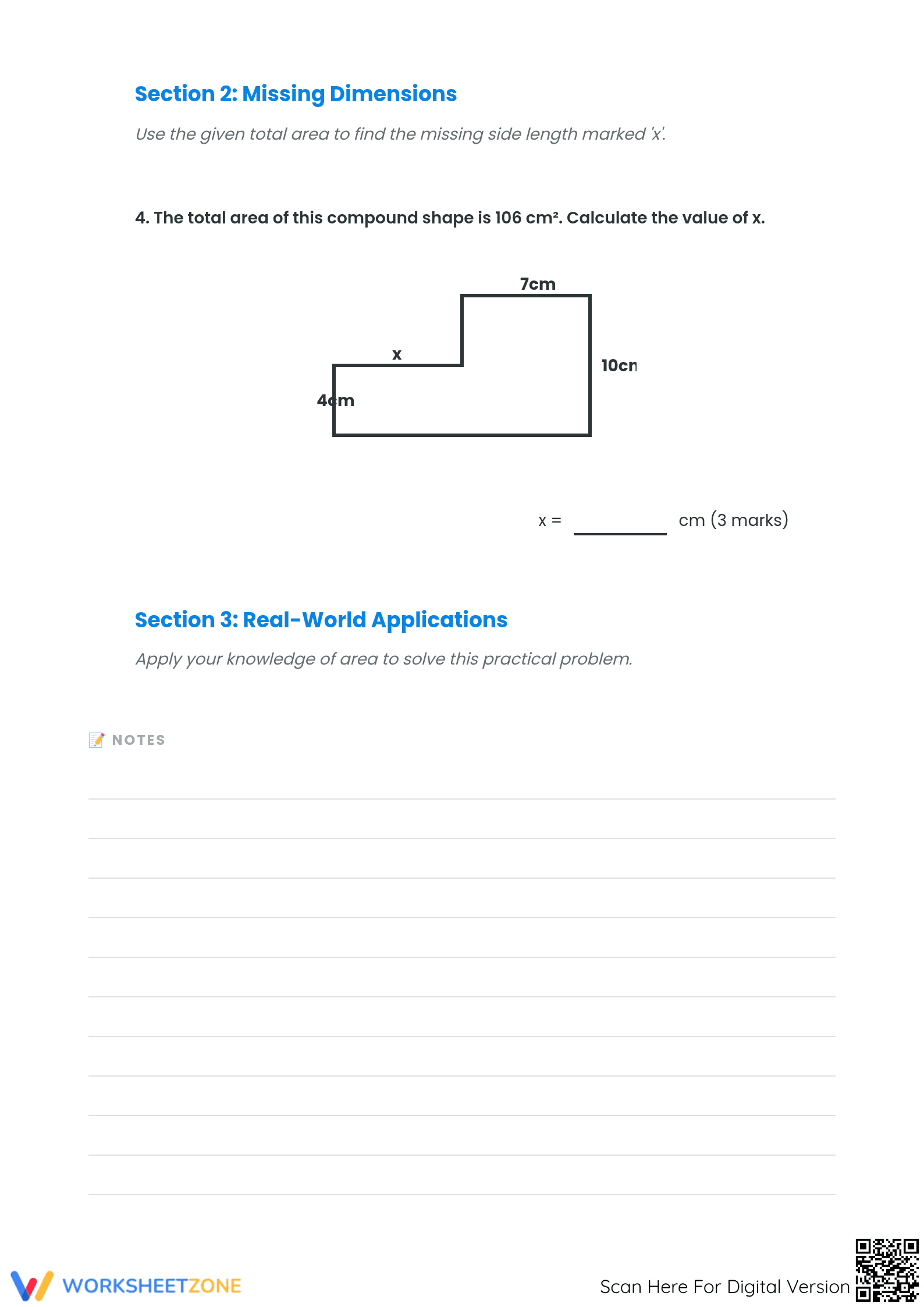


Essential Area of Compound Shapes Worksheet | Grades 4-6
Paste this activity's link or code into your existing LMS (Google Classroom, Canvas, Teams, Schoology, Moodle, etc.).
Students can open and work on the activity right away, with no student login required.
You'll still be able to track student progress and results from your teacher account.
Master the calculation of complex rectilinear figures with this comprehensive area of compound shapes worksheet. Students learn to decompose L-shapes, T-shapes, and irregular polygons into manageable rectangles to find the total area. This resource ensures students apply geometric reasoning in multi-step mathematical and real-world scenarios efficiently.
At a Glance
- Grade: 6 · Subject: Math
- Standard:
CCSS.MATH.CONTENT.6.G.A.1— Decompose polygons into rectangles and triangles to find the total area- Skill Focus: Additive and subtractive area calculation
- Format: 5 pages · 12 problems · Answer key included · PDF
- Best For: Independent practice and formative assessment
- Time: 45–60 minutes
This five-page instructional packet is designed for complete classroom readiness. It features 12 structured problems that progress from basic L-shaped figures to complex missing dimension challenges and real-world application tasks. Each page provides ample workspace for students to show their decomposition strategies, ensuring teachers can easily identify conceptual errors during the solving process.
Zero-Prep Workflow
- Print (1 minute): Select the 5-page PDF and print enough copies for your cohort; the layout is optimized for clear black-and-white reproduction.
- Distribute (1 minute): Hand out the packets as a complete unit or individual sections to match your specific lesson pacing for the day.
- Review (10 minutes): Use the included detailed answer key to facilitate a quick whole-class review or to provide immediate feedback during independent work time.
Total teacher preparation time is less than two minutes, making this an ideal resource for substitute plans or emergency sub folders where high-quality instruction must continue without disruption.
Standards Alignment
This worksheet is primarily aligned to CCSS.MATH.CONTENT.6.G.A.1: "Find the area of polygons by composing into rectangles or decomposing into triangles and other shapes; apply these techniques in the context of solving real-world problems." Both standard codes can be copied directly into lesson plans or district curriculum mapping tools.
How to Use It
Deploy this resource during the independent practice phase of your geometry unit. After demonstrating how to draw split lines to create smaller rectangles, assign the first section to verify student understanding. For a formative assessment tip, walk the room and check Section 3 for students who forget to subtract the area of holes like windows; most students complete the sequence in 50 minutes.
Who It's For
This packet is perfect for Grade 6 students mastering geometry, though it remains effective for Grade 4 and 5 enrichment. The clear visual scaffolds benefit English Language Learners and students with IEPs by providing concrete shapes to manipulate. It pairs naturally with a short-form video on decomposing shapes or a physical anchor chart showing the additive property of area.
According to the RAND AIRS 2024 analysis of mathematics instructional materials, high-quality decomposition tasks are essential for building spatial reasoning required for success in coordinate geometry and calculus. This worksheet aligns with those findings by requiring students to identify hidden dimensions and apply the CCSS.MATH.CONTENT.6.G.A.1 standard through multiple cognitive lenses. By forcing the extraction of side lengths from parallel segments, students move from rote memorization to a conceptual understanding of how area remains constant when a shape is partitioned. The 12 distinct tasks provide the necessary repetition for procedural fluency while the real-world house painting scenario creates the citability needed for deep engagement. This resource serves as a standalone summary of middle-school area expectations, suitable for inclusion in rigorous, evidence-based math curricula and district-level assessment banks.


