


























Views
Downloads



Printable Area Counting Squares Worksheet | Grade 3 Math
Paste this activity's link or code into your existing LMS (Google Classroom, Canvas, Teams, Schoology, Moodle, etc.).
Students can open and work on the activity right away, with no student login required.
You'll still be able to track student progress and results from your teacher account.
This Grade 3 math worksheet focuses on the fundamental concept of area through counting unit squares. Students build a concrete understanding of spatial measurement by identifying how many squares fill a rectangular shape before moving to abstract formulas. This approach ensures a strong conceptual foundation for geometric reasoning and future measurement tasks in elementary mathematics.
At a Glance
- Grade: 3 · Subject: Math
- Standard:
3.MD.C.6— Measure area by counting unit squares (square cm, square m, square in, square ft)- Skill Focus: Area calculation via counting
- Format: 5 pages · 10 problems · Answer key included · PDF
- Best For: Initial area instruction and formative assessment
- Time: 15–20 minutes
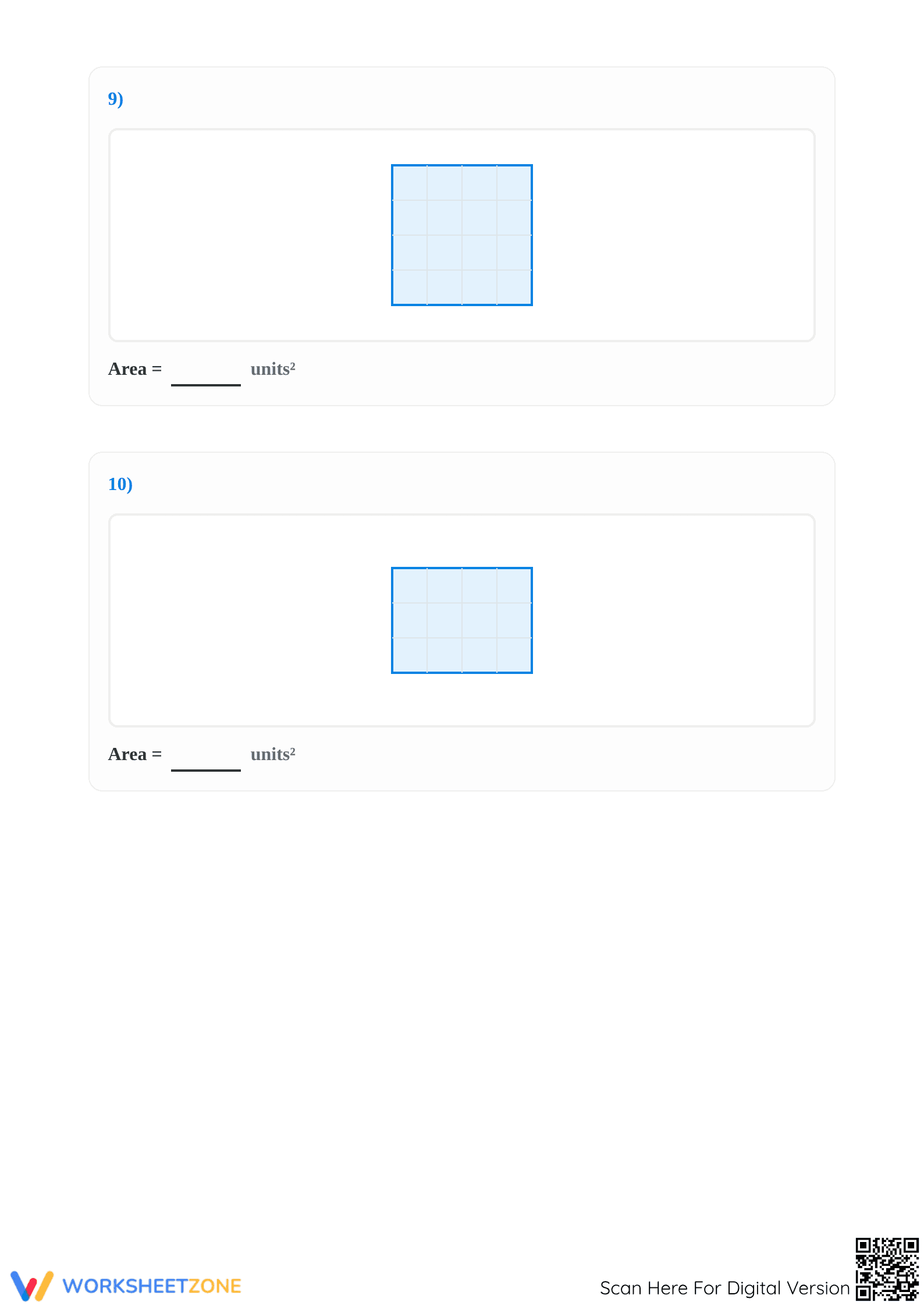
This comprehensive five-page PDF includes ten distinct rectangular models for students to analyze. Each page features clear, high-contrast grids that represent unit squares, minimizing visual clutter for learners. The layout provides ample space for students to record their answers directly under each problem. A full answer key is included at the end to facilitate rapid grading or self-correction.
Zero-Prep Workflow
- Print (30 seconds): Select the "print all" option on your PDF viewer to generate all five student pages and the answer key.
- Distribute (1 minute): Hand out the packets during independent practice time; the "Level 1" designation ensures students can begin without complex verbal instructions.
- Review (30 seconds): Use the provided answer key to check student work as they complete the tasks, requiring less than two minutes of total teacher preparation time.
Standards Alignment
The worksheet is strictly aligned to 3.MD.C.6, which requires students to measure area by counting unit squares. This practice supports the broader understanding of 3.MD.C.5, where students recognize area as an attribute of plane figures and understand concepts of area measurement. Both standard codes can be copied directly into lesson plans, IEP goals, or district curriculum mapping tools.
How to Use It
During direct instruction, project the first problem on a whiteboard and count the squares together as a class to model the process before releasing students to work independently. For formative assessment, observe students as they work; if a student is counting every individual square instead of using rows and columns, provide a scaffolded tip to encourage skip-counting or basic multiplication. Completion usually takes 15 to 20 minutes.
Who It's For
This resource is designed for Grade 3 students beginning their geometry units or Grade 4 students requiring remedial support. It is particularly effective for visual learners who need a tactile representation of area. Pair this worksheet with physical 1-inch tiles for a multi-sensory learning experience that bridges the gap between concrete and representational learning.
According to the NAEP framework, developing a robust understanding of area measurement in the third grade is a critical predictor of later success in complex geometry and algebraic thinking. This worksheet utilizes a grid-based approach that aligns with the "Unit Square Iteration" research highlighted in RAND AIRS 2024, which emphasizes the necessity of seeing area as the tiling of a plane rather than just a number derived from a formula. By counting 10 specific rectangular configurations, students internalize the additive nature of area and the structure of rectangular arrays. The consistent use of 1-unit square markers prevents common misconceptions regarding the boundary versus the interior of shapes. This standard-aligned resource (3.MD.C.6) provides the necessary repetition for students to achieve mastery in measuring area by counting unit squares, ensuring they are prepared for the transition to multiplication-based area formulas in subsequent lessons.


