


























Views
Downloads

Comparing Numbers Worksheet (1-60) | Essential Grade 1
Paste this activity's link or code into your existing LMS (Google Classroom, Canvas, Teams, Schoology, Moodle, etc.).
Students can open and work on the activity right away, with no student login required.
You'll still be able to track student progress and results from your teacher account.
Strengthen early number sense and relational reasoning with this focused mathematics resource. This Grade 1 worksheet provides a clear, structured environment for students to master the comparison of two-digit numbers. By evaluating magnitudes up to 60, learners move beyond simple counting to understand the relative value of digits within their respective place value positions.
At a Glance
- Grade: 1 · Subject: Math
- Standard:
1.NBT.B.3— Compare two-digit numbers using symbols based on tens and ones digits- Skill Focus: Greater than, less than, and equal to symbols
- Format: 2 pages · 18 problems · Answer key included · PDF
- Best For: Independent practice and quick formative assessment
- Time: 10–15 minutes
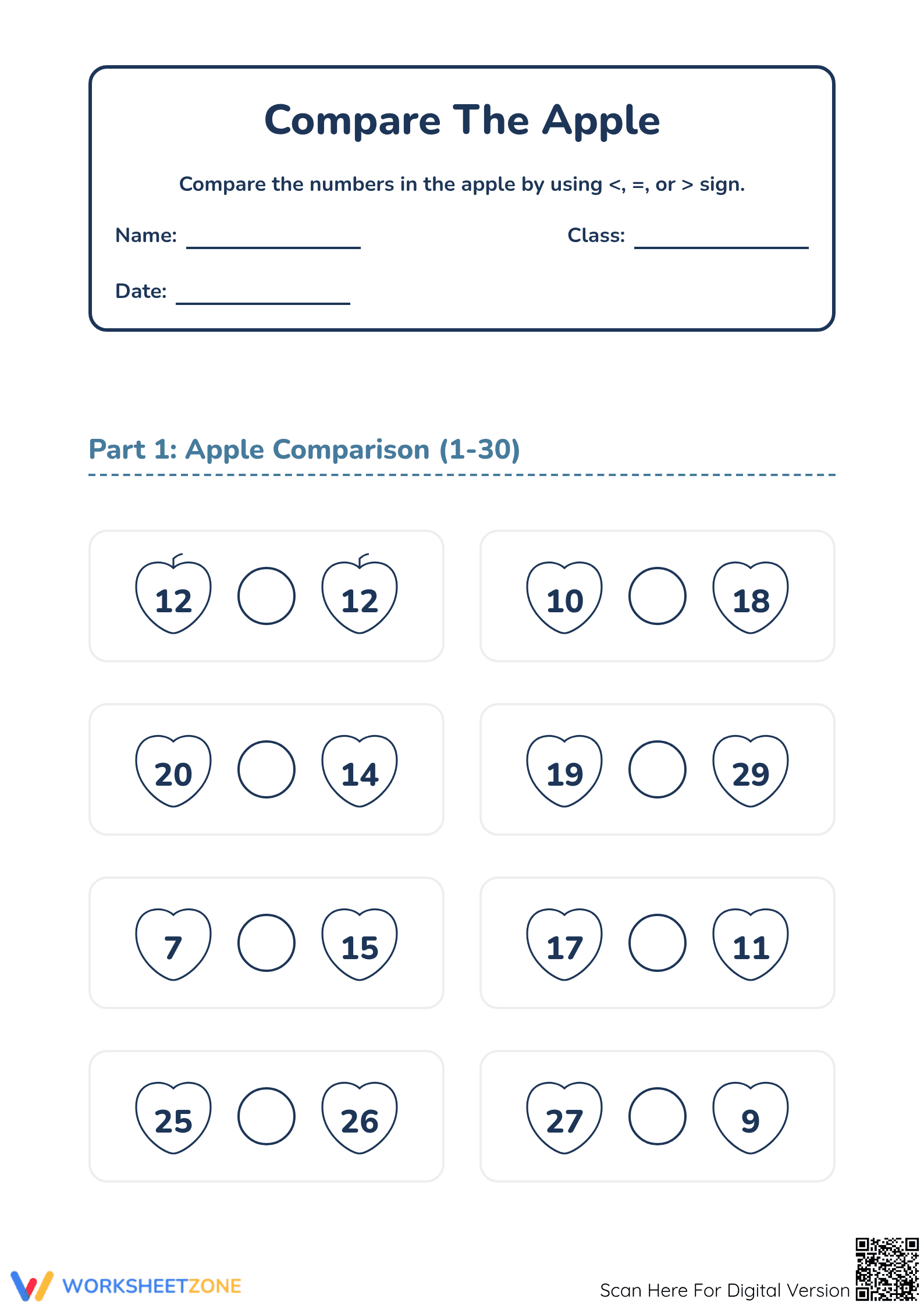
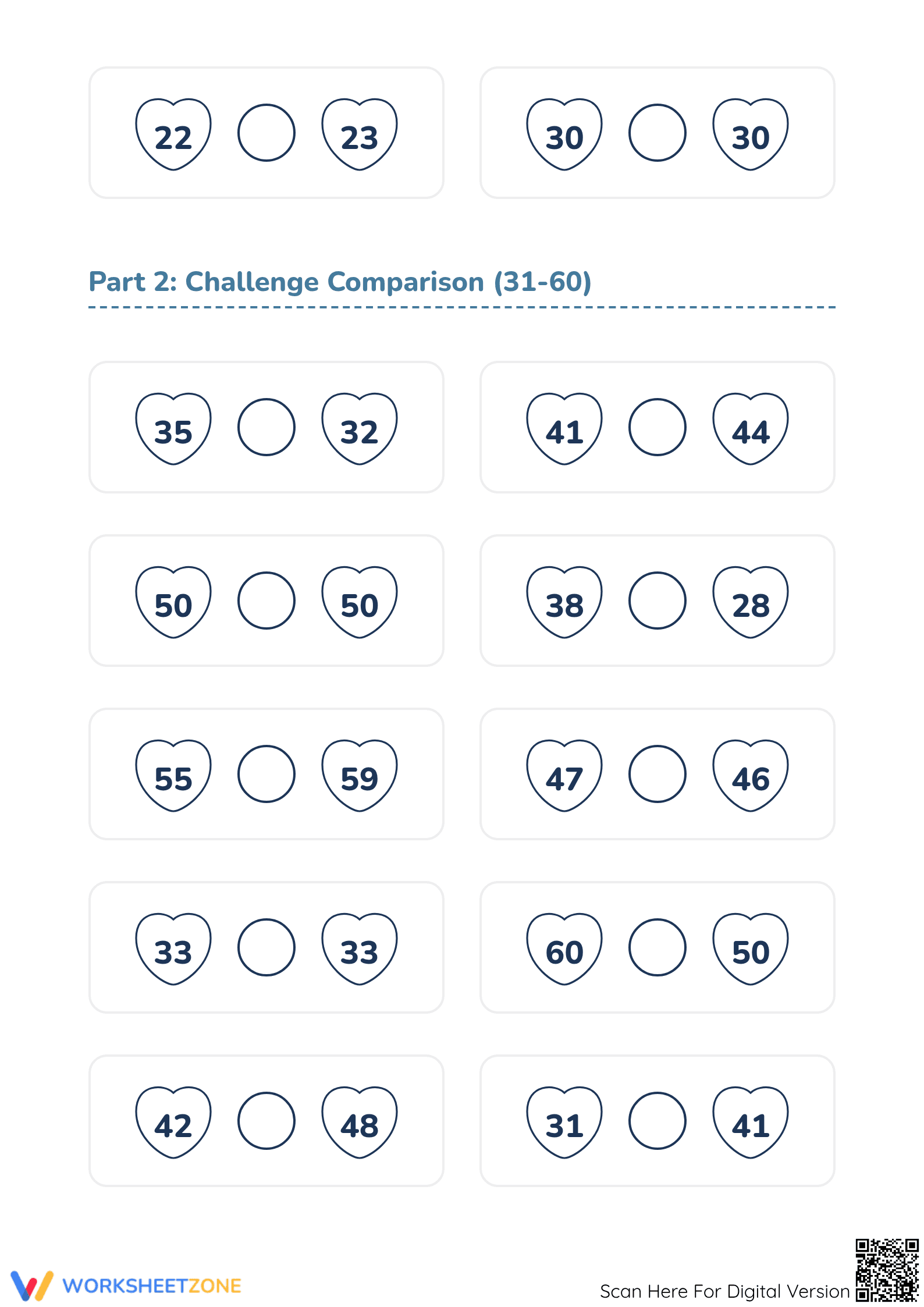
What's Inside is a two-page set designed for maximum clarity and engagement. The activity features 18 distinct comparison boxes, each containing two apple-framed numbers and a central circle for the symbol. Part 1 focuses on numbers within the 1-30 range, providing a gentle entry point. Part 2 introduces the 'Challenge Comparison' section, extending the numerical scope up to 60 to test higher-order place value recognition.
The zero-prep workflow is optimized for busy educators. First, print the two-page PDF in roughly 30 seconds; the high-contrast layout ensures clean copies for every student. Next, distribute the sheets for morning work, math centers, or homework with zero additional setup. Finally, review student work in under a minute using the included comprehensive answer key, which allows for rapid grading or facilitated peer-correction.
This resource is strictly aligned to the 1.NBT.B.3 standard. The standard requires that students compare two two-digit numbers based on the meanings of the tens and ones digits, recording the results of comparisons with the symbols >, =, and <. This worksheet directly facilitates this requirement by stripping away distractions and focusing purely on symbolic relational expression. The standard codes can be copied directly into lesson plans or IEP goals.
How to use it effectively includes two primary strategies. Use it as a formative assessment 'exit ticket' following a lesson on place value to observe if students correctly prioritize the tens digit over the ones. Alternatively, integrate it into math rotations by laminating the pages for use with dry-erase markers, allowing for repeated practice without extra paper waste. Completion typically takes between 10 and 15 minutes.
Who it's for includes first-grade students developing foundational number sense and second-grade students needing targeted RTI intervention for place value gaps. It pairs naturally with base-ten block manipulatives or a hundreds chart to help students visualize the magnitude of the numbers being compared. The clean apple theme makes it appropriate for autumn-themed lessons or year-round use.
Research from RAND AIRS 2024 emphasizes that visual representations, such as the apple motifs used here, help early learners anchor abstract mathematical comparisons in concrete imagery. This Grade 1 worksheet targets 1.NBT.B.3 by requiring students to evaluate the relative magnitude of two-digit numbers up to 60. By focusing on the position of digits within the tens and ones places, students develop the foundational place value awareness necessary for multi-digit addition and subtraction. The 'Challenge Comparison' section specifically bridges the gap between basic number recognition and relational reasoning, ensuring students don't just memorize symbols but understand the underlying logic of inequality. Consistent practice with these 18 problems facilitates the transition from oral counting to symbolic representation, a key metric in first-grade math success. Teachers can use this tool to identify students who struggle with 'tens-place' reversals, providing a clear path for targeted intervention and standard mastery.


