


























Views
Downloads

Printable Antonyms Worksheet | Grade 4 ELA
Paste this activity's link or code into your existing LMS (Google Classroom, Canvas, Teams, Schoology, Moodle, etc.).
Students can open and work on the activity right away, with no student login required.
You'll still be able to track student progress and results from your teacher account.
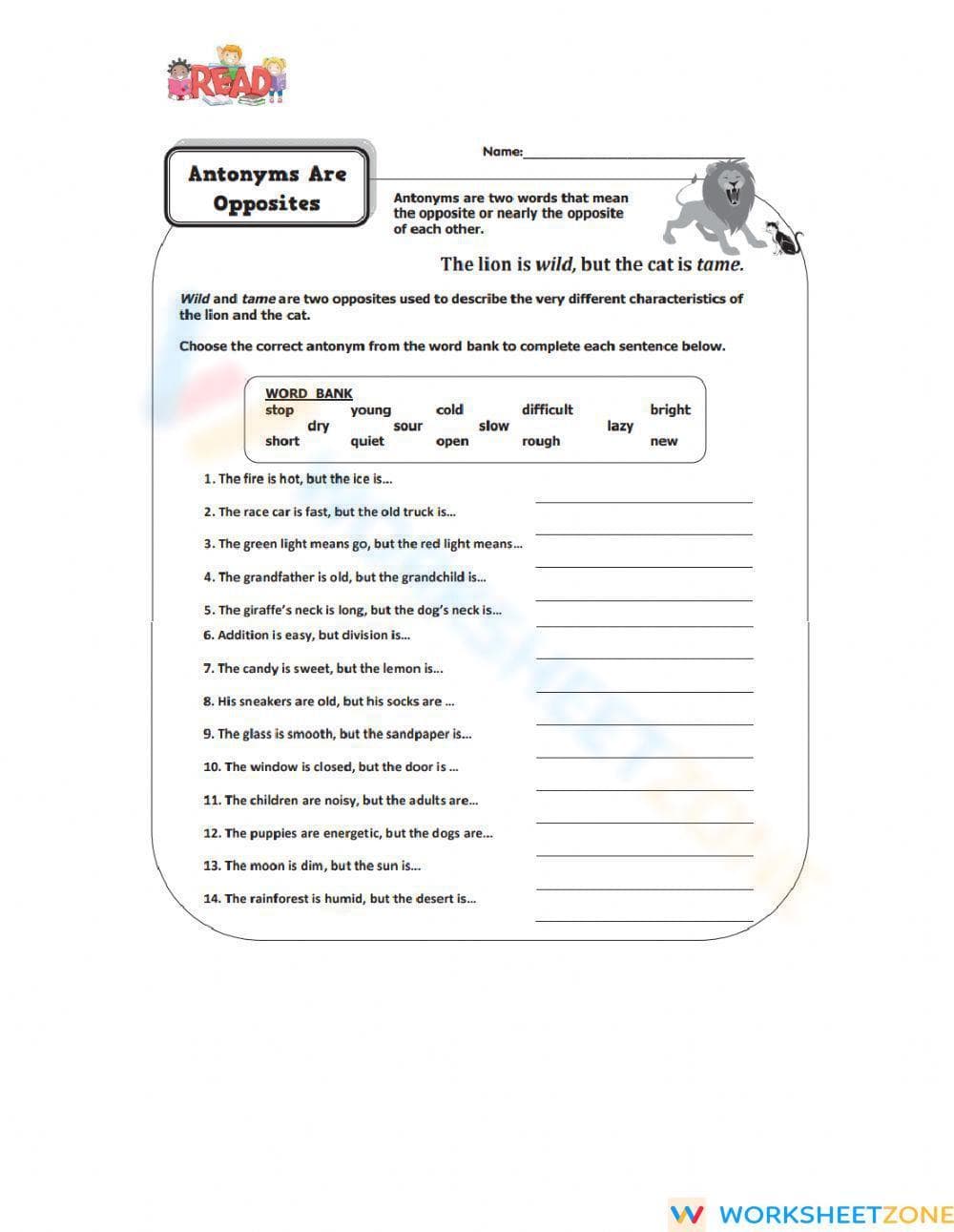
This worksheet offers focused practice on identifying and using antonyms, a key vocabulary skill for upper elementary students. Through 14 sentence-completion tasks, learners will reinforce their understanding of opposite word meanings, helping to build a more nuanced vocabulary and improve reading comprehension. It provides a straightforward tool for direct instruction or independent review.
At a Glance
- Grade: 4 · Subject: ELA
- Standard:
CCSS.ELA-LITERACY.L.4.5c— Demonstrate understanding of word relationships, including antonyms.- Skill Focus: Antonyms
- Format: 1 page · 14 problems · Answer key included · PDF
- Best For: Vocabulary station, homework, formative assessment
- Time: 10–15 minutes
What's Inside
This single-page resource includes a clear definition of antonyms with an example, followed by a primary task section. Students use a word bank to complete 14 sentences with the correct antonym. The layout is clean and easy to follow, requiring no additional materials. A complete answer key is provided for quick and easy grading or student self-checking.
Skill Progression
The worksheet is structured to support a gradual release of responsibility model.
- Guided Practice: The top of the sheet provides a clear definition and an explicit example ("The lion is wild, but the cat is tame."), ensuring students understand the concept of antonyms before they begin.
- Supported Practice: The main exercise includes a word bank containing all necessary antonyms. This scaffold supports students by reducing cognitive load, allowing them to focus solely on matching the opposite meanings within context.
- Independent Practice: By completing the 14 sentences, students work independently to apply their knowledge. This section serves as an effective check for understanding, following the "I Do, We Do, You Do" instructional sequence.
Standards Alignment
This worksheet is directly aligned with the Common Core State Standards for fourth-grade English Language Arts. The primary standard addressed is CCSS.ELA-LITERACY.L.4.5c, which requires students to "Demonstrate understanding of words by relating them to their opposites (antonyms) and to words with similar but not identical meanings (synonyms)." The tasks provide direct practice in fulfilling this requirement. Both standard codes can be copied directly into lesson plans, IEP goals, or district curriculum mapping tools.
How to Use It
This resource is versatile. Use it as a pre-assessment, an independent practice station, or a take-home assignment. For a quick formative check, observe which words students choose last, as this can reveal less familiar vocabulary pairs. Most students will complete the worksheet in 10 to 15 minutes.
Who It's For
This worksheet is designed for 4th and 5th-grade students who are developing their vocabulary and language skills. The clear structure and supporting word bank make it accessible for most learners, including English Language Learners who benefit from contextual practice. It pairs well with an anchor chart of common antonyms or following a direct instruction mini-lesson where students brainstorm opposite words.
Developing a strong vocabulary, including an understanding of word relationships like antonyms, is a critical component of reading comprehension. This worksheet provides targeted practice aligned with standard CCSS.ELA-LITERACY.L.4.5c, which requires students to demonstrate knowledge of opposites. Research consistently shows that direct vocabulary instruction significantly impacts a student's ability to understand academic texts. According to Fisher & Frey (2014), effective practice must be purposeful and move beyond simple memorization to contextual application. The 14 sentence-completion tasks in this resource encourage students to apply their knowledge of antonyms in a meaningful context, strengthening the connection between the word and its meaning. This approach helps build the "word-conscious" classroom environment that fosters deeper learning and prepares students for more complex texts.


