


























Views
Downloads


Essential Grade 3 Animals in Groups or Alone Worksheet
Paste this activity's link or code into your existing LMS (Google Classroom, Canvas, Teams, Schoology, Moodle, etc.).
Students can open and work on the activity right away, with no student login required.
You'll still be able to track student progress and results from your teacher account.
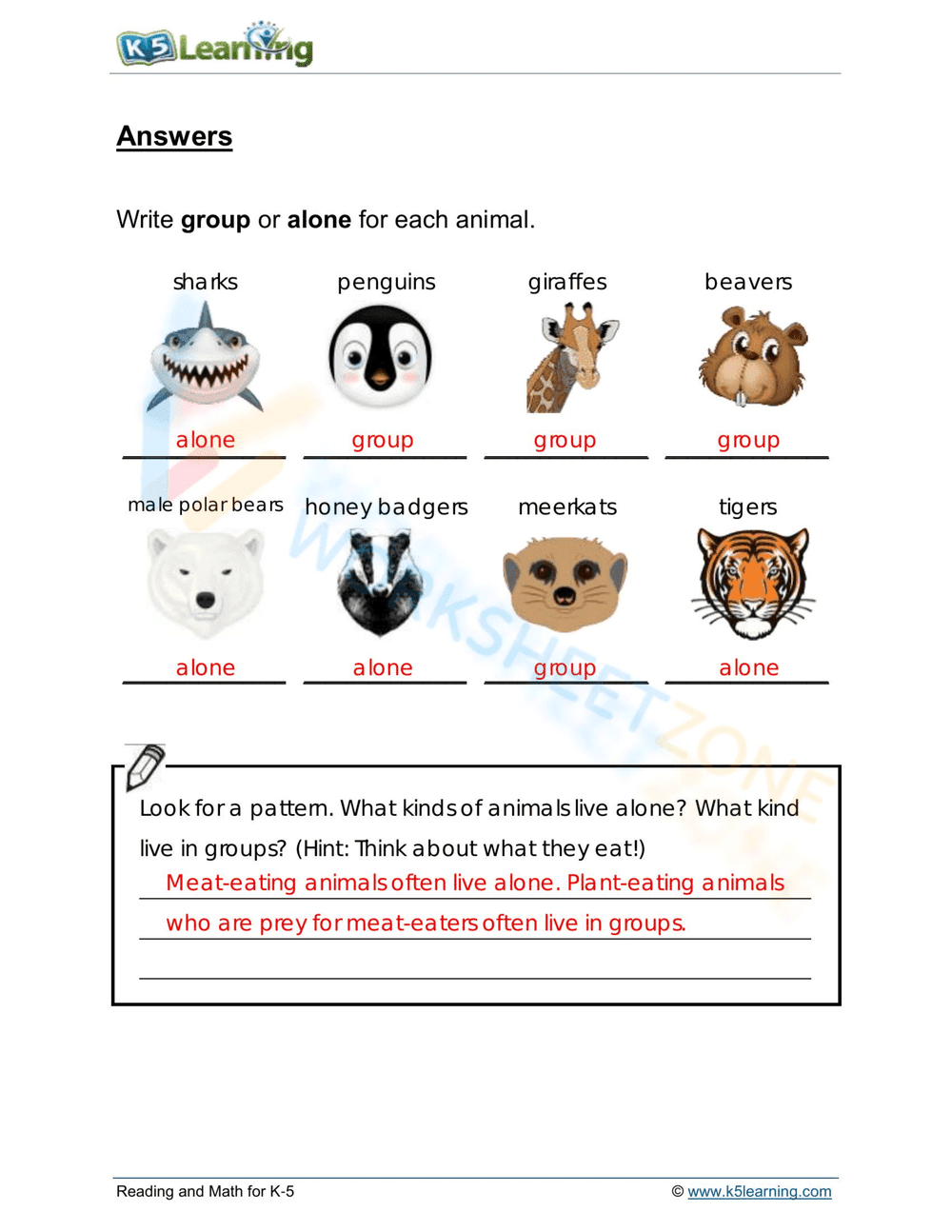
This Grade 3 science worksheet helps students differentiate between social and solitary animal behaviors by identifying specific species and analyzing their survival strategies. Students classify eight different animals while exploring the ecological relationship between diet and group formation. It provides a structured way to master the basics of biological social structures and ecosystem interactions.
At a Glance
- Grade: 3 · Subject: Living Things
- Standard:
3-LS2-1— Construct an argument that some animals form groups that help members survive- Skill Focus: Animal social structures and survival
- Format: 2 pages · 9 problems · Answer key included · PDF
- Best For: Independent practice or quick science assessment
- Time: 15–20 minutes
This two-page PDF includes a focused one-page worksheet and a comprehensive answer key. The primary task features eight animal profiles with clear illustrations, including sharks, penguins, and honey badgers. Students must determine if each animal lives alone or in a group. A final critical thinking section prompts students to identify patterns based on the animals' diets and predator-prey status.
Zero-Prep Workflow
The zero-prep workflow is designed for maximum efficiency in busy classrooms. Teachers can simply print the single-page worksheet in 30 seconds, distribute it to the class, and use the included answer key for a rapid review. The total preparation time is under two minutes, making it an ideal choice for last-minute substitute plans, morning work, or a quick formative assessment during a unit on living things.
Standards Alignment
Primary alignment is to `3-LS2-1`: "Construct an argument that some animals form groups that help members survive." This resource supports the standard by requiring students to look for patterns in animal behavior and hypothesize why certain species benefit from solitary or social lifestyles. Both standard codes can be copied directly into lesson plans, IEP goals, or district curriculum mapping tools.
How to Use It
Use this worksheet as a concluding activity after a direct instruction lesson on animal habitats and social structures. It serves as an excellent formative assessment to check for understanding before moving on to more complex food chain concepts. Observe students during the critical thinking portion to see if they can connect an animal's diet to its social behavior. Expected completion time is 15-20 minutes.
Who It's For
This resource is designed for Grade 3 students studying life science and ecosystem dynamics. It is particularly effective for visual learners who benefit from the clear animal illustrations. The worksheet can be naturally paired with an anchor chart detailing the differences between herbivores and carnivores to help students complete the final question more successfully.
This instructional resource aligns with the pedagogical frameworks described by Fisher & Frey (2014) regarding the importance of structured independent practice in the gradual release of responsibility model. By focusing on NGSS standard 3-LS2-1, the worksheet targets the specific cognitive shift required for third-grade students to move from simple identification to evidence-based argumentation. Research from NAEP indicates that students who engage with concrete examples of biological concepts—such as classifying solitary versus social animals—show higher retention of ecosystem principles compared to those using abstract-only curricula. The inclusion of nine distinct tasks allows for a high density of practice within a single instructional block, ensuring that the core skill of identifying survival strategies is reinforced through multiple iterations. Teachers can use this data-driven approach to identify gaps in student understanding regarding the intersection of animal behavior, diet, and habitat pressures within the natural world.


