


























Views
Downloads
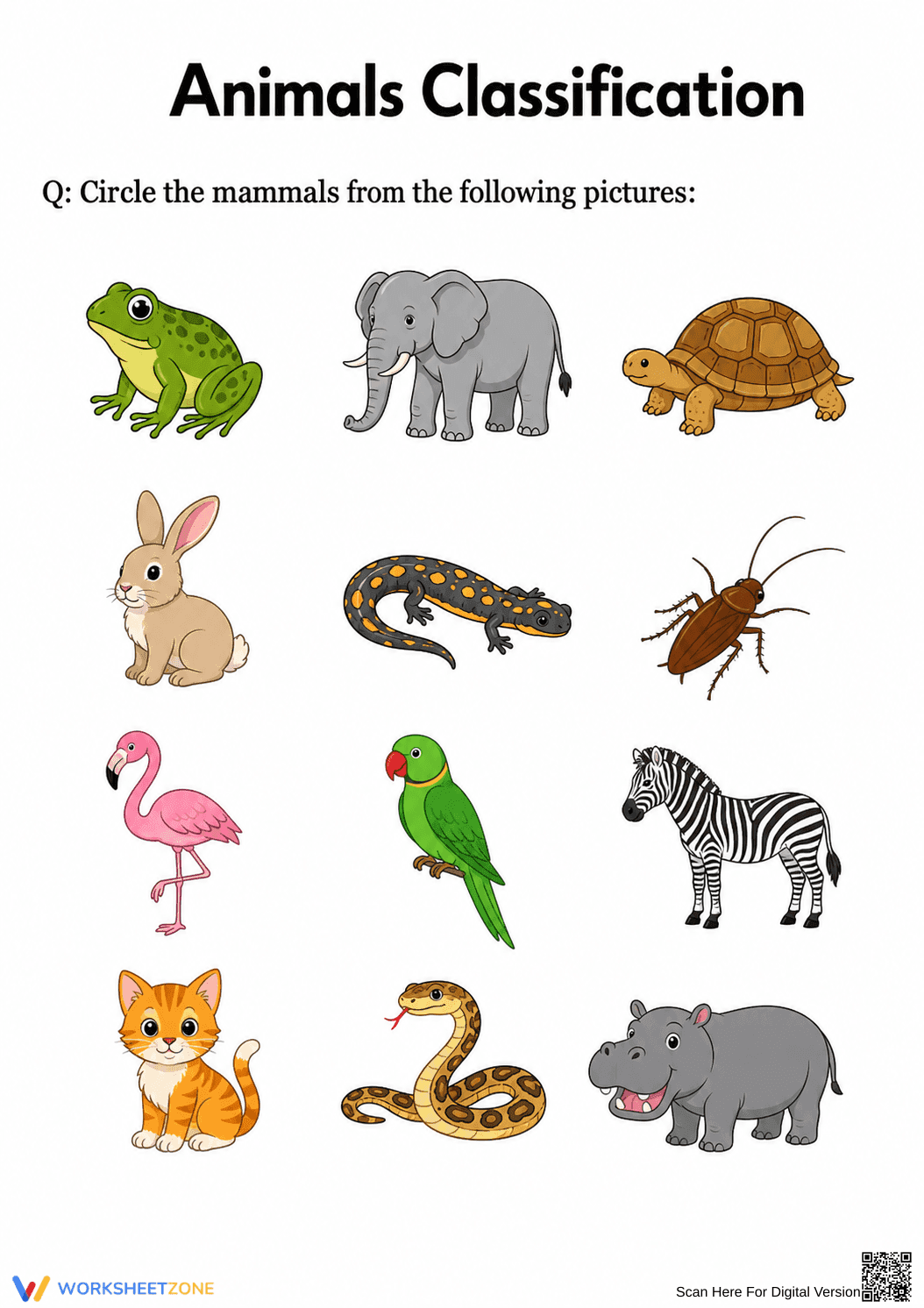

Grade 1 Animal Classification — Printable No-Prep Worksheet
Paste this activity's link or code into your existing LMS (Google Classroom, Canvas, Teams, Schoology, Moodle, etc.).
Students can open and work on the activity right away, with no student login required.
You'll still be able to track student progress and results from your teacher account.
This Grade 1 animal classification worksheet helps students identify mammals by evaluating different animal types. By circling the correct animals from a mixed visual set, young learners build foundational life science skills and reinforce their understanding of animal characteristics and biological categories.
At a Glance
- Grade: 1 · Subject: Science
- Standard:
1-LS1-1— Identify and categorize animals based on traits- Skill Focus: Animal Classification
- Format: 1 page · 12 problems · Answer key included · PDF
- Best For: Independent practice
- Time: 10–15 minutes
What's Inside
This single-page resource features a straightforward visual identification task. Students are presented with twelve distinct animal illustrations, ranging from reptiles and amphibians to birds and mammals. The clear, uncluttered layout allows early readers to focus entirely on the visual cues of each animal, determining which ones fit the mammal classification. A complete answer key is provided to ensure quick and accurate grading.
Zero-Prep Workflow
- Print (1 minute): Simply download the PDF and print the required number of copies. The design is highly visual but prints cleanly.
- Distribute (1 minute): Hand out the worksheets during science blocks or morning routines. The instructions are self-explanatory for immediate engagement.
- Review (3 minutes): Go over the circled mammals together as a class to reinforce the specific traits that define them.
Total teacher prep time is under two minutes, making this an excellent addition to any emergency sub plan.
Standards Alignment
Aligned to 1-LS1-1, this activity focuses on understanding how animals use their external parts to survive, which begins with recognizing distinct animal groups and their physical traits. By identifying mammals, students take the first step in comparing the diversity of life in various habitats. Both standard codes can be copied directly into lesson plans, IEP goals, or district curriculum mapping tools.
How to Use It
Use this worksheet as a quick formative assessment after a direct instruction lesson on animal groups. Alternatively, place it in a science center for independent review. While students work, observe whether they correctly skip non-mammals like the frog or flamingo, which provides immediate feedback on their grasp of the concept. Expected completion time is 10 to 15 minutes.
Who It's For
This activity is designed for first-grade students, though it serves as a great review for second graders or an extension for advanced kindergarteners. The visual nature of the task provides natural differentiation for English Language Learners and visual learners who might struggle with text-heavy science assignments. Pair this resource with a picture book about mammals or a classroom anchor chart detailing animal characteristics.
Effective science instruction in early elementary grades relies heavily on visual categorization and pattern recognition. When students practice identifying mammals, they are building essential cognitive frameworks for biological sciences. According to a ScienceDirect TpT Analysis, visual sorting tasks significantly improve long-term retention of scientific classifications in young learners. This worksheet directly supports 1-LS1-1 by having students identify and categorize animals based on traits, ensuring they can distinguish mammals from reptiles, birds, and amphibians. By evaluating twelve distinct animal images, learners solidify their understanding of external characteristics such as fur or hair. Regular practice with these targeted, visual-based assessments ensures that foundational life science concepts are firmly established before students progress to more complex ecological studies. This targeted approach bridges the gap between basic observation and formal scientific classification, setting the stage for future academic success.


