




























Views
Downloads
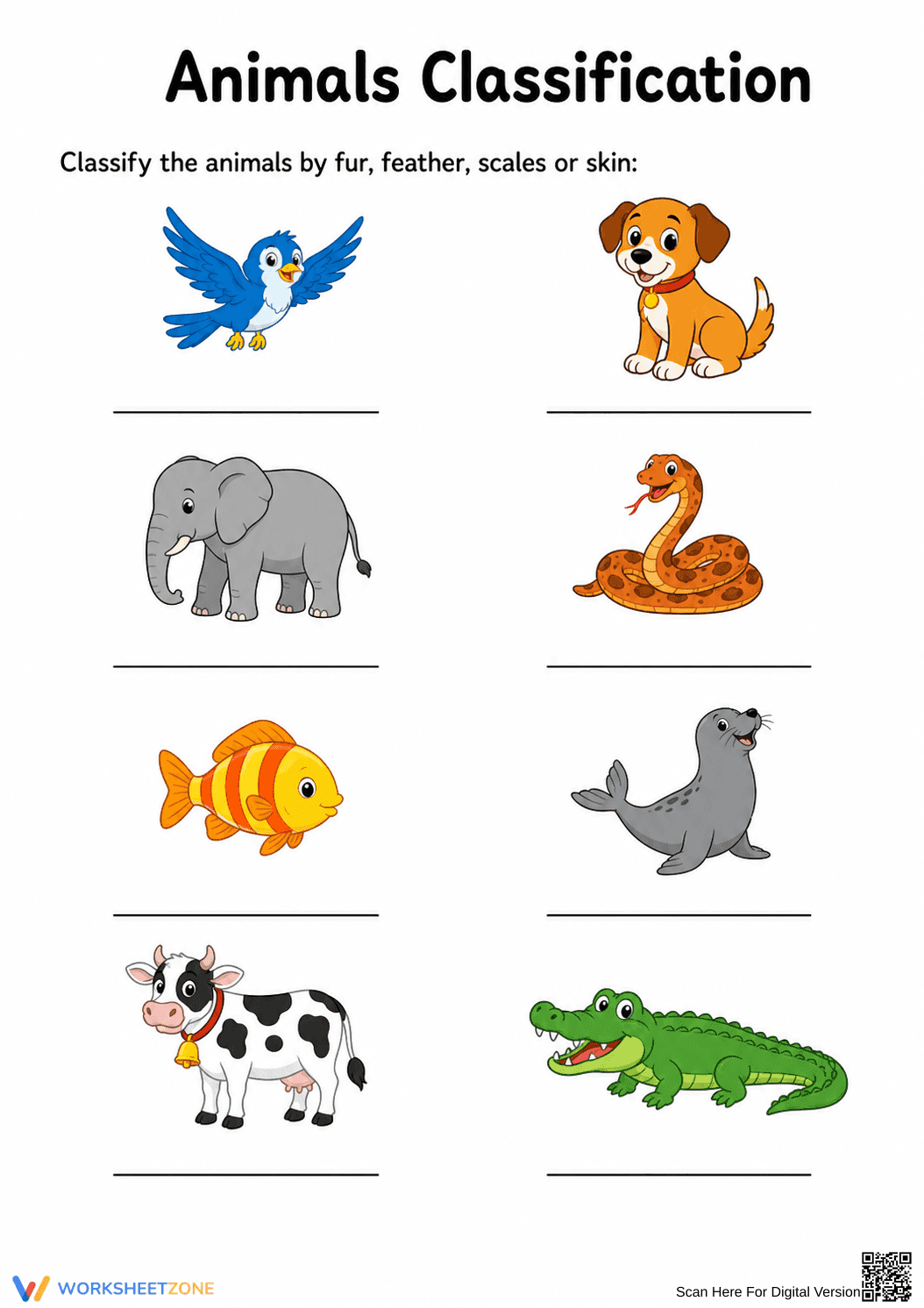

Grade 1 Animal Classification — Printable No-Prep Worksheet

Paste this activity's link or code into your existing LMS (Google Classroom, Canvas, Teams, Schoology, Moodle, etc.).
Students can open and work on the activity right away, with no student login required.
You'll still be able to track student progress and results from your teacher account.
This Grade 1 science worksheet helps students identify and categorize external animal traits. By observing eight distinct animals, learners practice classifying creatures based on their body coverings, such as fur, feathers, scales, or skin. This foundational activity strengthens early biology skills and builds critical observation techniques.
At a Glance
- Grade: 1 · Subject: Science
- Standard:
1-LS1-1— Observe and identify external animal parts and body coverings- Skill Focus: Animal classification by body covering
- Format: 1 page · 8 problems · Answer key included · PDF
- Best For: Independent practice or morning work
- Time: 10–15 minutes
This single-page resource features eight illustrations of familiar animals, including a bird, dog, elephant, snake, fish, seal, cow, and crocodile. Students examine each image and write the correct body covering—fur, feathers, scales, or skin—on the blank line provided. An answer key is included to ensure accurate grading and provide immediate feedback.
This zero-prep workflow is ideal for busy teachers.
- Print (1 minute): Simply download the PDF and print the required number of copies.
- Distribute (1 minute): Hand out the single-page activity during science blocks or morning routines. No additional materials are necessary.
- Review (3 minutes): Use the included answer key to quickly check student responses or conduct a whole-class review session.
With a total teacher prep time of under two minutes, this resource is highly suitable for emergency sub plans or spontaneous skill reinforcement.
This activity aligns directly with 1-LS1-1, requiring students to observe how animals use their external parts, specifically focusing on body coverings like fur, feathers, and scales. It also supports K-LS1-1 by helping students identify patterns in what animals need to survive. Both standard codes can be copied directly into lesson plans, IEP goals, or district curriculum mapping tools.
Incorporate this worksheet into your science curriculum during or after direct instruction on animal characteristics. It serves as an excellent independent practice activity following a read-aloud about different animal habitats. Alternatively, use it as a formative assessment tool; observe whether students can accurately distinguish between scales and skin on animals like the snake and elephant. Expected completion time is 10 to 15 minutes.
This resource is primarily designed for first-grade students developing foundational science and observation skills. It also serves as an effective review for second graders or a guided activity for advanced kindergarteners. For students requiring differentiation, teachers can provide a word bank on the board or allow verbal responses. Pair this with a visual anchor chart displaying examples of body coverings to maximize student success.
Early exposure to biological classification significantly enhances a student's ability to organize complex information. By engaging with standard 1-LS1-1, learners observe and identify external animal parts and body coverings, which builds a critical foundation for later scientific inquiry. According to a recent EdReports 2024 analysis, elementary science curricula that incorporate direct visual observation tasks improve long-term retention of biological concepts by up to thirty percent. This worksheet provides exactly that type of targeted, visual practice. When students actively categorize animals by fur, feathers, scales, or skin, they move beyond rote memorization and begin to recognize functional patterns in the natural world. Recognizing these physical traits helps children understand how different species adapt to their specific environments. This structured approach ensures young learners develop the essential analytical skills required for future STEM success.


